Pakistan, Turkiye, Qatar and Indonesia have agreed to deepen defence cooperation through a new agreement aimed at strengthening military capabilities, expanding defence industry partnerships and improving collaboration in research, development and technical training.
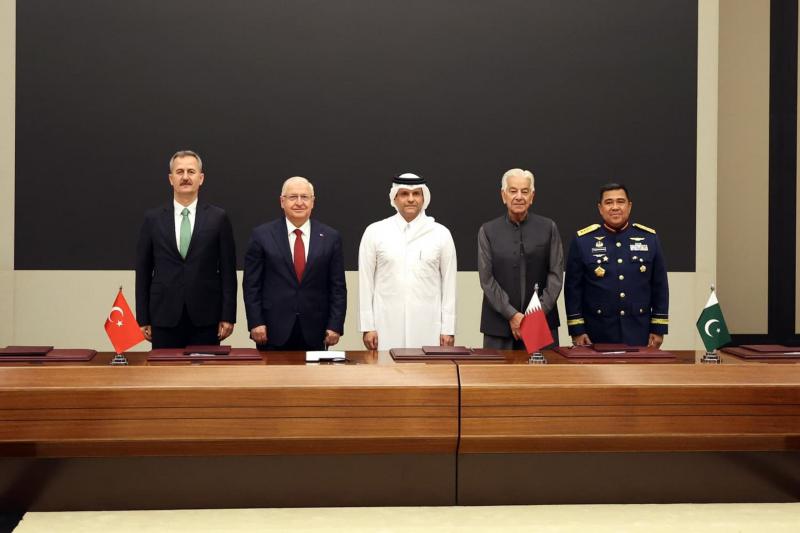
The Turkish Defence Ministry announced on Wednesday that the four countries had signed the Badr Memorandum of Understanding (MoU) in Doha. The agreement reflects their shared intention to develop partnerships and broaden cooperation in the defence sector.
According to the ministry, the accord is intended to support military production, enhance defence capabilities and facilitate cooperation in technical training, research and development.
The initiative will draw on the countries’ respective military production capabilities to strengthen defence industries, improve integration and help meet the requirements of allied and friendly nations.
Agreement Focuses on Joint Production and Technology Transfer
The Badr MoU builds on existing defence projects among the four countries and represents another step towards closer multilateral cooperation.
The initiative seeks to move beyond the purchase and supply of military equipment towards joint manufacturing, technology transfer, improved interoperability and integrated supply chains.
Turkiye’s defence industry has become an important part of its foreign policy, with Ankara pursuing partnerships designed to expand production capacity and increase exports.
The Turkish defence industry secretariat said cooperation initiatives supported by President Recep Tayyip Erdogan were among the strategic elements underpinning the country’s international engagement.
It added that efforts to expand mass production and exports had gained momentum under Haluk Gorgun, head of the secretariat.
Turkiye’s Defence Exports Continue to Grow
Turkiye’s expanding defence industry provides an economic foundation for its growing military partnerships.
According to the Turkiye Defence and Aerospace Industry Exporters’ Association, the country’s defence and aerospace sector recorded approximately $54 billion in exports from 2012 through the first nine months of 2026.
More than $30 billion of that total was generated between 2023 and 2026, accounting for over 55% of exports during the period.
Defence and aerospace exports increased by 48% year-on-year in 2025, exceeding $10 billion. Exports over the latest 12-month period also surpassed $11 billion for the first time, according to the figures cited in the report.
The Stockholm International Peace Research Institute (SIPRI) reported that Turkiye increased its arms exports by 122% over the preceding five-year period, becoming the world’s 11th-largest arms supplier. NATO members accounted for 56% of Turkiye’s defence and aerospace exports, according to the report.
Turkiye and Qatar Expand Defence Industry Partnership
Qatar has maintained close defence industry ties with Turkiye, making the two countries an established example of the cooperation that the new agreement seeks to encourage.
Turkish-made Bayraktar TB2 armed drones, armoured vehicles and fast attack craft supplied to Qatar’s armed forces are among the products associated with their bilateral defence relationship.
Barzan Holdings, a subsidiary of Qatar’s Defence Ministry, has also signed cooperation agreements with Turkish defence companies, including Aselsan, STM and MKE.
One example is BARQ, a joint venture established in Qatar by Aselsan and Barzan Holdings. The venture has begun local assembly, production and calibration activities involving SARP remote-controlled weapon systems and electro-optical equipment.
Such projects can also create opportunities for Turkish defence companies to provide products and services to other countries through their operations in Qatar.
Turkey Plans Military Deployment to Saudi Arabia Under Defence Pact
Pakistan and Turkiye Cooperate on Naval Production
The PN MILGEM Babur-class corvette programme is a major example of defence industry cooperation between Pakistan and Turkiye.
Under the four-vessel project, led by Turkish defence contractor ASFAT, the first two corvettes were built in Istanbul, while the remaining two were constructed at Karachi Shipyard.
The programme has supported the modernisation of Karachi Shipyard’s production infrastructure and facilitated the transfer of shipbuilding and outfitting engineering capabilities to Pakistan’s workforce.
Beyond supplying naval vessels, the project has contributed to the development of Pakistan’s domestic shipbuilding capacity and technical expertise.
The new Badr agreement could provide a broader framework for the participating countries to build on such projects and explore additional opportunities for industrial cooperation.
Turkiye and Indonesia Pursue Joint Tank Development
Turkiye’s defence partnership with Indonesia is illustrated by the KAPLAN MT medium-weight tank programme.
Developed under an intergovernmental agreement involving Turkiye’s defence industry secretariat and Indonesia’s Defence Ministry, the tank was jointly designed and developed by Turkish company FNSS and Indonesia’s PT Pindad.
Prototypes and the first series-production tanks manufactured by FNSS were delivered to Indonesian users. Production is continuing at PT Pindad in Indonesia under a technology transfer arrangement.
The programme demonstrates how joint development and local manufacturing can help participating countries build their own defence industry capabilities while maintaining industrial partnerships.
New Framework for Four-Country Defence Cooperation
The Badr MoU brings Pakistan, Turkiye, Qatar and Indonesia together under a framework intended to strengthen defence industry links and expand practical military cooperation.
Its emphasis on joint production, technology transfer, research and development and supply-chain integration reflects a broader shift towards partnerships that extend beyond conventional equipment purchases.
The agreement also provides an opportunity for the four countries to build on their existing bilateral projects while exploring areas of common interest in defence production and military capabilities.
The full impact of the initiative will depend on how the participating countries implement the memorandum and translate its objectives into concrete projects.