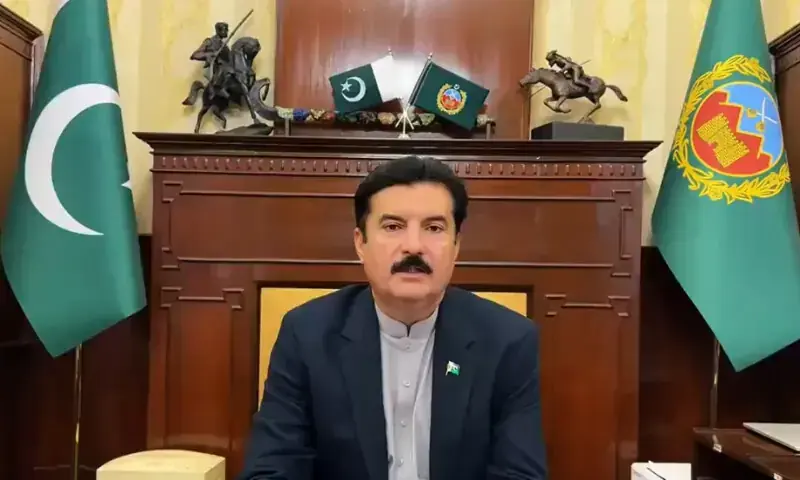
PESHAWAR: Khyber-Pakhtunkhwa (K-P) Governor Faisal Karim Kundi on Sunday said the province’s people would have the “first right” to its natural resources, pledging to prioritise their interests for as long as he remained in office.
Addressing a ceremony marking the annual Urs of Darbar-e-Aalia Murshidabad Sharif in Peshawar, Kundi said the province was rich in natural resources, including gas, minerals, electricity and oil.
“My first priority is the protection of the people. As long as I hold this office, the first right over our resources will belong to the people of our province,” he said.
Call for Peace
Kundi said K-P’s residents had made immense sacrifices in the fight against terrorism, stressing that restoring peace required collective efforts.
“Although we may have differences on many issues, we must stand united to establish peace in the province,” he said.
He noted that schoolchildren, security personnel, police officers and journalists had all suffered as a result of prolonged terrorism in the province.
“Our mission is to make the province a cradle of peace,” he said.
The governor also highlighted the province’s sporting talent, saying its people had distinguished themselves in various fields. He added that more than half of the national cricket team’s players belonged to K-P.
“We have immense talent in the field of sports,” he said.
Kundi urged religious scholars to play an active role in promoting peace, noting that people listened to and respected their views.
He said children wanted to live full and peaceful lives, while residents sought opportunities for business and employment.
“It is our shared responsibility to play our full part in the development, prosperity and peace of the province,” he said, adding that the government would welcome constructive suggestions to improve the province and its cities.
He also pledged to work with all stakeholders to promote peace, prosperity and development across K-P.
K-P Governor Calls Federal Cooperation a Stroke of Good Fortune
Mineral Rights
On October 11, governor’s rule and an emergency were imposed in K-P, transferring executive authority from the Pakistan Tehreek-e-Insaf-led provincial government to the governor. An 11-member advisory council was formed to assist Kundi in overseeing provincial administrative affairs.
The federal government also established a separate administrative structure for 12 districts, including an Area Representative and a Development Council to facilitate local representation and development planning.
On October 17, six days after governor’s rule was imposed, Kundi announced plans to extract and sell the province’s mineral resources. He invited domestic and foreign companies to invest through joint ventures with Pakistani firms and local communities.
“Our province is rich in minerals, and we will extract and sell these minerals. We will have many agreements signed so that people can prosper,” he said.
Kundi argued that such partnerships would create jobs, support local businesses and improve economic conditions. He also called for the extraction of the province’s oil and gas reserves.
Political Concerns
Kundi’s remarks prompted concerns among opposition parties that governor’s rule could be used to gain control over the province’s mineral wealth.
Parliamentary Affairs Minister Tariq Fazal Chaudhry subsequently rejected any connection between the imposition of the emergency and mineral extraction, saying the measure had been introduced to address the security situation.
He also said the federal government had maintained that K-P and Balochistan should have the first right to their respective mineral resources, with the proceeds used for provincial development.
Control over K-P’s mineral wealth has remained a contentious issue.
In April 2025, political parties across the provincial assembly opposed the proposed Mines and Minerals Bill, arguing that it threatened provincial autonomy and the assembly’s authority over natural resources.
In January 2025, a separate Mineral Development and Management Company Bill also drew criticism from PTI leaders and supporters. The provincial government defended the proposed legislation as a means of regulating the mining sector and ensuring that local communities benefited from mineral wealth.
However, its implementation was subsequently put on hold amid public and political opposition.