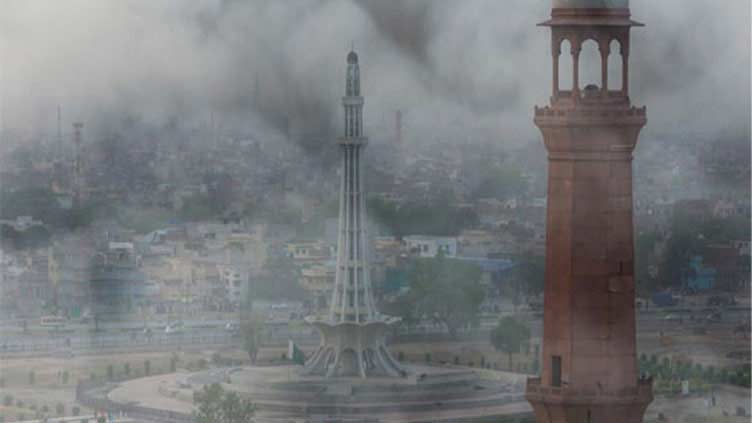
Lahore remained the world’s most polluted major city on Thursday as hazardous air quality continued to affect several parts of Punjab, with multiple cities recording Air Quality Index (AQI) readings above 500.
According to the Pakistan Air Quality Initiative (PAQI), air pollution in Lahore increased by 32% compared with the corresponding period last year, highlighting the worsening smog situation across the provincial capital.
Punjab’s air quality monitoring data showed Lahore’s AQI at 346 at 8am on Thursday, down from 444 recorded at the same time a day earlier. However, readings recorded by IQAir at different times ranged between 344 and 371, with Lahore retaining the top position in its global pollution rankings. New Delhi stood second.
Several Punjab Cities Record Hazardous AQI Levels
The pollution crisis extended beyond Lahore, with several other cities reporting extremely high readings.
According to IQAir, Raiwind recorded an AQI of 519, followed by Bahawalpur at 515 and Multan at 507. Gujranwala also reported a high reading of 411.
Punjab’s environmental monitoring network recorded AQI levels of up to 500 in Kasur, Jhang, Nankana Sahib, Okara, Pakpattan and Sahiwal.
Within Lahore, Kahna Nau was among the most polluted areas, recording an AQI of 423. Multan Road and DHA Phase VI each registered 414, while Egerton Road recorded 390, Safari Park 380, Barki Road 364 and Shahdara 357.
The readings indicate that unhealthy air conditions are affecting residential and commercial areas across the provincial capital, as well as other urban centres in Punjab.
PAQI Report Shows 32% Increase in Lahore’s Pollution
A PAQI report covering November 4 to 10 found that Lahore’s average concentration of fine particulate matter (PM2.5) reached 207.1 micrograms per cubic metre.
This was 32% higher than the average of 156.4 micrograms recorded during the same period last year. The city’s average AQI for the seven-day period stood at 257.
The report found that PM2.5 concentrations remained above Pakistan’s National Environmental Quality Standards (NEQS) limit of 35 micrograms per cubic metre on all seven days.
November 9 was identified as the most polluted day during the period, when PM2.5 levels reached 253.7 micrograms per cubic metre and the average AQI stood at 303.
The average PM2.5 concentration was approximately 13.8 times higher than the World Health Organisation’s recommended 24-hour guideline of 15 micrograms per cubic metre.
Lahore AQI Hits 535 as Hazardous Smog Engulfs Punjab
Weather Conditions and Fire Incidents Contribute to Smog
The PAQI report identified unfavourable weather conditions as one of the factors contributing to the deterioration in air quality.
Wind speeds were 32% lower than during the corresponding period last year, limiting the dispersal of pollutants. The report estimated that these meteorological conditions contributed 16% to the increase in pollution levels.
Satellite data from NASA also identified 4,933 fire incidents across Pakistan and India between November 4 and 10. Of these, 2,824 were reported in Pakistan and 2,104 in India.
The report found that PM2.5 concentrations were 124% higher on days when winds passed over areas affected by fires, indicating a link between fire activity, air movement and pollution levels in Lahore.
PM10 Levels Also Remain Far Above Permissible Limits
The report highlighted another major concern, with Lahore’s average PM10 concentration reaching 435.4 micrograms per cubic metre during the seven-day period.
This was nearly three times Pakistan’s permissible limit of 150 micrograms per cubic metre.
A review of nine years of available air quality data also showed that the first week of November 2026 was the fourth most polluted week recorded during the period.
The latest findings underline the scale of Lahore’s smog problem and the wider air pollution challenge facing Punjab, with pollution levels remaining significantly above national and international health guidelines.
Source: The Express Tribune, Pakistan Air Quality Initiative (PAQI).