Air travel disruptions across the United States are expected to continue until late Sunday, November 15, as airlines struggle to restore normal operations following a nationwide flight shutdown caused by problems with air traffic control communications systems. The disruption has resulted in thousands of cancelled and delayed flights, leaving passengers stranded at airports across the country.
Federal Aviation Administration (FAA) Administrator Bryan Bedford said airline operations were expected to largely return to normal by late Sunday. He apologised to passengers for the inconvenience and said the aviation system remained stable.
Thousands of Flights Cancelled Across the United States
According to flight-tracking website FlightAware, US airlines cancelled more than 6,400 flights and delayed over 8,000 on Saturday.
The disruption followed another difficult day on Friday, when approximately 9,200 flights were cancelled and 7,500 delayed after the FAA ordered a nationwide ground stop because of problems affecting air traffic communications.
FlightAware also reported that 875 flights scheduled for Sunday had already been cancelled.
The nationwide ground stop on Friday halted nearly all departing flights for almost five hours. It was the longest nationwide suspension of US air travel since the September 11, 2001 attacks.
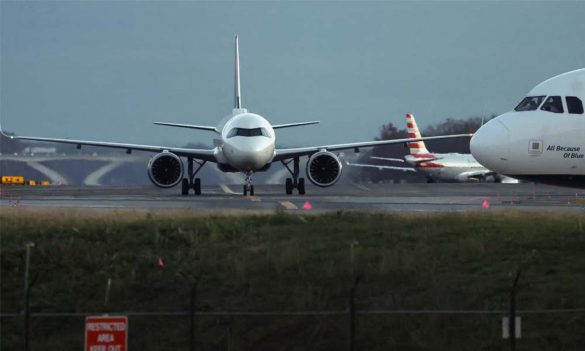
Although the FAA lifted the restriction on Friday evening, the impact continued as airlines struggled to reposition aircraft and flight crews to resume normal schedules.
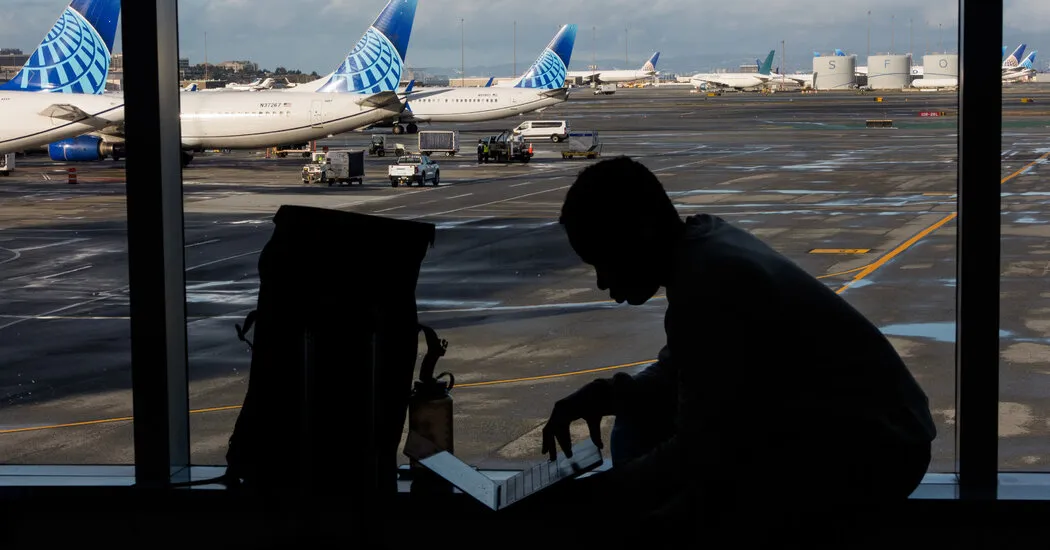
Thousands of passengers remained stranded at airports, while several airlines offered passengers the option to rebook their journeys without additional charges.
Faulty Router Installation Suspected in Aviation Disruption
US authorities traced the communications problems to maintenance work involving L3Harris, a contractor responsible for installing new networking equipment at an FAA facility.
Transportation Secretary Sean Duffy said the installation of at least one new router at a remote location triggered problems across the air traffic control communications network.
Officials are investigating whether the disruption resulted from an installation mistake, user error or defective equipment.
The Professional Aviation Safety Specialists union, which represents FAA safety employees, said the issue involved two routers that were updated on Friday. An official told Reuters that the equipment was believed to be located in Arkansas and Texas.
The union also said its technicians were not involved in the upgrades that led to the nationwide disruption.
L3Harris said it was taking the matter seriously and cooperating with the FAA investigation.
Communications Problems Affected 17 Air Traffic Control Centres
According to Duffy, the technical failure caused instability in radar and communications systems at several air traffic control facilities.
The problem generated an unusually high volume of network connection attempts, overwhelming other communications centres.
Duffy said the system was receiving more than 1,000 connection attempts every four to five seconds, creating difficulties in communication between air traffic controllers and aircraft while also affecting radar operations.
The disruption affected communications at 17 of the FAA’s 22 en route air traffic control centres, which manage aircraft during the cruising portion of their journeys.
FAA Administrator Bryan Bedford said the nationwide ground stop was ordered as a precaution because officials were concerned that a control centre could lose all communications.
He clarified that no facility had completely lost its communications capabilities and the system had not gone entirely offline.
The FAA is conducting additional testing with L3Harris to determine whether the equipment could create further risks.
US Seeks $50 Billion to Modernise Air Traffic Control After Nationwide Flight Disruption
Major Airlines Cancel Thousands of Flights
The disruption significantly affected the operations of major US airlines.
Delta Air Lines, United Airlines and American Airlines each cancelled approximately 25 per cent of their scheduled flights on Saturday.
JetBlue experienced an even greater impact, cancelling nearly 45 per cent of its flights.
Airlines also issued travel waivers allowing affected passengers to change their bookings for later dates without paying additional fees.
The disruption affected more than ordinary holiday and business travellers, with several college football teams also experiencing travel difficulties ahead of scheduled matches.
US Government Seeks $50 Billion to Modernise Air Traffic Systems
The incident has renewed concerns about the condition of the United States’ air traffic control infrastructure, which officials and industry representatives say is affected by ageing technology, equipment problems and a shortage of several thousand air traffic controllers.
Transportation Secretary Sean Duffy called for $50 billion in additional funding to modernise the country’s air traffic control systems.
The request represents an increase from his previous proposal of $30 billion. Congress had already approved $12.5 billion for the modernisation programme last year.
House Speaker Mike Johnson expressed support for approving additional funding for aviation infrastructure.
However, Democratic lawmakers Rick Larsen and Andre Carson said congressional committees would investigate the incident and hold the administration accountable.
The lawmakers also questioned the pace of infrastructure spending, saying the Transportation Department had awarded contracts worth $4.3 billion but spent only $1 billion from the $12.5 billion approved last year.
Investigation Continues as Passengers Await Normal Services
The FAA and its contractor are continuing their investigation to establish the precise cause of the technical failure and determine whether further safety measures are necessary.
The incident has highlighted the importance of reliable communications infrastructure in managing one of the world’s busiest aviation networks.
Although the FAA expects flight schedules to largely recover by late Sunday, passengers have been advised to remain in contact with their airlines and check their flight status before travelling to airports.
The disruption has also intensified calls for investment in modern aviation technology to prevent similar incidents from affecting millions of travellers in the future.
Source: Reuters, reporting by David Shepardson, published November 15, 2026.