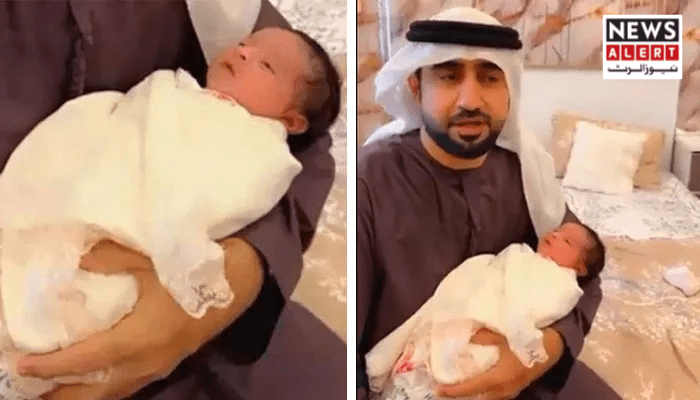
A newborn girl in Sharjah has shocked doctors and delighted her family after developing teeth only six days after birth. The unusual incident, reported in the United Arab Emirates, is being described as a rare medical phenomenon that has drawn significant attention from pediatric specialists.
A Rare and Surprising Moment for the Family
The baby, named Mehra Abdul Rahman, was born healthy. However, her parents noticed something unexpected less than a week later. Her father recalls the moment with a mixture of disbelief and joy. He explained that he had never heard of such a case before. Therefore, seeing two tiny teeth emerging in his daughter’s lower gum was both surprising and heart-warming.
He described it as a memorable moment for the entire family. While the sight initially startled them, the parents quickly informed the medical team overseeing Mehra’s care.
Doctors Confirm a Rare but Documented Condition
Doctors examined the infant and confirmed that Mehra’s condition is known medically as natal teeth. These are teeth present at birth or emerging within the first 30 days of life. Although extremely uncommon, the condition is documented in medical literature.
Health experts note that natal teeth occur in approximately 1 in every 2,000 to 3,000 births. Most cases involve one or two teeth, typically in the lower front gum. In many instances, these early teeth are smaller and weaker because they lack full root development.
The medical team assured the parents that Mehra was completely healthy. They emphasized that her early tooth eruption posed no immediate danger. However, they recommended continued observation to ensure that the teeth do not interfere with feeding or cause discomfort.
Possible Causes and Medical Concerns
Although doctors still do not fully understand why some newborns develop teeth so early, several factors are under consideration. These may include genetic predisposition, developmental variations, or rare underlying medical conditions. Despite these possibilities, most babies with natal teeth do not develop any long-term problems.
Doctors explained that natal teeth are usually harmless. However, they may sometimes create minor risks. For example, they can cause irritation to the baby’s tongue or make breastfeeding slightly challenging. In a few rare cases, loose teeth may pose a choking risk, prompting doctors to remove them.
Because of these potential complications, Mehra’s doctors decided to keep her under close monitoring. This precaution ensures they can act quickly if the situation changes.
Parental Relief and Gratitude
Mehra’s parents expressed deep gratitude that their daughter remains in good health. They also shared that her rare condition has become a source of fascination and happiness within the family. The experience has sparked curiosity among relatives and friends, many of whom had never heard of natal teeth before.
The father added that although the situation was unexpected, it made the first days of Mehra’s life especially memorable. He said the family views the incident as a blessing and remains thankful for the medical team’s guidance.
A Reminder of Nature’s Unpredictability
Cases like Mehra’s highlight how unpredictable human biology can be, even in the earliest days of life. Although rare, natal teeth remind doctors and parents that newborn development can vary widely. Experts say that as long as the baby remains under observation and continues feeding normally, such cases usually resolve without complications.
For now, Mehra continues to grow, bringing joy and surprise to everyone around her—her tiny teeth marking an unusual start to her early life.