Australia are facing uncomfortable questions about the future of their Test team after suffering a stunning nine-wicket defeat to Bangladesh in Darwin, a result that has been described by Australian media as one of the country’s biggest Test humiliations.
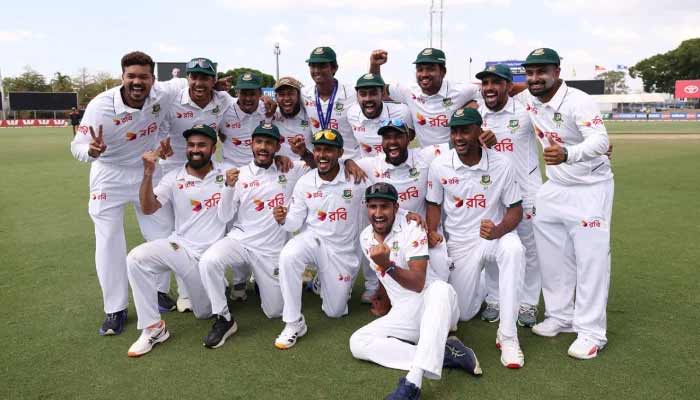
The defeat was completed inside four days on Sunday, giving ninth-ranked Bangladesh a historic victory over the world’s top-ranked Test side.
What was expected to be a relatively straightforward home series has instead left Australia under significant pressure. The second and final Test, scheduled to begin in Mackay, Queensland, on Saturday, has now taken on considerably greater importance.
Australia will need a convincing victory to level the series and ease concerns that the Darwin defeat could be a sign of deeper problems within the team.
Australian Media Slams ‘Shambolic’ Defeat
Australian cricket writer Robert Craddock described the result in particularly strong terms in the Courier Mail.
He called the defeat a “gob-smacking shambles” and argued that Australia’s loss could rank among the most humiliating results in the country’s long Test history.
The reaction reflects the scale of the upset. Australia had entered the series as the heavily favoured side, while Bangladesh arrived with considerably lower expectations.
However, the visitors dominated important phases of the match and exposed weaknesses in both Australia’s batting and bowling.
Batting Problems Come Under Spotlight
Captain Pat Cummins acknowledged Australia’s poor performance after the match, although he suggested that the game had effectively slipped away when his team was dismissed for just 198 in the first innings.
Nevertheless, Australia struggled throughout the match rather than in a single period.
The batting unit has consequently attracted the greatest scrutiny, particularly because several of the concerns had already emerged during the previous home summer.
Opener Jake Weatherald has struggled to establish himself at Test level and could now face pressure to retain his place.
Meanwhile, Marnus Labuschagne is also under the spotlight after two disappointing dismissals in Darwin.
Once regarded as one of Australia’s most reliable top-order batters, Labuschagne’s prolonged struggles have created additional pressure on the rest of the batting lineup.
Cholo Bangladesh! A closer look at the celebrations in Darwin 💚❤️ #AUSvBAN pic.twitter.com/1rCzF6Vvcj
— cricket.com.au (@cricketcomau) August 16, 2026
Calls for a New Generation
The defeat could also intensify calls for Australia to begin rebuilding its batting order.
Head coach Andrew McDonald and the selectors have so far largely retained an experienced group, particularly after Australia secured a 4-1 Ashes series victory over England during the home summer.
However, the lack of young domestic batters producing overwhelming numbers has made the transition more complicated.
The selectors must now decide whether to give the existing players another opportunity in Mackay or begin making difficult changes with a longer-term view.
Ageing Bowling Attack Under Pressure
Australia’s bowling attack has traditionally been one of the team’s biggest strengths, but the defeat in Darwin exposed concerns about its age and workload.
The experienced pace trio of Pat Cummins, Josh Hazlewood and Mitchell Starc has taken more than 1,000 Test wickets collectively and played a central role in Australia’s success over the years.
Yet the conditions in Darwin proved demanding as Bangladesh accumulated 426 runs, establishing a substantial first-innings advantage.
The performance also raised questions about whether Australia can continue relying so heavily on its experienced fast bowlers without gradually introducing younger options.
PCB Grants NOCs to 12 Players for CPL 2026 and County Cricket
Lyon Also Outbowled
Veteran spinner Nathan Lyon, who will turn 39 in November, also endured a difficult match.
Playing on his home ground, Lyon was outperformed by Bangladesh’s part-time off-spinner Mehidy Hasan Miraz, adding another surprising element to Australia’s defeat.
For a team accustomed to controlling Test matches through its bowling attack, the inability to contain Bangladesh represented a significant warning sign.
Australia Must Respond in Mackay
Australia are expected to respond strongly in the second Test, particularly with their pride damaged by the unexpected defeat.
The selectors could choose to give the existing squad another opportunity to prove that the Darwin result was an isolated failure.
However, the timing of the defeat makes the situation more significant.
Australia are scheduled to face South Africa in a three-Test series in October, meaning the team has limited time to address any weaknesses before another major challenge.
As a result, the selectors may have to look beyond simply securing a series-levelling victory in Mackay.
The second Test could therefore become an important test not only of Australia’s ability to recover from a shock defeat, but also of whether the current generation remains capable of leading the team through the next phase of its Test campaign.