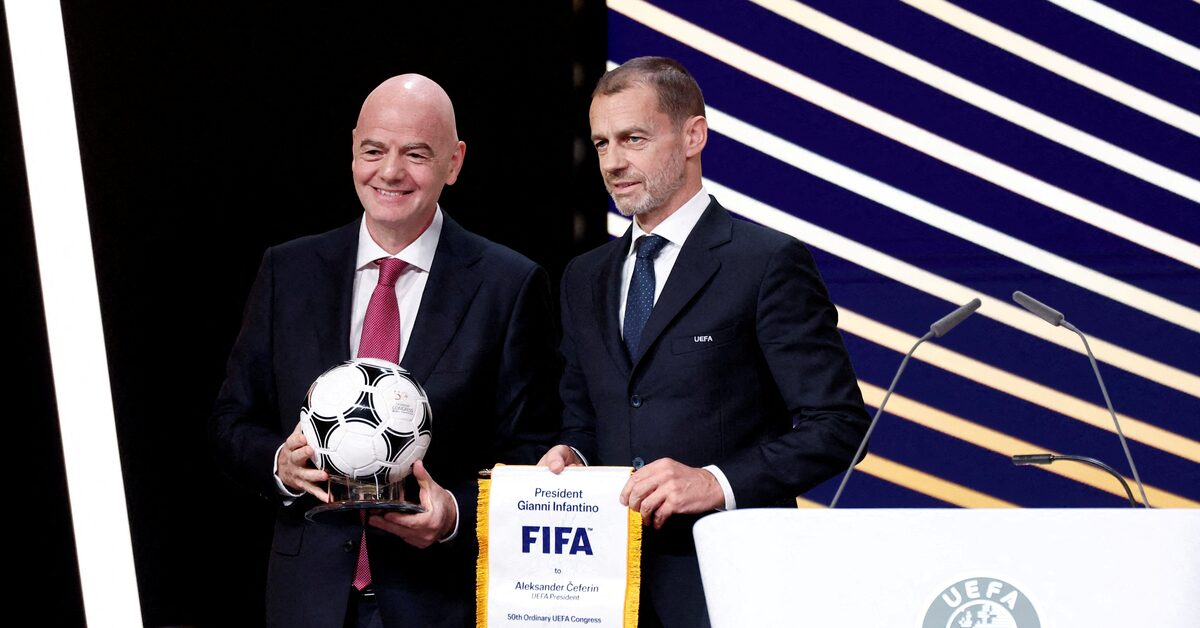
UEFA president Aleksander Ceferin is emerging as a central figure in the campaign to challenge FIFA president Gianni Infantino, as tensions between European football authorities and world football’s governing body intensify ahead of the next presidential election in March 2027.
Although Ceferin has decided not to contest the FIFA presidency himself, he is leading efforts to unite opposition against Infantino and has backed French Football Federation president Philippe Diallo as Europe’s preferred candidate for the top position.
The 59-year-old Slovenian has led the Union of European Football Associations (UEFA) since 2016 and has increasingly become one of Infantino’s most prominent critics.
Ceferin Leads UEFA’s Campaign Against Infantino
Ceferin’s growing influence became particularly evident after UEFA opposed Infantino’s proposed plan to bring private investors into FIFA’s commercial operations.
The proposal triggered widespread criticism among European football authorities, who raised concerns about transparency, governance and the concentration of decision-making powers.
UEFA even threatened to boycott the World Cup if Infantino proceeded with the plan. The pressure eventually forced the FIFA president to abandon the proposal.
Terrence Burns, a former brand and marketing strategist for two successful World Cup hosting bids, told AFP that Ceferin had handled the confrontation effectively.
Burns said UEFA had carried the campaign collectively while Ceferin avoided making personal statements, allowing the organisation to present a united position.
The episode strengthened Ceferin’s standing among critics of Infantino’s leadership.
Philippe Diallo Selected to Challenge FIFA President
Rather than entering the presidential race himself, Ceferin and UEFA have backed Philippe Diallo, the president of the French Football Federation, as their preferred challenger.
Diallo has received unanimous backing from UEFA’s 55 member associations, although securing sufficient support beyond Europe remains a major challenge.
The FIFA presidential election is scheduled for March 18, 2027, in Rabat, Morocco.
Infantino, who has led FIFA since 2016, is seeking another term. He faces growing criticism over his leadership style and several controversial decisions.
Ceferin’s strategy is centred on building an international coalition capable of challenging the current FIFA leadership and pushing for greater institutional transparency.
UEFA Demands Answers From FIFA Over Gianni Infantino’s Presidency
Previous Battles Against FIFA and European Super League
The latest confrontation is not the first time Ceferin has successfully challenged major football initiatives.
In 2021, UEFA joined forces with South America’s CONMEBOL to oppose Infantino’s proposal to organise the men’s World Cup every two years. The plan was eventually abandoned following resistance from several football authorities.
Ceferin also played a leading role in opposing the European Super League project, which threatened to create a breakaway competition involving some of Europe’s biggest clubs.
He strongly criticised the proposal when it emerged in April 2021, particularly targeting then-Juventus chairman Andrea Agnelli, one of the project’s leading supporters.
Ceferin later recalled facing intense pressure and threats while working to prevent the breakaway competition from moving forward.
Despite the project’s rapid collapse, UEFA subsequently reformed the Champions League format to strengthen its flagship club competition.
Leadership Controversy Within UEFA
Despite his campaign for changes at FIFA, Ceferin has also faced criticism over governance issues within UEFA.
In 2024, UEFA introduced a change to its presidential term-limit rules, excluding terms that began or were served before July 1, 2017, from the calculation.
The change effectively allowed Ceferin to seek a fourth presidential term in 2027, despite an existing three-term limit.
The decision prompted criticism from Croatian football great Zvonimir Boban, who resigned from his position as UEFA’s chief of football.
Boban argued that the change contradicted governance reforms previously introduced under Ceferin’s own leadership.
From Lawyer to One of Football’s Most Influential Leaders
A lawyer by profession, Ceferin served in the Yugoslav Army during the 1980s and was later called up by Slovenian forces during the country’s 1991 War of Independence.
He became UEFA president in 2016 and has since developed a reputation for confronting powerful figures and institutions in international football.
Ceferin has previously described himself as an underdog despite leading European football’s governing body for a decade.
His approach to political battles is reflected in one of his frequently quoted principles: choosing battles carefully rather than engaging in every confrontation.
As the FIFA presidential election approaches, Ceferin’s ability to build support for Diallo beyond Europe could determine whether his campaign becomes a serious challenge to Infantino or remains primarily a European-led effort to reshape football’s global leadership.
Source attribution: Based on an AFP report published by The Express Tribune on November 18, 2026. Additional background was cross-checked against Reuters and official UEFA statements.