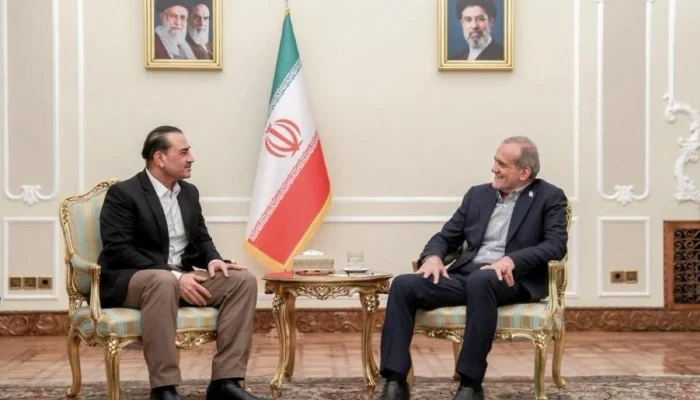
ISLAMABAD: Chief of Defence Forces and Chief of Army Staff Field Marshal Syed Asim Munir and Interior Minister Mohsin Naqvi have concluded a day-long visit to Iran, as Pakistan continues its diplomatic efforts to help break the deadlock in the ongoing US-Iran conflict.
According to the Inter-Services Public Relations (ISPR), the visit was aimed at advancing dialogue, preventing further escalation and exploring ways to achieve lasting peace and regional stability.
The visit comes at a sensitive time, with tensions continuing to rise between Washington and Tehran following an expanded US sanctions campaign against Iran.
High-Level Meetings in Tehran
During the visit, Field Marshal Asim Munir held a series of high-level meetings with Iran’s senior political and security leadership.
He met Iranian President Masoud Pezeshkian, Supreme Leader’s representative on the Supreme National Security Council Mohsen Rezaei, Parliament Speaker Mohammad Bagher Ghalibaf, Foreign Minister Abbas Araghchi and Interior Minister Eskandar Momeni.
Interior Minister Mohsin Naqvi accompanied the field marshal during the visit.
According to the ISPR, the discussions focused on measures to prevent further escalation, reopen the strategically important Strait of Hormuz and bring the conflict to an end.
The two sides also exchanged views on regional peace and possible ways to reach a negotiated settlement to the disputes.
Field Marshal Munir was received upon arrival in Tehran by Iranian Interior Minister Eskandar Momeni and other senior Iranian civil and military officials.
Iran Appreciates Pakistan’s Diplomatic Role
The Iranian leadership welcomed Pakistan’s diplomatic efforts and appreciated what the ISPR described as Islamabad’s “constructive role and sincere efforts” to facilitate dialogue and reduce tensions.
Tehran also acknowledged Pakistan’s efforts to encourage a peaceful resolution to the conflict and prevent the situation from escalating into a broader regional crisis.
Pakistan has positioned itself as an important mediator between Tehran and Washington as it seeks to encourage dialogue between the two sides.
The latest visit formed part of Islamabad’s broader diplomatic efforts to break the existing stalemate and support negotiations aimed at achieving a lasting peace.
CDF Asim Munir, President Erdogan Discuss Regional Security and Defence Cooperation in Ankara
Pakistan’s Mediation Efforts Continue
The US-Iran conflict began following US and Israeli strikes on Iran on February 28.
Pakistan later helped broker a two-week ceasefire between the two sides on April 8, bringing six weeks of fighting to a temporary halt. Since then, Islamabad has continued to facilitate communication and relay messages between Washington and Tehran.
Pakistan’s earlier mediation efforts also resulted in an interim peace agreement known as the Islamabad Memorandum, signed in June. However, the agreement quickly broke down after fighting resumed, raising concerns that the conflict could develop into a wider regional confrontation.
The latest visit to Tehran reflects Pakistan’s continued effort to restore diplomatic engagement and encourage both sides to return to negotiations.
Strait of Hormuz Remains a Major Concern
The Strait of Hormuz has emerged as one of the central concerns of the wider conflict.
The strategic waterway is a vital route for global oil shipments, and disruptions to shipping through the strait have placed additional pressure on international energy markets.
Oil shipments through the waterway have been severely disrupted, while Iran has warned that it could take action against tankers attempting to transit the strait without authorisation.
The disruption has brought shipping activity close to a standstill and contributed to rising global energy prices.
Despite suffering significant military and economic damage during the conflict, Iran continues to retain missile and drone capabilities that could be used against US interests and Gulf states. These capabilities also pose a potential threat to oil tankers travelling through the region.
US Sanctions Add to Economic Pressure
The visit also comes as the United States prepares further sanctions against Iran.
US officials have described the planned measures as among the toughest economic restrictions imposed on Tehran, with Washington seeking to increase pressure on countries that continue to provide economic support to Iran.
President Donald Trump has warned of economic consequences for countries providing what he has described as “any type of lifeline” to Tehran.
The conflict has added to Iran’s existing economic difficulties, including high inflation, a weakening currency, energy shortages and structural economic problems.
In addition, the war has damaged infrastructure, disrupted trade and industrial production and increased reconstruction costs, placing further pressure on the Iranian economy.
A Critical Moment for Regional Diplomacy
The latest diplomatic engagement comes as the broader Middle East remains under significant strain.
Thousands of people have been killed since the conflict began, with most of the casualties reported in Iran and Lebanon. The strikes have also caused extensive economic and infrastructure damage.
The precise condition of Iran’s nuclear programme remains unclear, despite US and Israeli efforts to weaken or dismantle it.
For Pakistan, the immediate priority remains preventing a further escalation and encouraging a negotiated settlement between Washington and Tehran.
Field Marshal Asim Munir’s visit, together with the participation of Interior Minister Mohsin Naqvi, highlights Islamabad’s continuing efforts to keep diplomatic channels open.
While the latest talks have been described as constructive, the long-term outcome will depend on whether all sides are prepared to return to negotiations and take practical steps towards ending a conflict that continues to affect regional security, international trade and global energy markets.