KARACHI: Police have submitted the charge sheet in the Gul Plaza fire case to a Karachi court, holding the shopping mall’s association primarily responsible for the deadly blaze.
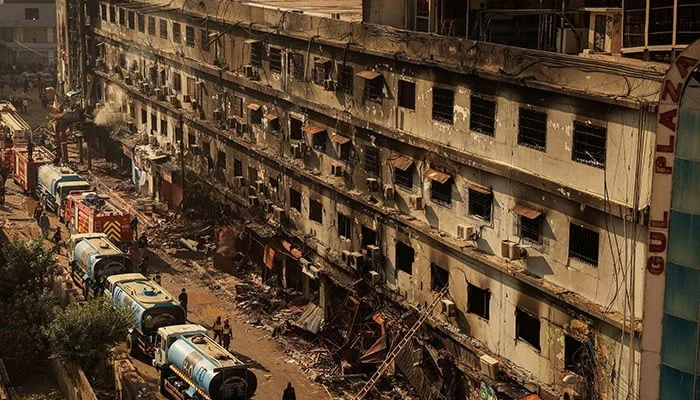
The massive fire that engulfed Gul Plaza, a popular three-storey shopping centre in Karachi, on January 17 claimed the lives of more than 70 people and raised serious questions about fire safety standards in the country’s largest city.
The mall housed nearly 1,200 businesses across its basement, mezzanine and three floors, selling everything from wedding dresses and toys to household goods and baby clothes. The devastating blaze reduced much of the complex and its contents to ashes.
Police find no negligence by KMC, fire brigade
According to the charge sheet, investigators found no negligence on the part of the Karachi Metropolitan Corporation (KMC), fire brigade or Civil Defence.
Police, however, raised questions about fire safety arrangements at Gul Plaza and highlighted alleged negligence by the mall’s administration.
The charge sheet includes 87 witnesses and details the evidence collected during the investigation.
Investigators also obtained CCTV footage and other material evidence, which have been incorporated into the case record.
Forensic report finds no explosive material
The forensic examination did not find any explosive material in the items examined by investigators.
The report also found no traces of flammable liquid.
However, forensic experts detected particles associated with burning in some of the examined items.
The findings are part of the evidence submitted with the police charge sheet as investigators continue to establish how the deadly fire spread through the building.
Gul Plaza Fire Killed 79 People, Most on Mezzanine Floor: Investigation Report
Management ‘was aware of flaws’
The police findings come after a Commission of Inquiry raised serious concerns about the mall’s fire safety arrangements.
The commission observed last month that Gul Plaza’s de facto management was aware of existing fire safety deficiencies but failed to take corrective measures.
According to the judicial commission report issued by the Sindh Home Department, shortcomings existed across all three key areas of fire safety: prevention, detection and firefighting.
The commission concluded that the absence of an integrated fire safety system meant the building was being operated in a hazardous condition.
It said the fire therefore could not simply be viewed as an unforeseeable incident, but rather as a foreseeable consequence of the conditions in which the building was being operated.
Reports highlighted missing firefighting systems
The inquiry report pointed to Civil Defence inspection reports from 2024 and 2025, both of which recorded serious deficiencies in the building’s firefighting infrastructure.
The reports cited the absence of essential systems, including:
- Fire hydrants
- Hose reels
- Fire pumps
- A reliable functioning alarm system
- Trained firefighting personnel
- Regular fire drills
- Adequate rescue equipment
The findings indicate that major fire safety gaps had been documented before the January tragedy.
What the charge sheet means for the case
The police charge sheet puts the focus firmly on the alleged failures of Gul Plaza’s administration and the safety arrangements maintained inside the shopping complex.
While investigators did not find negligence by KMC or the fire brigade, the evidence presented in the case raises questions about whether the mall’s management took adequate steps to address known fire hazards.
The inclusion of 87 witnesses, CCTV footage and forensic findings is expected to form a key part of the proceedings as the court considers the allegations surrounding one of Karachi’s deadliest recent commercial-building fires.