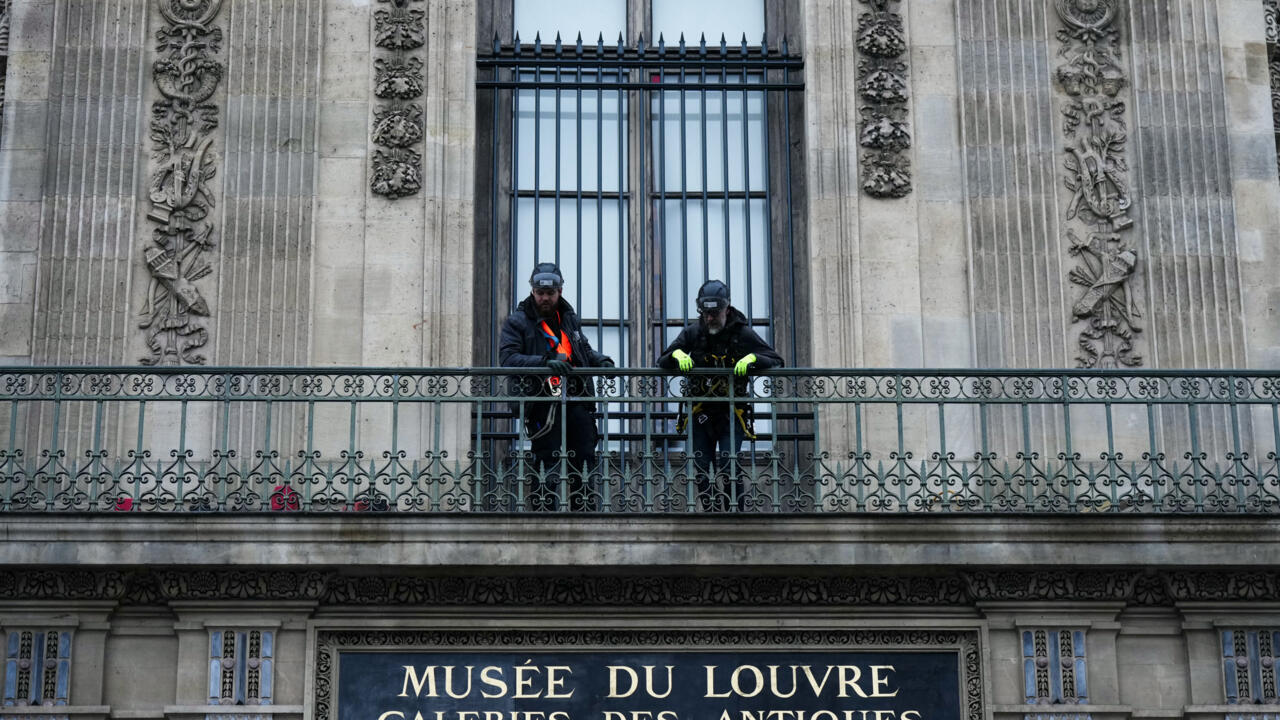
PARIS: One year after a daring robbery at the Louvre Museum shocked France, the stolen crown jewels remain missing, with investigators facing mounting uncertainty over whether the historic treasures can be recovered.
On October 19, 2025, thieves disguised as workmen broke into the world-famous museum using industrial disc-cutters and escaped with eight valuable items. The stolen collection included a brooch and a crown belonging to Empress Eugénie, the wife of Napoleon III.
French President Emmanuel Macron described the robbery as an attack on France’s history, underscoring the cultural significance of the missing treasures.
All four main suspects were arrested within 10 days of the heist and remain in custody awaiting trial. However, despite an extensive investigation, police have yet to locate the jewels.
Investigators Struggle to Find the Missing Treasures
Experts in law enforcement and private art recovery believe the chances of recovering the jewels may depend on whether the thieves acted independently and concealed the items somewhere in the Paris region.
Christopher Marinello of Art Recovery International told AFP that the suspects may initially have hidden the treasures in a wall or buried them while deciding what to do next.
The last known sighting of the jewels reportedly came from CCTV footage recorded at an underground storage facility in Aubervilliers, a suburb north of Paris where the suspects live.
A team of around 100 investigators has searched the suspects’ homes and relatives’ properties, including cellars, garages and attics. The searches have so far failed to uncover the missing items.
Police Hope Suspects Will Reveal the Jewels’ Location
Investigators may still recover the treasures if one of the suspects agrees to disclose their location in exchange for a more lenient sentence.
Arthur Brand, a prominent Dutch private art detective, told AFP that French police had considerable experience investigating such crimes and questioning suspects.
He suggested that investigators might need only one member of the group to cooperate to make a breakthrough.
However, the longer the jewels remain missing, the more difficult it may become to establish whether they are still intact or have been transferred to others.
Fears the Jewels Were Handed to Organised Crime
A more concerning possibility is that the robbery was organised by a criminal ringleader or middleman who arranged for the stolen treasures to be transferred soon after the break-in.
Corrado Catesi, head of Interpol’s stolen art unit, said organised crime networks could provide not only the expertise needed to carry out a robbery but also the contacts required to move and sell stolen objects.
According to a source close to the investigation cited by AFP, two suspects in custody have claimed that a ringleader was involved. Investigators have reportedly treated those claims with scepticism.
If the jewels were handed to contacts in the underground precious-stones market, recovering them could prove considerably more difficult.
France Protests Turn Violent as 1,200 Arrested in Nationwide Riots
Could the Stolen Diamonds Be Cut and Sold?
Experts fear that the diamonds could be removed from their original settings, recut and introduced into the legitimate jewellery trade.
Arthur Brand identified Antwerp, Belgium, a major international diamond-trading centre, as one possible destination. Christopher Marinello also mentioned Tel Aviv and India as potential locations, although there is no confirmation that the jewels have been taken to any of these places.
Tobias Kormind, managing director of online diamond retailer 77 Diamonds, told AFP that recut stones could potentially re-enter the legitimate supply chain through wholesalers and retailers.
He warned that identifying a stolen diamond could become extremely difficult after it had been recut and polished, particularly if it lacked distinctive internal characteristics.
The loss of the jewels’ original form and identifying features would therefore create another obstacle for investigators.
Previous Cases Offer Hope of Recovery
Despite the concerns, experts say the recovery of the Louvre treasures remains possible.
Brand pointed to previous cases in which stolen jewellery and valuable objects were recovered, including a robbery at the TEFAF art fair in the Netherlands in 2022 and a break-in at the Green Vault museum in Dresden, Germany, in 2019.
He said stolen gold, silver and diamonds were sometimes recovered even when their return initially appeared unlikely.
“There is still a chance that we will see the Louvre jewels again and it might be that somebody talks before the court case,” Brand told AFP.
Stolen Jewels Remain on Interpol’s Database
The missing treasures remain listed in Interpol’s database of stolen artworks, keeping their disappearance on the radar of international law enforcement agencies.
Catesi said investigations worldwide showed that stolen objects could take anywhere from three months to 40 years to recover.
For the Louvre, the year-long search has yet to produce a breakthrough. With the suspects awaiting trial and the jewels’ whereabouts still unknown, investigators face the challenge of determining whether the treasures remain hidden, have been transferred to criminal networks or have already been dismantled for resale.