Cybercrime agency asks Supreme Court to withdraw its directive to the Islamabad High Court, while the hearing on the couple’s sentence suspension pleas is postponed again.
NCCIA Moves Supreme Court Against Earlier Order
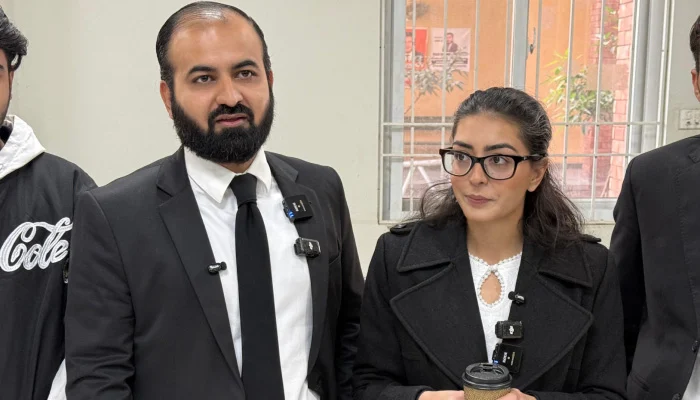
The National Cyber Crime Investigation Agency (NCCIA) has approached the Supreme Court seeking the withdrawal of its May 12 order that directed the Islamabad High Court (IHC) to decide the sentence suspension pleas of lawyer and human rights activist Imaan Mazari and her husband, lawyer Hadi Ali Chattha.
The agency argues that the Supreme Court should not intervene in matters that are already pending before a high court and that decisions regarding suspension of sentences fall within the jurisdiction of the relevant high court.
The latest development adds a new legal dimension to a case that has attracted significant public attention due to the profile of the accused and the legal questions surrounding judicial authority and due process.
Background of the Case
In January 2026, a district and sessions court in Islamabad sentenced Imaan Mazari and Hadi Ali Chattha to a combined total of 17 years imprisonment each under various provisions of the Prevention of Electronic Crimes Act (PECA). The convictions were linked to a case involving controversial social media posts.
The couple challenged the verdict before the Islamabad High Court in early February, seeking both an appeal against the conviction and suspension of their sentences pending the outcome of the case.
Subsequently, the Supreme Court directed the Islamabad High Court to decide the sentence suspension applications by May 26.
The order was issued by a three-member bench headed by Justice Shahid Waheed and comprising Justice Naeem Akhtar Afghan and Justice Shafi Siddiqui.
NCCIA’s Legal Arguments
In its petition, the NCCIA contended that the authority to decide sentence suspension applications lies solely with the concerned high court after hearing all parties and examining the merits of the case.
The agency argued that the Supreme Court’s directions to the Islamabad High Court were inconsistent with the principle that courts should independently decide matters pending before them without external interference.
Bilawal Calls for Simultaneous Elections in Gilgit-Baltistan, AJK and Pakistan
According to the petition, all parties appearing before the courts should be treated equally, and no litigant should receive special concessions or preferential treatment. The agency further maintained that legal procedures should be allowed to run their course in accordance with established judicial norms.
The NCCIA has requested the apex court to recall its May 12 order and allow the matter to proceed before the Islamabad High Court under normal legal procedures.
Islamabad High Court Postpones Hearing
Meanwhile, in separate proceedings, the Islamabad High Court adjourned the hearing on the couple’s sentence suspension pleas after members of the special prosecution team failed to appear before the court.
The case was heard by Justice Muhammad Azam Khan, who was informed that although a three-member prosecution team had been constituted, none of its members were available to present arguments during the hearing.
According to the prosecution, one team member had travelled from Lahore, while another was engaged in proceedings before another bench, preventing their appearance in the case.
Court Expresses Concern Over Delay
During the hearing, Justice Azam Khan noted that he had adjusted his schedule and attended court specifically for this matter despite being nominated for mediation training.
The court also discussed the Supreme Court’s earlier directions and the expiry of the timeline set by the apex court for deciding the applications.
Counsel for the couple, Faisal Siddiqi, suggested proceeding once the prosecution became available. However, the prosecution requested a fresh date for the hearing.
After hearing both sides, the court fixed June 4 as the next date of hearing.
Case Remains Under Judicial Consideration
The latest proceedings highlight the ongoing legal debate surrounding jurisdiction, judicial procedure, and the handling of sentence suspension applications in high-profile cases.
With the NCCIA challenging the Supreme Court’s earlier directive and the Islamabad High Court yet to hear substantive arguments on the suspension pleas, the matter remains under active judicial consideration.
The upcoming hearing on June 4 is expected to determine whether the court can finally proceed with arguments on the couple’s request for suspension of sentence while their appeals against conviction continue.