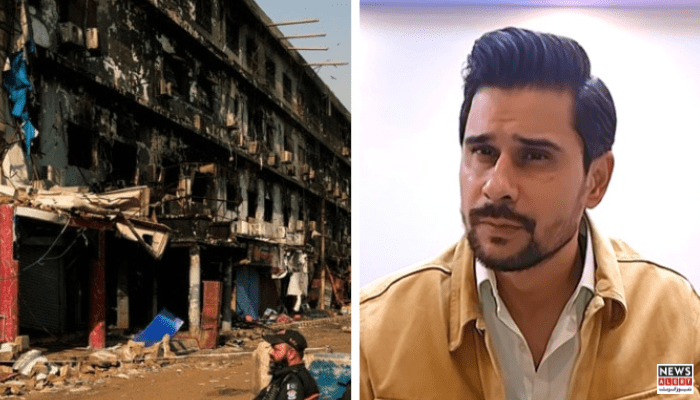
Pakistan’s well-known television host Tabish Hashmi has sparked debate after making unusually blunt remarks about Karachi’s governance, following the tragic incident at Gul Plaza in the city.
Speaking on Geo News’ current affairs programme Report Card, Hashmi expressed deep sorrow over the tragedy and used the moment to deliver a wider critique of how Karachi is run. His comments, although partly satirical, reflected a frustration shared by many residents of Pakistan’s largest metropolis.
Karachi, a city of more than 20 million people, has long struggled with poor infrastructure, weak regulation, and a lack of accountability in public administration. The Gul Plaza incident, which reportedly involved a major fire and loss of property, once again raised questions about safety standards and emergency preparedness in commercial buildings.
Also Read: Rescue Operations Continue at Gul Plaza After Tragic Collapse in Karachi
A City Tied to Gul Plaza
During the programme, Hashmi said it was difficult to find a household in Karachi that did not have some connection to Gul Plaza.
From childhood to youth, and now even in mature age, the associations we had with Karachi are disappearing one by one, he said.
Gul Plaza, like many old commercial centers in Karachi, has long been a hub for shopping and small businesses. For decades, it symbolised the city’s bustling retail culture. Therefore, its destruction was not only a material loss, but also an emotional one for many residents.
Hashmi’s remarks highlighted how such places are woven into the daily life of Karachiites. When one collapses or burns down, it feels like a part of the city’s identity is lost.
Questioning Official Accountability
Hashmi then turned his attention to the provincial government, particularly the Sindh chief minister.
He referred to a recent press conference in which the chief minister said he was answerable for what happened. However, Hashmi challenged what that accountability truly meant.
Accountability is not just about words, Hashmi said. It requires action.
He added that this was not the first such incident in Karachi. Over the years, the city has witnessed numerous fires in factories, markets, and residential buildings. Similarly, several children have reportedly lost their lives after being run over by heavy dump trucks on city roads.
These repeated tragedies, Hashmi argued, point to a deeper structural failure rather than isolated accidents.
If He Is Responsible, What Has Changed?
The host went further by questioning whether any meaningful consequences ever follow such statements of responsibility.
If the chief minister is truly answerable, he asked, has he lost his position? Has his salary been cut?
He also pointed out that compensation paid to victims is rarely borne personally by officials. Instead, it comes from public funds, which essentially means taxpayers are paying for failures in governance.
This argument resonates strongly in Karachi, where citizens often complain that powerful figures rarely face penalties, even after repeated disasters.
According to data from local safety groups, Karachi has seen dozens of major fires in commercial and residential buildings over the past decade, many caused by faulty wiring and illegal construction. Despite this, enforcement of building codes remains weak.
A Provocative Suggestion: Privatise Karachi?
Perhaps the most striking part of Hashmi’s comments was his suggestion that Karachi itself should be privatised.
If the government realised it could not run PIA and decided to privatise it, he said, referring to Pakistan International Airlines, then you might as well privatise Karachi too.
He continued by saying that people from all communities living in Karachi – Pathans, Baloch, Sindhis, Muhajirs, Punjabis, and others – could collectively buy the city and manage it themselves.
Although clearly symbolic, this idea touched on a serious issue: widespread public frustration with state management of urban services.
A Satirical Remark with a Serious Message
Hashmi said he was confident that ordinary citizens could run the city better.
At the very least, we would not do worse, he remarked. Even with all our efforts, we could not mismanage it more than it already is.
While said partly in humour, the underlying message was sharp. Karachi suffers from broken roads, water shortages, power outages, and chronic traffic problems. The city also contributes nearly 20 percent to Pakistan’s GDP, yet many residents feel it receives far less in return in terms of public investment.
Urban experts often point out that Karachi lacks a strong, empowered local government system. Without clear authority at the city level, responsibilities remain scattered among various provincial bodies, leading to inefficiency and blame-shifting.
Why Hashmi’s Comments Matter
Tabish Hashmi is not a politician, but his voice carries weight among urban, middle-class audiences. His remarks reflect a growing public impatience with routine expressions of regret that are not followed by reform.
Moreover, the Gul Plaza tragedy has once again exposed the fragile state of safety regulation in Pakistan’s largest city. Whether it is fires, building collapses, or road accidents, the pattern is disturbingly familiar: shock, sympathy, promises – and then silence.
Hashmi’s words, therefore, were not just about one incident. They were about a system that many believe is failing Karachi’s people.
As debates continue on social media and television, one question remains central: will this tragedy lead to lasting change, or will it become yet another forgotten headline in a city that desperately needs better governance?