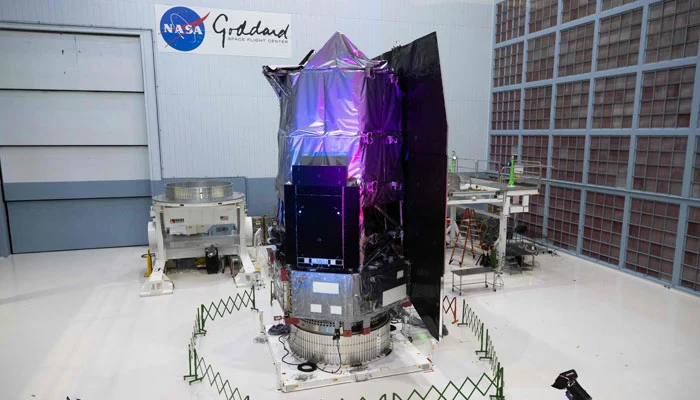
NASA has officially unveiled its latest space observatory, the Nancy Grace Roman Space Telescope, marking a major milestone in modern astronomy. Designed to explore some of the universe’s deepest mysteries, the telescope is expected to transform our understanding of dark energy, dark matter, and planets beyond our solar system.
A Next-Generation Observatory
The Roman Space Telescope was revealed at NASA’s Goddard Space Flight Center, where scientists highlighted its advanced capabilities. Measuring about 12 metres in length and equipped with large solar panels, the telescope represents more than a decade of engineering work and an investment exceeding $4 billion.
Named after pioneering astronomer Nancy Grace Roman, often called the “Mother of Hubble,” the mission builds on the legacy of the Hubble Space Telescope, which revolutionized space observation after its launch in 1990.
Mapping the Universe at an Unprecedented Scale
One of Roman’s most remarkable features is its wide field of view—at least 100 times larger than Hubble’s. Positioned about 1.5 million kilometres from Earth, the telescope will scan vast regions of space and send back enormous amounts of data—up to 11 terabytes per day.
According to NASA officials, this capability will allow scientists to create a detailed “atlas” of the universe. The telescope is expected to identify billions of galaxies, thousands of supernovae, and tens of billions of stars. Importantly, it may also discover tens of thousands of new planets, offering valuable insights into how common planetary systems are across the cosmos.
The Nancy Grace Roman Space Telescope is in final preparations for an early September launch, eight months AHEAD of schedule and UNDER budget.
This milestone is the result of more than a decade of dedication and millions of hours of work by NASA and our industry partners. Their… pic.twitter.com/dmNglbc93h
— NASA Administrator Jared Isaacman (@NASAAdmin) April 21, 2026
Probing Dark Matter and Dark Energy
Beyond visible objects, Roman will focus on the invisible forces that shape the universe. Scientists believe that Dark Matter and Dark Energy together make up about 95% of the universe.
Dark matter is thought to hold galaxies together, while dark energy drives the accelerating expansion of the universe. Using its infrared instruments, Roman will observe light emitted billions of years ago, effectively allowing researchers to look back in time and study how these forces have influenced cosmic evolution.
Collaboration with Other Space Missions
The Roman telescope will work alongside other advanced observatories, including the James Webb Space Telescope, as well as Europe’s Euclid Space Telescope and Chile’s Vera C. Rubin Observatory. Together, these instruments will provide complementary data, helping scientists answer some of the most fundamental questions about the universe.
‘NASA Force’ Explained: Not a Military Unit, but a Talent Recruitment Drive
Looking Ahead
The telescope is scheduled for launch aboard a SpaceX rocket, with the earliest target set for September. Once operational, it is expected to reshape our understanding of cosmic structure and potentially lead to discoveries that scientists have not yet even imagined.
As experts suggest, the Roman mission could unlock entirely new areas of research—perhaps even discoveries worthy of future Nobel Prizes—highlighting the vast and still largely unexplored nature of our universe.