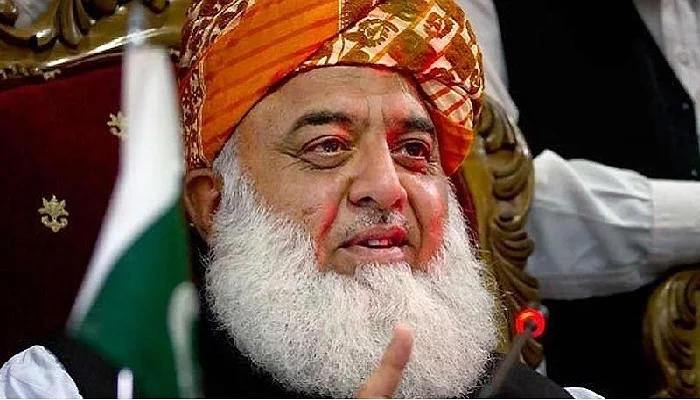
Jamiat Ulema-e-Islam-Fazl (JUI-F) chief Maulana Fazlur Rehman has warned against making unilateral decisions on the creation of new provinces, calling instead for a broad national debate on Pakistan’s administrative and political structure.
Addressing a Khatm-e-Nabuwwat conference at Wahdat Road Cricket Ground in Lahore, Fazl said Pakistan’s strength depended on the security, dignity and political participation of its people. He also criticised policies that, in his view, had contributed to political divisions, ethnic tensions and economic dependence.
Referring to September 6, 1965, Fazl said the day represented an important chapter in Pakistan’s history, particularly in defending the country’s geographical boundaries.
JUI-F wants debate on new provinces
Fazl made clear that JUI-F was not opposed to the creation of additional provinces or administrative units in principle. However, he said any such decision should take into account the prevailing political circumstances and the needs of the country.
“We are not against provinces, but the time and circumstances must also be considered,” he said.
The JUI-F chief stressed that decisions regarding the country’s administrative structure should not be imposed without consultation. Instead, political parties and other stakeholders should openly debate the issue before any major step is taken.
He also pointed to the 18th Amendment, under which provinces exercise significant authority over natural and mineral resources, saying political parties therefore had an important role in discussions about any restructuring.
“Do not impose any decision unilaterally; there should be a debate on it,” Fazl said.
Criticising major political parties, he said the Pakistan Peoples Party had mainly discussed the issue in the context of Sindh, while the Pakistan Muslim League-Nawaz had remained largely silent.
Political divisions and national unity
Fazl also expressed concern over what he described as growing political and ethnic divisions in the country. He argued that Pakistan had struggled to develop a strong sense of national unity and that ethnic divisions had contributed to unrest and violence.
According to the JUI-F chief, political disputes and social fragmentation had weakened the country instead of strengthening its federal structure.
He said Pakistan needed an environment in which citizens could live with security and dignity, warning that the country was facing “division upon division”.
Fazl also criticised what he described as the growing influence of international financial institutions over Pakistan’s economic policies.
Criticism of dependence on foreign loans
The JUI-F leader said Pakistan had built much of its economic foundation on foreign borrowing and criticised its dependence on institutions such as the World Bank and International Monetary Fund.
“Colonialism has ended, but international institutions decide for our country today,” he said.
Fazl argued that allowing external lenders to influence domestic economic decisions amounted to another form of colonialism.
No Region or Province Targeted in Restructuring Debate: Official
He said Pakistan belonged to its people and that the state could not become genuinely strong without peace, security and economic dignity. He also criticised what he called elite and oppressive politics, saying attempts to impose political power on citizens would ultimately fail.
Fazl further said JUI-F would oppose any movement seeking to repeal Pakistan’s blasphemy laws.
Debate over Pakistan’s administrative structure
Fazlur Rehman’s remarks come as political parties and government officials continue to debate whether Pakistan requires additional provinces or deeper decentralisation within the existing provincial framework.
Interior Minister Mohsin Naqvi reignited the debate in July when he described Pakistan’s governance system as having deteriorated severely and called for fundamental reforms. He argued that the country needed new administrative units, whether they were ultimately designated as provinces or given another status.
Naqvi said administrative restructuring could help improve governance and speed up development by transferring greater powers to lower levels of government.
The Pakistan Peoples Party, however, opposed moving forward with the proposal, saying no concrete restructuring plan had been presented to the party.
The discussion expanded further when Planning and Development Minister Ahsan Iqbal called for a national debate on Pakistan’s administrative structure and suggested that the country could eventually have between 12 and 15 provinces.
Iqbal proposed that an administrative reforms committee examine possible changes, while stressing that the creation of new provinces would ultimately require political consensus.
He has also argued that Pakistan’s four existing provinces have become highly centralised, with considerable authority concentrated in provincial capitals despite the devolution process introduced through the 18th Amendment.
Iqbal suggested creating around 160 empowered district governments, arguing that governing large provinces effectively from Karachi, Lahore, Peshawar and Quetta was administratively difficult.
He warned that demands for new provinces could become stronger if meaningful powers were not transferred to districts and local governments.
The debate, therefore, now revolves around two broad options: redrawing provincial boundaries to create new provinces, or strengthening decentralisation by transferring more authority to districts and local governments within the existing provinces.