The Charter of Democracy, signed by Benazir Bhutto and Nawaz Sharif in 2006, sought to restore parliamentary government and strengthen provincial autonomy.
The 7th National Finance Commission (NFC) Award and the 18th Amendment were important steps towards fulfilling that commitment. The NFC Award, agreed in December 2009 and implemented from July 2010, increased the provincial share of the divisible pool to 56% in FY2010–11 and 57.5% thereafter, after prescribed deductions. It also introduced poverty, revenue collection and inverse population density alongside population in determining the distribution of funds among provinces.
The 18th Amendment, enacted in April 2010, abolished the Concurrent Legislative List, expanded provincial legislative powers and strengthened the Council of Common Interests (CCI).
More than 16 years later, there is enough data to examine what these reforms achieved, where they fell short and why, particularly in terms of delivering benefits to citizens.
Devolution increased provincial resources
World Bank estimates show that average transfers from the federal government to provinces increased from 3.2% of GDP during FY2002–09 to 5.1% during FY2010–24.
Provincial spending also increased, rising from an average of 4.3% of GDP before the reforms to 6.3% during FY2010–25. Provisional fiscal accounts for FY2025–26 put NFC transfers at 6.0% of GDP and provincial expenditure at 6.8%.
The increase in provincial transfers has also contributed to concerns over the federal government’s fiscal position. Provinces agreed to provide grants to the federal government under Article 164 in FY2026–27, although the impact of those grants will only become clear after the end of the fiscal year.
However, the federal budget deficit cannot be addressed through provincial transfers alone. Despite the devolution of powers, the federal government has not fully relinquished its responsibilities or administrative structures.
Average federal spending increased from 11.2% of GDP during FY2002–09 to 13.0% during FY2010–24. Excluding interest payments, however, it remained around 8.4%.
Debt servicing helps explain the increase in overall spending. At the same time, retaining overlapping programmes and administrative structures limited the savings that might otherwise have resulted from devolution.
Some federal spending provides legitimate support for national redistribution, including the Benazir Income Support Programme. However, questions remain about whether the federal government should continue financing social protection programmes in provinces through additional borrowing.
Provinces still depend heavily on Islamabad
Provincial tax receipts have increased from around 0.3% of GDP in FY2009 to approximately 1.0% in FY2025–26. Despite this improvement, provinces remain heavily dependent on federal transfers.
Weak documentation and enforcement have limited the collection of taxes on property and agricultural income. Expanding tax collection can also create visible costs for property owners and other influential groups, giving provincial governments little incentive to rely less on federal transfers.
The social development gains associated with the NFC Award and 18th Amendment are mixed.
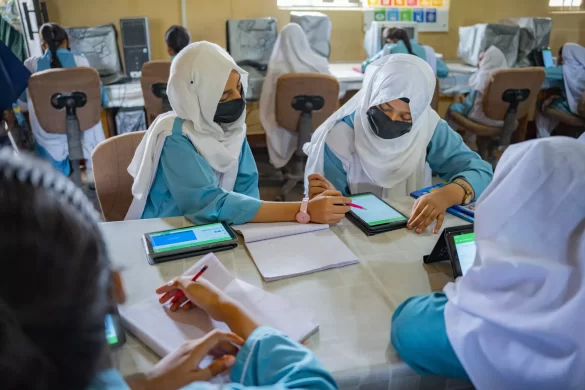
Between the 2018–19 and 2024–25 household surveys, literacy among people aged 10 and above increased from 60% to 63%. Full immunisation among children aged 12–23 months rose from 68% to 73%, while infant mortality declined from 60 to 47 deaths per 1,000 live births.
The proportion of children aged five to 16 who were out of school fell from 30% to 28%.
These comparisons cover only part of the post-reform period, however, and cannot establish how much of the improvement was directly caused by devolution.
Official poverty estimates show poverty declining from 36.8% in 2010–11 to 21.9% in 2018–19 before rising to 28.9% in 2024–25. The Gini coefficient, a measure of inequality, increased from 28.4 to 32.7 between the last two surveys.
Covid-19, floods and inflation all affected household welfare. Judging the reforms solely on the basis of the latest deterioration would therefore overlook earlier improvements as well as the impact of broader national economic policies.
Local governments remain the missing link
Significant disparities remain between provinces and within them.
In 2024–25, the out-of-school rate was 21% in Punjab compared with 45% in Balochistan. Poverty stood at 23.3% in Punjab and 47.0% in Balochistan.
Geography, security conditions, administrative capacity and inherited infrastructure can all affect service delivery. However, available evidence also suggests that resources are not necessarily reaching populations facing the greatest disadvantages.
World Bank district-level data show that real per-capita expenditure attributed to Quetta in FY2023 was more than five times higher than in other Balochistan districts. The corresponding ratios were around four for Lahore, three for Peshawar and two for Karachi compared with other districts in their respective provinces.
KP Assembly speaker hits back at Naqvi over parliamentary privileges
These figures include provincial headquarters costs, so they cannot establish how much spending directly benefited residents of the provincial capitals.
The situation becomes clearer when local government spending is examined.
Local governments’ recorded share of general government expenditure fell from around 10% in 2005 to 4.7% in 2024. Article 140A of the Constitution requires provinces to devolve political, administrative and financial authority to elected local governments.
However, the Constitution does not guarantee a specific fiscal share for local governments or establish a timetable for Provincial Finance Commission awards.
Once funds reach provincial governments, their distribution among development schemes and plans at the sub-provincial level can therefore remain heavily influenced by provincial decision-making.
Provincial control remains a major hurdle
According to the writer, provincial governments have been reluctant to hold local government elections and, even when elections take place, control over the release of funds gives provincial leaders significant influence over elected local representatives.
Repeated changes to local government structures further reinforce this control.
As a result, citizens can end up depending on provincial and federal legislators for services that elected local councillors should have the authority and resources to provide.
Regular Provincial Finance Commission awards, the writer argues, would help clarify whether failures in essential service delivery stem from provincial governments or local administrations.
The federal government also has responsibilities under the Constitution. Article 154 requires the Council of Common Interests to meet at least once every 90 days. According to the writer, more than 500 days have passed since its last meeting.
The lack of regular CCI meetings has also contributed to delays in reaching agreement on a successor NFC Award. Future awards would ideally reflect current population levels, deprivation and the costs of providing public services, but provincial shares remain linked to older inputs, including data from the 1998 Census.
New provinces alone may not solve the problem
The debate over redesigning Pakistan’s federal arrangements must be viewed against this broader background.
Calls for new provinces are partly driven by concerns over neglected regions. Smaller administrative units could potentially improve representation and reduce the distance between governments and citizens.
However, creating additional provinces would not automatically guarantee greater authority for local governments.
Local governments would continue to operate within any new provincial boundaries, meaning the same question of provincial control over districts could remain.
The writer argues that completing the decentralisation envisioned by the Charter of Democracy requires provincial governments to surrender some of their own control.
Political parties opposed to the creation of new provinces, he suggests, should explain which powers and revenues they would transfer to elected local governments. Parties advocating new provinces should make similar commitments for the new units they propose.
Ultimately, the argument is that voters should assess both approaches by examining how much authority, funding and responsibility elected local representatives would actually receive.
The writer heads the Sustainable Development Policy Institute (SDPI), chairs the board of the National Disaster Risk Management Fund and serves on the ADBI’s Advisory Board. He posts on LinkedIn @Abidsuleri.
Disclaimer: The views expressed in this piece are the writer’s own and do not necessarily reflect Geo.tv’s editorial policy.
Originally published in The News.