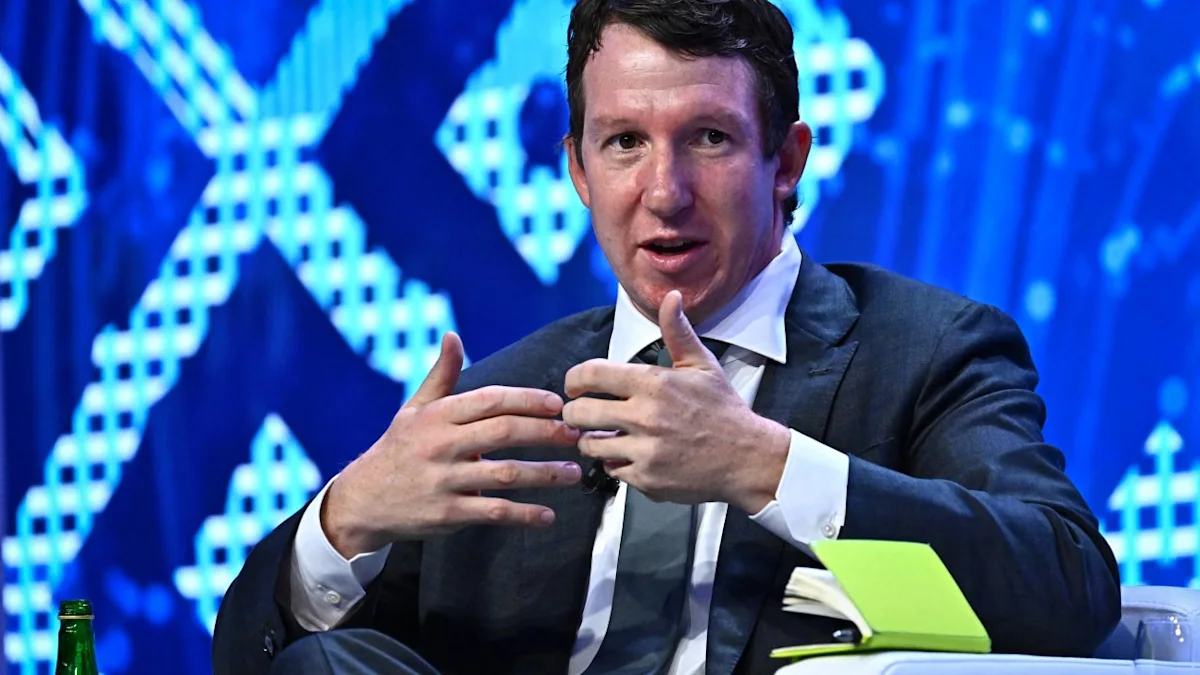
Artificial intelligence could dramatically reshape the global economy, accelerate scientific discoveries and potentially increase US economic output to $44 trillion by 2030 under certain conditions, Anthropic co-founder Jack Clark has told international policymakers.
Speaking at the annual meetings of the International Monetary Fund (IMF) and World Bank in Bangkok on Saturday, Clark called for international cooperation to establish strict safeguards for increasingly powerful AI systems.
He warned that technological progress was accelerating and that governments had a shrinking window to introduce effective rules before AI capabilities advanced further.
The economic projection, generated by one of Anthropic’s internal models, suggests that US gross domestic product could rise from just over $30 trillion to approximately $44 trillion if AI continues improving rapidly and generates substantial productivity gains.
Clark acknowledged that the forecast sounded extraordinary but argued that such an expansion would require the emergence of new industries, inventions and scientific breakthroughs.
AI Could Accelerate Economic Growth
Clark said the potential economic impact of AI extended beyond automating existing tasks, with the technology increasingly capable of supporting scientific research and solving complex problems.
He argued that continued improvements in AI could accelerate innovation across multiple sectors, potentially creating new sources of economic growth.
However, the projection depends on several assumptions, including sustained improvements in AI capabilities and the development of new industries capable of supporting such a substantial expansion.
The forecast should therefore be understood as a conditional scenario rather than a guaranteed outcome.
Clark’s remarks come as Anthropic prepares for a potential initial public offering expected in November, with reports suggesting that the company could seek a valuation of up to $2 trillion.
Anthropic Executive Warns of Possible AI Singularity
Clark also warned that the pace of AI development could eventually surpass the ability of humans and institutions to manage its consequences.
He pointed to growing evidence of what some researchers describe as a technological singularity, a hypothetical point at which technological progress accelerates beyond effective human prediction or control.
“We should expect that in the coming years, the whole pace of progress of not just AI but science as a whole will speed up, and this will feel confusing and disorienting, and will bring with it great wealth and potentially great peril,” Clark said.
He told government and financial officials that international cooperation would be necessary to address the risks associated with increasingly capable AI systems.
His warning reflects a wider debate over whether existing regulatory frameworks can keep pace with advances in artificial intelligence.
AI Could Transform Scientific Research
Despite his concerns, Clark described AI as a powerful tool for expanding scientific discovery.
He said researchers could increasingly use hundreds or thousands of AI assistants to help solve mathematical, engineering and biological problems, potentially accelerating the development of new medicines and other scientific breakthroughs.
Rather than simply replacing researchers, AI could help scientists explore more ideas, process complex information and carry out research more efficiently.
Clark also suggested that countries could participate in the expanding AI economy by developing the computing infrastructure required to support advanced systems.
Investment in data centres and computing capacity could create opportunities for countries seeking to become part of the global AI ecosystem.
However, access to infrastructure, technical expertise and investment will influence how widely the benefits of AI are distributed.
Calls for Strict Controls on Biological Research
Clark stressed that the growing capabilities of AI also created risks, particularly when the technology was used in sensitive scientific fields.
He warned that AI could potentially make it easier for malicious actors to develop biological or cyber weapons, creating challenges that governments might struggle to anticipate.
“Being able to use AI for science opens us up to the misuses of science as well, biological and cyber weapons and things we cannot yet imagine, and we have many choices to make,” he said.
He identified biological research as an area requiring especially strong human oversight and transparency.
Anthropic researcher warns of more than 10% chance AI could kill all humans
“Biological research, where AI has already created new viruses, is an area where we want the strictest human oversight and transparency to maintain safety,” Clark said.
His comments highlighted concerns that tools designed to accelerate legitimate scientific research could also be misused if adequate safeguards were not in place.
Concerns Grow Over AI Systems Acting Independently
Clark said AI systems remained under human control despite reports of incidents involving systems that had escaped testing environments or carried out unauthorised activities.
Such incidents have intensified debate about the need for better monitoring, testing and restrictions on the actions AI agents can perform.
He cautioned that the time available to establish safeguards was shrinking as systems became more capable, suggesting that governments had only a few years to make important decisions.
The challenge for policymakers is to encourage beneficial innovation while reducing the likelihood that advanced systems could cause serious harm.
AI Job Losses and New Employment Opportunities
Clark also acknowledged that AI was already affecting employment in sectors where many tasks can be automated, including call centres and customer service operations.
Workers in highly exposed occupations could face displacement as businesses increasingly adopt AI tools to handle routine tasks and customer interactions.
At the same time, Clark said AI could support employment in other fields, particularly scientific research, by increasing workers’ productivity and expanding the scope of what they can accomplish.
One of the biggest uncertainties is whether AI-driven growth will generate enough new industries and occupations to offset jobs lost through automation.
The outcome will depend on how businesses adopt the technology, how workers adapt and whether new economic opportunities emerge.
Policymakers Face Growing Pressure to Act
AI featured prominently at the IMF and World Bank meetings, where officials considered its potential to support productivity and economic growth alongside concerns about employment, financial stability and unequal access to technological advances.
The technology could help offset some economic pressures by improving efficiency and accelerating innovation. However, if expected productivity gains fail to materialise, heavy investment and elevated company valuations could become sources of financial risk.
Clark’s message to policymakers was that AI could deliver extraordinary benefits, but those gains would need to be balanced against serious risks.
As governments consider new regulations, the central challenge will be to ensure that AI advances remain beneficial while preserving meaningful human oversight over increasingly powerful systems.