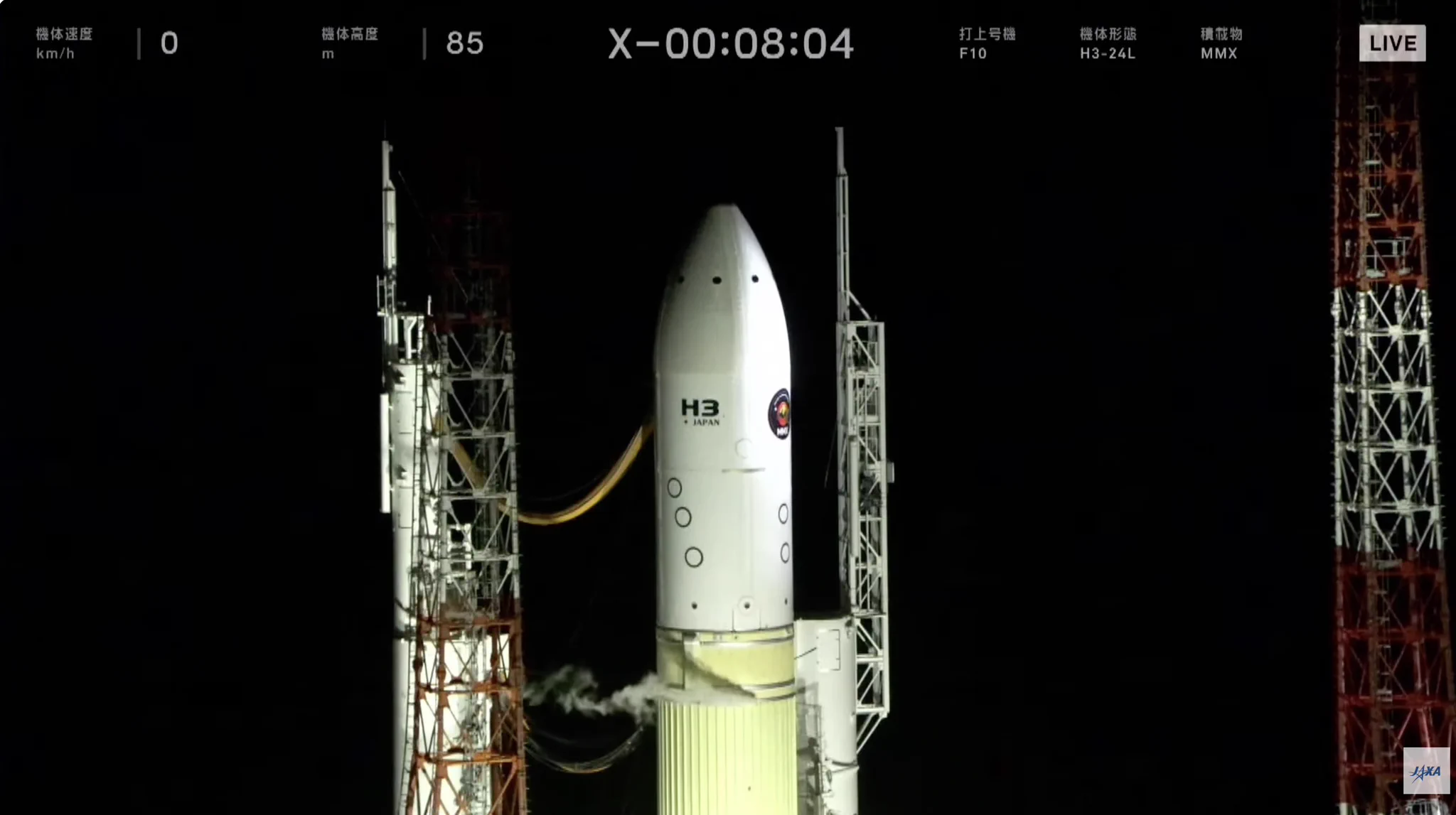
Japan has successfully launched a spacecraft on a historic mission to collect rock and sand samples from Phobos, one of Mars’ two moons, in what the country’s space agency says is the world’s first such sample-return mission to a Martian moon.
The Martian Moons eXploration (MMX) spacecraft successfully separated from an H3 rocket and entered its planned orbit, the Japan Aerospace Exploration Agency (JAXA) announced.
The rocket lifted off from the Tanegashima Space Centre in southwestern Japan at 4:41am local time on Tuesday, or 1941 GMT on Monday.
JAXA project manager Makoto Arita said the spacecraft reached its planned orbit with “exceptional precision.”
Spacecraft Heads for Phobos
The 4,480-kilogram MMX spacecraft will travel toward Phobos, the larger and closer of Mars’ two moons.
The probe is scheduled to enter Martian orbit in August 2027, after which it will begin its detailed exploration of the Martian system.
A French-German rover will be deployed to Phobos before the Japanese spacecraft makes two planned landings on the moon to collect samples from its surface.
The mission is designed to retrieve rocks and sand that could provide scientists with new clues about the origin and evolution of Mars and its moons.
Probe Will Also Study Deimos
After completing its work around Phobos, the MMX spacecraft will also observe Deimos, Mars’ smaller moon.
The probe is expected to leave Martian orbit in November 2030 and begin its journey back toward Earth.
The samples collected from Phobos are scheduled to arrive on Earth in July 2031, potentially giving researchers material that can be studied in laboratories using instruments unavailable on spacecraft.
SpaceX Rocket Crashes Into Moon, Leaving 60-Foot Crater, NASA Images Reveal
Mission Could Reveal How Mars’ Moons Formed
One of the main objectives of the international MMX mission is to determine how Phobos and Deimos formed.
Scientists have proposed different theories about the moons’ origins, including the possibility that they are remnants of material associated with Mars or captured objects from elsewhere in the Solar System.
By studying Phobos directly and bringing samples back to Earth, researchers hope to gain a better understanding of the moon’s composition and history.
The mission is also expected to test technologies that could support future exploration of Mars and other planetary bodies.
Launch Was Delayed After H3 Rocket Failure
The MMX launch was originally planned for 2024 but was delayed following the failure of the H3 rocket during its maiden flight in 2023.
The successful launch marks an important step for Japan’s ambitious planetary exploration programme and could make the MMX mission a major milestone in the study of Mars’ moons.
Japanese Prime Minister Sanae Takaichi welcomed the launch and expressed hope that the historic mission would successfully complete its journey.
If the mission proceeds as planned, the return of Phobos samples to Earth in 2031 could provide scientists with an unprecedented opportunity to study material from a Martian moon and shed new light on the early history of the Mars system.