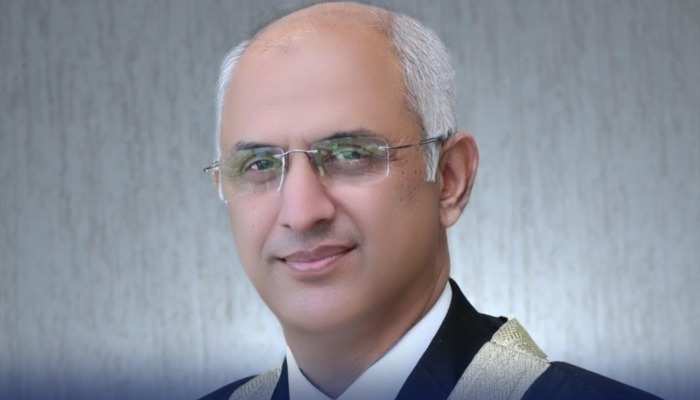
LAHORE: Lahore High Court (LHC) Justice Mohsin Akhtar Kayani tendered his resignation on Wednesday, submitting it to President Asif Ali Zardari. The judge was due to retire in 2032.
Justice Kayani was transferred from the Islamabad High Court (IHC) to the LHC in May this year and had been serving at the high court’s principal seat in Lahore. Under a recently issued judicial roster, he had been reassigned to the Rawalpindi bench.
Before his transfer, Justice Kayani ranked second in seniority at the IHC. At the LHC, he was placed 10th in the seniority order.
Known for Rulings on Human Rights and Enforced Disappearances
Justice Kayani was elevated to the Islamabad High Court bench in December 2015. During his judicial career, he presided over several high-profile cases involving fundamental rights, human rights violations and enforced disappearances.
His rulings on cases involving missing persons and allegations of unlawful detention brought him into the spotlight, particularly amid broader concerns about the protection of constitutional rights.
He was also a vocal critic of the 27th Constitutional Amendment, making remarks about the measure during its passage last year.
His resignation comes months after the Judicial Commission of Pakistan (JCP) approved the transfer of three Islamabad High Court judges to other high courts.
Judicial Commission Approved Transfers in April
In April 2026, the Judicial Commission of Pakistan approved Justice Kayani’s transfer to the Lahore High Court, Justice Babar Sattar’s transfer to the Peshawar High Court and Justice Saman Riffat Imtiaz’s transfer to the Sindh High Court.
The transfers followed constitutional changes that altered the process for relocating high court judges between provinces.
The development marked the first direct application of the relevant provisions of the 27th Amendment, which was approved in November 2025. Amendments to Article 200 removed the requirement for a judge’s consent before a transfer and empowered the relocation of high court judges between provinces on the recommendation of the Judicial Commission of Pakistan.
The transfers triggered debate over judicial independence, seniority and the constitutional framework governing appointments and transfers within the superior judiciary.
LHC Summons Punjab Home Secretary Over Continued Detention of Imran Khan’s Sisters
Judge Was Among Six IHC Judges Who Raised Concerns
Justice Kayani was among six Islamabad High Court judges who had written to the Supreme Judicial Council, seeking guidance on how to address alleged interference by intelligence agencies in judicial affairs.
The letter raised concerns about the independence of judges and allegations of external pressure on the judiciary.
Justice Babar Sattar and Justice Saman Riffat Imtiaz, who were also transferred to other high courts, were among the judges associated with the initiative.
The episode became part of a wider debate about judicial independence and the relationship between the judiciary and other state institutions.
Earlier Opposition to Justice Dogar’s Elevation
In February 2025, Justice Sardar Sarfraz Dogar was elevated from the Lahore High Court to become chief justice of the Islamabad High Court.
Justice Kayani and several other IHC judges had expressed reservations about the elevation, raising questions concerning seniority and the legitimacy of the appointment.
Five judges who had voiced concerns did not attend Justice Dogar’s oath-taking ceremony, despite receiving formal invitations. Justice Dogar nevertheless assumed office about a week after the appointment.
Justice Kayani’s resignation follows a period of significant changes within the superior judiciary, including judicial transfers and disputes over seniority and institutional independence. The reasons for his resignation were not specified in the supplied report.