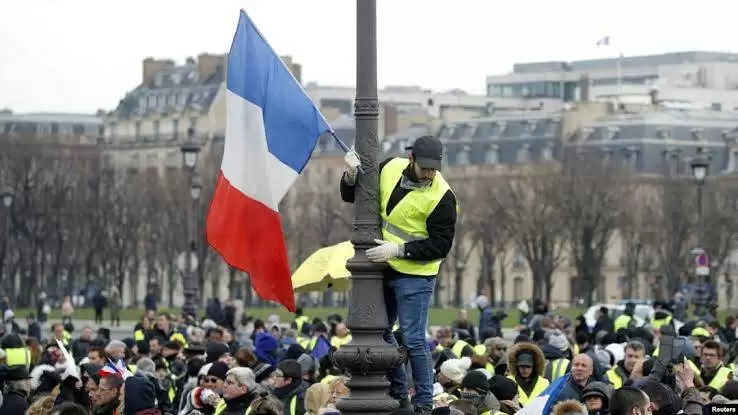
The demonstrations are scheduled for Saturday, following weeks of youth-led unrest and nationwide strikes that have brought hundreds of thousands of workers onto the streets.
The protests come less than six months before France elects a new president to replace centrist leader Emmanuel Macron, whose presidency is due to end in May 2027. The far right is currently leading in opinion polls.
Yellow Vests Defy Protest Ban
Student organisations and trade unions have called for an authorised march through central Paris under the slogan of opposing the rising cost of living and supporting young people.
However, the Yellow Vests movement has refused to join the demonstration, announcing plans for a separate rally at Place de la Concorde.
The location is near the French parliament’s lower house and the presidential palace. Authorities have banned demonstrations in the area, but Yellow Vests activists have insisted that their gathering should proceed.
Benjamin Ball, a member of the movement’s coordinating committee, said activists were calling for “mass disobedience”.
The Yellow Vests movement first gained widespread attention eight years ago through large grassroots demonstrations against Macron’s government over planned fuel tax increases.
70,000 Security Personnel Deployed
Interior Minister Laurent Nunez said 70,000 police officers and security personnel would be deployed nationwide to maintain order and prevent violence.
“If there are any rioters or looters… we’ll be ready and waiting for them,” he said.
Authorities are particularly concerned about a repeat of the violence witnessed during demonstrations on October 17, when France experienced some of its worst rioting in years.
Although most recent demonstrations have remained largely peaceful, clashes with police and incidents of vandalism have occurred on the sidelines.
On Thursday, hundreds of thousands of workers participated in strikes and demonstrations across France. Most gatherings remained orderly, but confrontations between protesters and police were reported in several cities.
The Interior Ministry said the demonstrations had generally gone well, despite 642 arrests.
Police Response Under Scrutiny
The security response has also attracted criticism, with allegations that police have used excessive force against demonstrators.
Dozens of internal investigations have reportedly been launched into claims of police brutality.
The treatment of journalists covering the unrest has raised additional concerns. Following several reported incidents involving AFP journalists, the international news agency called on authorities on Friday to ensure the safety of its reporters.
Press freedom organisation Reporters Without Borders (RSF) said it had documented 40 cases in which security personnel obstructed journalists covering the demonstrations. Of these, 21 involved physical violence.
France Deploys 70,000 Police as Protests Raise Fears of Fresh Unrest
Unions Demand Wage Increases
The protests have placed additional pressure on Macron’s government as it approaches the final months of his presidency.
Prime Minister Sebastien Lecornu is scheduled to meet representatives of trade unions and employers’ organisations on Monday to discuss wages and purchasing power.
An inter-union coalition said the demonstrations would continue until the government addressed demands raised by workers, public servants, young people and pensioners.
The unions are demanding an increase in the minimum wage, across-the-board salary raises, tax reforms and improved learning conditions for young people.
They also argue that the minimum wage has not received a discretionary increase since 2012.
Government Faces Economic Pressure
The government faces a difficult challenge in responding to the demands, as France’s economy remains under pressure to reduce public debt.
The country’s limited financial flexibility could make it difficult for the government to introduce measures that fully satisfy protesters.
With demonstrations continuing and the presidential election approaching, the unrest has become a major political and economic challenge for Macron’s administration.