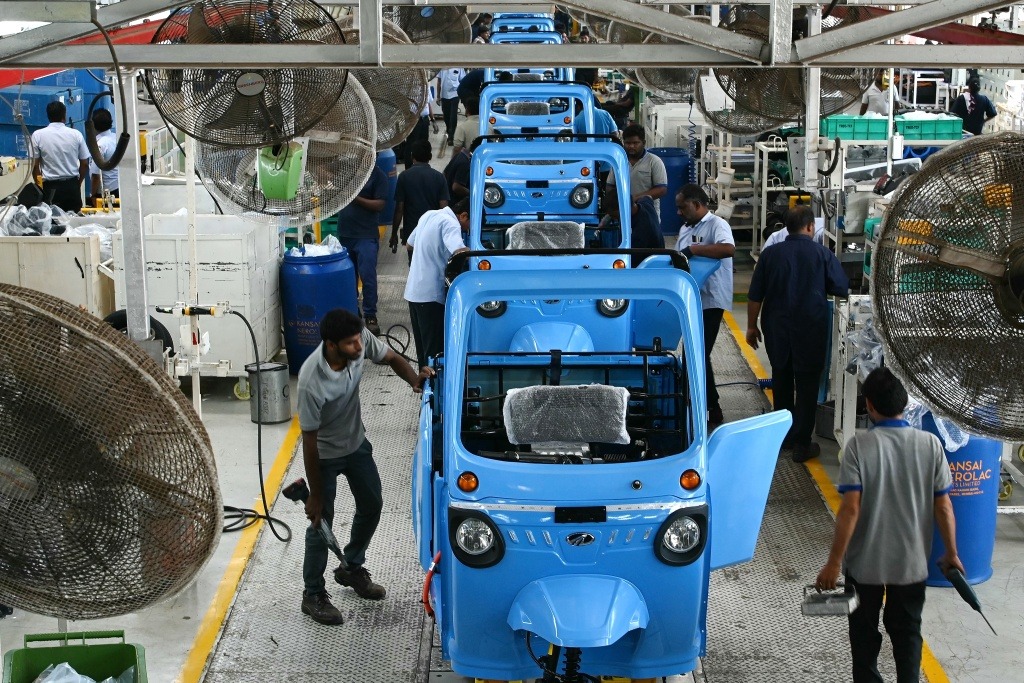
India’s electric three-wheeler industry is expanding rapidly, with a new vehicle rolling off production lines approximately every 90 seconds. The country has become the world’s largest market for electric auto rickshaws, as lower running costs, government support and improved vehicle technology accelerate the shift away from petrol and gas-powered transport.
At a busy manufacturing plant operated by Mahindra Last Mile Mobility, workers and automated machines assemble battery packs, attach body panels to metal frames and install wheels to meet growing demand.
The expansion reflects a major change in India’s transport sector. In September, more than half of all newly sold three-wheelers in the country were electric. By comparison, electric vehicles accounted for approximately 8.5% of new car sales and 11.6% of two-wheeler sales.
Rapid Market Growth
Mahindra Last Mile Mobility has emerged as one of the major players in India’s electric three-wheeler market.
Company chief executive Suman Mishra said its electric vehicle penetration had increased sixfold over the past five years.
According to Mishra, adoption has accelerated particularly during the last two years as government subsidies, better vehicle quality and lower operating expenses have encouraged drivers to switch to electric models.
Electric rickshaws first appeared on New Delhi’s streets more than a decade ago. Initially, many were assembled in small roadside workshops using Chinese-made batteries fitted to modified pedal-powered vehicles.
The industry has since developed into a major manufacturing sector, with established automakers entering the market and challenging traditional fuel-powered three-wheelers.
Lower Costs Attract Drivers
For many drivers, financial savings rather than environmental concerns are the biggest reason for switching to electric vehicles.
Afroz Alam, a 31-year-old driver in Hyderabad, replaced his gas-powered rickshaw with an electric model this year.
He said charging the vehicle saves him several hundred rupees daily, helping him repay the loan taken to purchase the more expensive electric version.
Although electric rickshaws generally require a higher initial investment, their lower running costs can offset the difference over time.
Research by Indian think tank the Council on Energy, Environment and Water (CEEW) estimated in 2025 that petrol-powered three-wheelers cost more than twice as much per kilometre to operate over their lifetime compared with electric alternatives.
Bidisha Bhattacharya of the Delhi-based Chintan Research Foundation said rickshaw drivers benefit considerably because their vehicles remain in operation for long hours every day, allowing them to accumulate fuel savings quickly.
Changing India’s Cities
The growing popularity of electric rickshaws is transforming the appearance and sound of Indian cities.
Across northern India, electric vehicles are increasingly visible outside railway stations, shopping areas and crowded markets, replacing many traditional three-wheelers powered by petrol or gas.
The transition has also attracted government attention because India imports a large share of its oil and natural gas requirements.
Reducing dependence on imported fuel has become an important economic priority, particularly amid higher energy costs following the outbreak of conflict in the Middle East in February.
Climate think tank Ember has also highlighted India’s progress, saying the country consumes less transport fuel per person than China did at a comparable income level in 2012.
The organisation attributed this development partly to the expansion of affordable solar power and declining battery costs.
Charging Infrastructure Challenges
Despite the rapid expansion, electric vehicle adoption remains uneven across India.
Electric rickshaws are widely used in cities such as Lucknow but are less common in Mumbai, where limited parking space and inadequate charging infrastructure create difficulties for owners.
Mishra said the lack of dedicated parking and charging facilities was a major obstacle in Mumbai.
She pointed out that drivers could park conventional fuel-powered vehicles along roadsides, but electric vehicles require access to charging facilities, making the situation more complicated.
Saudi Arabia unveils futuristic first homegrown electric cars
Supply Chain Concerns
India’s electric vehicle industry also faces challenges related to imported components and battery manufacturing.
Last year, China restricted exports of rare-earth magnets, which are essential for electric motors. The restrictions forced several Indian automakers to reduce or temporarily suspend production.
In response, the Indian government has been encouraging domestic manufacturing, particularly of battery cells.
However, most battery cells used by Indian manufacturers are still imported from China and South Korea.
Mishra said two companies were close to beginning commercial battery cell production in India, although the industry would need time to establish local manufacturing capabilities.
Can Cars Follow Rickshaws?
The success of electric three-wheelers has raised questions about whether the same transition can be achieved in private cars and heavy vehicles.
Analysts believe commercial transport fleets could play an important role in the next phase of India’s electric vehicle expansion.
Bhattacharya said switching taxi fleets to electric vehicles could help expand charging networks and build public confidence in the technology.
For drivers who have already made the transition, however, the financial benefits are the strongest argument.
Mohammad Ali, a 26-year-old electric rickshaw owner, dismissed concerns about battery performance and encouraged sceptics to try an electric vehicle for themselves.
He said drivers could better understand the potential savings by using an electric rickshaw for a full day rather than relying on assumptions about its performance.
As manufacturers increase production and technology improves, electric three-wheelers are becoming an increasingly important part of India’s transport system.