The Philippines and Australia have signed a new defence cooperation agreement aimed at strengthening military ties and improving their ability to respond to security threats in the Indo-Pacific region, particularly amid continuing tensions with China in the South China Sea.
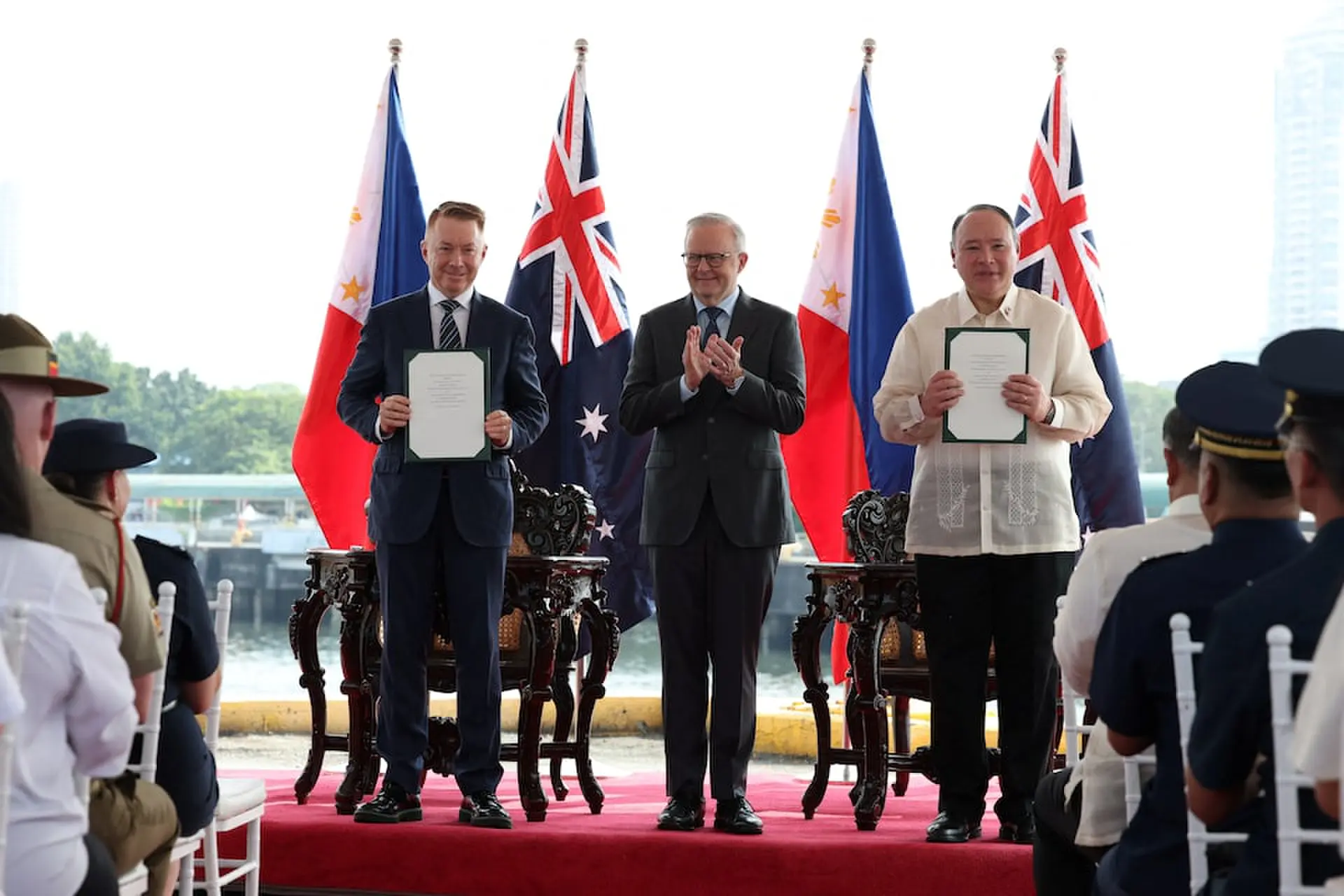
The agreement was signed in Manila on Sunday, November 15, 2026, with Australian Prime Minister Anthony Albanese witnessing the ceremony alongside Philippine Defence Secretary Gilberto Teodoro. The arrangement is designed to simplify military coordination, expand joint operations and strengthen regional security cooperation.
New Defence Agreement to Simplify Military Cooperation
The agreement will streamline the implementation of the Status of Visiting Forces Agreement (SOVFA), which provides a framework for military personnel from both countries to conduct activities on each other’s territory.
Teodoro said the new arrangement would significantly reduce administrative procedures required to organise joint military activities.
“Rather than 100 steps to do a single thing, it will just now take 10,” he told reporters, describing the agreement as an anti-red-tape measure.
The simplified procedures are expected to make it easier for the two countries to organise military exercises, coordinate operations and strengthen cooperation between their armed forces.
The agreement will cover maritime, air and land operations, as well as humanitarian assistance and disaster response activities.
South China Sea Tensions Drive Closer Security Ties
The defence agreement comes as the Philippines continues to face tensions with China over competing territorial and maritime claims in the South China Sea.
The Philippines has increasingly strengthened its security partnerships with regional allies to improve its defence capabilities and respond to what Manila describes as China’s increasingly assertive activities in disputed waters.
Australia has consistently supported the Philippines’ position on the strategic waterway and has expanded defence cooperation with Manila in recent years.
Teodoro said the new arrangement would strengthen the Philippines’ credible deterrence capabilities, particularly in areas where the country has maritime jurisdiction.
China claims sovereignty over large parts of the South China Sea, including waters and features also claimed by several Southeast Asian countries.
The dispute has become a major source of regional tension, particularly around strategically important reefs and maritime areas.
Australia Announces Additional Maritime Security Support
Australian Prime Minister Anthony Albanese said the agreement would improve maritime awareness and information sharing between the two countries.
He also highlighted opportunities to expand strategic dialogue, military training, operational coordination and defence infrastructure development.
Australia announced additional investment in the Philippines’ maritime domain awareness capabilities, including drone technology, equipment and specialised training.
The support is intended to help the Philippines improve its ability to monitor maritime activities and identify potential security threats, including those involving cybersecurity.
Improved surveillance capabilities are particularly important for the Philippines, an archipelago consisting of thousands of islands with extensive maritime boundaries.
Australian PM Urges US to De-escalate Iran War After Midterm Election Losses
2016 International Ruling Remains Central to Maritime Dispute
Australia has repeatedly supported the Philippines’ position on the South China Sea, including the 2016 ruling by an international arbitral tribunal in The Hague.
The tribunal rejected the legal basis of China’s expansive claims under its so-called nine-dash line, finding that they were incompatible with certain rights under the United Nations Convention on the Law of the Sea.
China rejected the ruling and maintains that its activities in the disputed waters are lawful.
Beijing has also criticised joint military exercises involving the Philippines and its security partners, arguing that such activities increase regional tensions.
China’s defence and foreign ministries had not immediately responded to requests for comment on the latest agreement, according to Reuters.
Philippines Expands Defence Partnerships
The agreement reflects Manila’s broader efforts to strengthen its international security partnerships while maintaining its longstanding military alliance with the United States.
The Philippines and Australia have increased joint maritime patrols, military exercises and defence coordination as tensions in the South China Sea have continued.
Their latest arrangement is expected to make practical military cooperation easier and provide additional opportunities for both countries to work together on regional security challenges.
The development also highlights Australia’s growing involvement in Indo-Pacific security at a time when competition between China and Western-aligned countries is shaping regional defence policies.
As maritime disputes continue, the Philippines and Australia are seeking to strengthen their military coordination, improve surveillance capabilities and reinforce their ability to protect their respective interests in the region.
Source: Reuters, reporting from Manila, November 15, 2026.