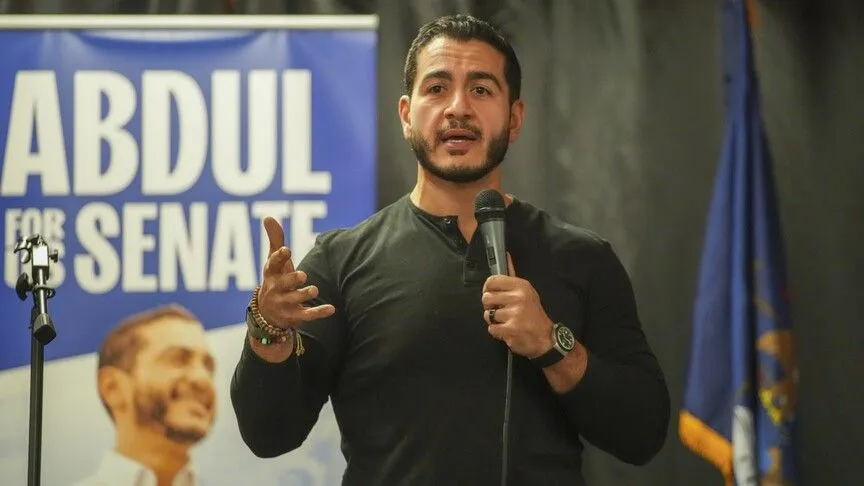
Democrat Abdul El-Sayed has made history by winning Michigan’s closely contested US Senate race against former Republican Representative Mike Rogers, according to US media projections.
A medical doctor and former public health official, El-Sayed secured the seat being vacated by retiring Democratic Senator Gary Peters. He will become the first Muslim to serve in the US Senate when the new Congress convenes in January.
His victory comes after a contentious campaign in which his Muslim faith and political views became major issues, with President Donald Trump and other Republican figures repeatedly targeting him over his religious background.
El-Sayed rejected allegations linking him to extremism and argued that the attacks were intended to distract voters from economic challenges and the rising cost of living.
Emotional Victory Speech
El-Sayed celebrated his projected victory early Wednesday, thanking Michigan voters and promising to bring determination, openness and compassion to the Senate.
“Michigan, I cannot wait to serve you with the same big-heartedness, open-mindedness, grit, and earnestness that you’ve shown me,” he told supporters at his election-night gathering.
He described the result as a collective victory and urged supporters to view it as a rejection of his political opponents.
“Let them know tomorrow that the bad guys lost,” he said. “Let them know that we together, fighting for something bigger, we won. We won! So Mike, enjoy your retirement.”
The newly elected senator also directed a remark at Vice President JD Vance, referring to the constitutional process through which senators are sworn into office.
“There is this delicious irony in the fact that you’re constitutionally obligated to swear me in in January,” El-Sayed said.
He also responded to Trump, who had repeatedly struggled to pronounce his name during campaign appearances.
“Donald, look, I know you struggled with my name,” El-Sayed said. “So after JD swears me in in January, you can just go on and call me senator.”
Early Life and Education
Born in Rochester Hills, Michigan, to Egyptian immigrant parents, El-Sayed pursued a career in medicine and public health before entering electoral politics.
He graduated from the University of Michigan in 2007 and earned a doctorate in public health from the University of Oxford in 2011 as a Rhodes Scholar. He later received his medical degree from Columbia University in 2014.
In 2015, he became health director for Detroit, where he oversaw efforts to rebuild the city’s public health services following its financial crisis. He held the position until 2017.
El-Sayed entered the 2018 Michigan gubernatorial race but lost the Democratic primary to Gretchen Whitmer.
From 2023 to 2025, he served as director of the Wayne County Department of Health, Human and Veterans Services, an agency covering Detroit and surrounding communities.
Trump approval remains at record-low 32% as Democrats lead ahead of midterms
Political Rise and Senate Campaign
El-Sayed returned to electoral politics in 2026 and defeated Representative Haley Stevens in Michigan’s Democratic Senate primary in August.
His campaign received support from prominent progressive politicians, including Senator Bernie Sanders, Representative Alexandria Ocasio-Cortez and Michigan Representative Rashida Tlaib.
His policy agenda included expanding healthcare access through Medicare for All, reducing housing costs, limiting the influence of wealthy donors in politics and improving economic opportunities for working families.
On foreign policy, El-Sayed strongly criticised US military support for Israel. He described Israel’s military campaign in Gaza as genocide and called for an end to unconditional American military assistance.
These positions became a major source of controversy during the campaign.
Stevens, whom El-Sayed defeated in the Democratic primary, broke with her party shortly before the general election and endorsed Rogers. She cited concerns about El-Sayed’s campaign rhetoric and political associations.
Her decision sparked criticism from fellow Democrats but did not prevent El-Sayed from securing the projected victory.
Muslim Identity and Historic Achievement
El-Sayed’s religious identity remained a prominent issue throughout the Senate race, with Trump and other Republican figures repeatedly criticising him over his faith and political positions.
The Democrat rejected the attacks, arguing that his name and religion were being used to divert attention from economic problems facing American households.
His election represents a historic milestone for Muslim Americans in US politics. Although no Muslim had previously served in the Senate, Muslim Americans have held seats in the House of Representatives.
Keith Ellison became the first Muslim elected to Congress in 2006. In 2018, Rashida Tlaib and Ilhan Omar made history as the first Muslim women elected to the House.
El-Sayed’s victory now adds another milestone to that political history, making him the first Muslim elected to the upper chamber of the US Congress.