Scientists have warned that Antarctica’s rapidly melting ice may release large amounts of toxic mercury trapped for thousands of years, potentially contaminating marine ecosystems and threatening food chains across the globe.
A recent study by researchers at the University of Washington, published in the Proceedings of the National Academy of Sciences (PNAS), suggests that rising global temperatures are accelerating the release of mercury from the Antarctic Peninsula—one of the fastest-warming regions on Earth.
Antarctica’s ice has acted as a natural storage system
For centuries, Antarctica’s vast ice sheet has served as a frozen reservoir for pollutants carried by wind and ocean currents from around the world.
Among these pollutants is mercury, a highly toxic heavy metal that has remained trapped beneath layers of snow and ice. As glaciers melt due to climate change, scientists fear this mercury will be released into the atmosphere, surrounding land, and eventually the Southern Ocean.
Researchers describe this process as a “mercury loop,” in which mercury continuously circulates between the atmosphere, glaciers, land, and oceans.
Why mercury is especially dangerous
Unlike many pollutants that gradually break down over time, mercury remains in the environment for decades and accumulates inside living organisms.
This process, known as bioaccumulation, causes mercury concentrations to increase as it moves up the food chain.
Large predators typically contain the highest mercury levels because they consume many smaller organisms throughout their lives.
Threat to Antarctic wildlife
The Southern Ocean food web begins with krill, tiny crustaceans that are a primary food source for:
- Penguins
- Seals
- Whales
- Seabirds
- Many fish species
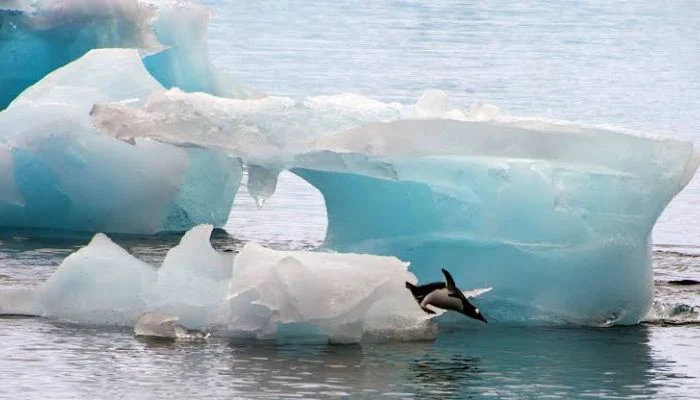
As krill absorb mercury, the toxin passes to larger animals that feed on them. Scientists have already detected measurable mercury levels in Antarctic wildlife, including Adélie penguins and other seabirds.
Researchers have monitored mercury contamination in penguin feathers for years because the birds serve as reliable indicators of environmental pollution.
Scientists warn that additional mercury released from melting glaciers could significantly increase contamination throughout the Antarctic ecosystem.
Warming creates a dangerous feedback loop
Researchers say similar processes are occurring in both Antarctica and the Arctic.
As rising temperatures melt glaciers and thaw frozen ground, more long-trapped pollutants are released into the environment. This creates a feedback loop in which continued warming leads to greater pollution, further threatening fragile ecosystems.
Because cold environments slow the natural breakdown of contaminants, mercury released in Antarctica may remain active for a long time.
Global consequences beyond Antarctica
Scientists caution that the effects will not remain limited to Antarctica.
Migratory seabirds can transport mercury between continents, while ocean currents can carry dissolved pollutants far beyond the Southern Ocean.
As a result, mercury released from Antarctica could eventually affect marine ecosystems in other parts of the world.
Study highlights growing climate risks
Researchers say Antarctica has functioned as one of Earth’s largest natural storage systems for hazardous pollutants for thousands of years.
As climate change accelerates ice loss, that frozen storage is beginning to release contaminants back into the environment, raising concerns about long-term impacts on marine biodiversity, global food chains, and ecosystem health.