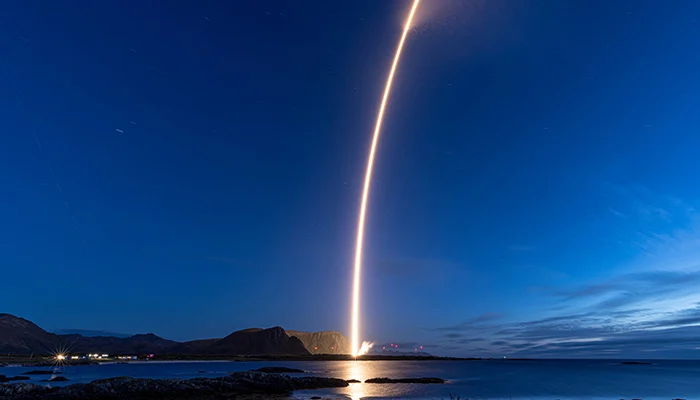
German startup Isar Aerospace has successfully sent its Spectrum rocket into orbit from Arctic Norway, marking a major milestone for Europe’s growing commercial space industry.
The uncrewed rocket lifted off from the Andøya Spaceport and became the first commercial rocket to reach orbit from continental Europe, according to the company.
The achievement comes as European countries seek greater independence in space amid growing demand for satellite launches and shifting global geopolitical alliances.
Isar Aerospace rocket reaches orbit
Isar Aerospace said it plans to rapidly expand satellite deployments following the successful launch.
The Spectrum rocket carried five small satellites as well as an in-flight technology experiment. It is designed to serve the expanding market for small and medium-sized satellite payloads.
Isar co-founder and CEO Daniel Metzler described launch capability as one of the biggest bottlenecks facing the space industry.
The company said it remains well funded and that an initial public offering is not currently being considered.
Germany hails historic space launch
German Chancellor Friedrich Merz welcomed the successful launch, describing it as the beginning of a new era.
Merz had visited Isar’s launch site in March, highlighting Germany’s interest in strengthening Europe’s independent space capabilities.
The successful mission also reflects broader European efforts to reduce reliance on non-European launch providers and establish greater autonomy in accessing space.
Second launch succeeds after previous failure
The latest mission was Isar Aerospace’s second launch attempt.
The company’s first Spectrum rocket lifted off from the same Norwegian site about 18 months earlier but plunged into the sea and exploded shortly after takeoff. No one was injured in the incident.
Saturday’s mission was designed to serve both as a qualification flight and as the rocket’s first mission carrying payloads.
Isar said it already has five additional rockets in production as it prepares to increase its launch frequency.
Isar targets 40 launches a year
The German company has set an ambitious long-term target of conducting around 40 launches annually as it scales up its operations.
Isar is also developing another launch site in Nova Scotia, Canada. The company said the facility could be ready for launches in 2028.
The expansion reflects the growing global competition in the commercial satellite-launch market, where companies are racing to provide reliable and frequent access to orbit.
NASA Astronaut Butch Wilmore Feared He Might Die During Starliner Failure
Europe seeks greater space independence
Norwegian Industry and Commerce Minister Cecilie Myrseth said the successful launch strengthens Norwegian and European security during what she described as turbulent times.
EU Defence and Space Commissioner Andrius Kubilius also welcomed the mission, saying Europe’s independent access to space had received a major boost.
Other European countries are developing their own launch capabilities. Sweden is working from its Esrange Space Center, while Britain is developing launch operations at SaxaVord Spaceport in Scotland’s Shetland Islands.
SpaceX and ArianeGroup lead global market
The commercial launch sector is dominated by major international players including Elon Musk’s SpaceX in the United States and France’s ArianeGroup, a joint venture between Airbus and Safran.
ArianeGroup operates launches from the European spaceport in French Guiana.
The rapid growth of satellite-based services has increased demand for launch capacity, making independent European access to orbit an increasingly important strategic and commercial goal.
Isar secures €200 million for expansion
Isar Aerospace said last week that it had secured around €200 million ($232 million) from the European Space Agency.
The funding will support the development of new rockets as well as the expansion of the company’s testing and launch infrastructure.
With its latest orbital success, Isar now faces the next challenge: turning a historic breakthrough into a reliable, high-frequency commercial launch operation.