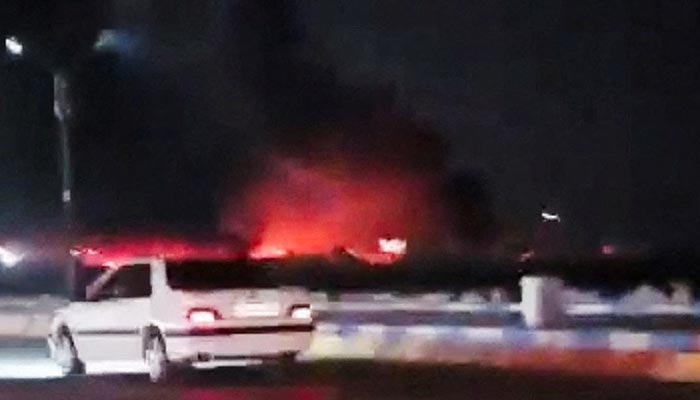
A new round of military confrontation erupted in the Gulf on Wednesday after Iran’s Revolutionary Guards (IRGC) said they launched missile and drone attacks on US military sites in Bahrain and Kuwait, hours after the United States carried out fresh strikes on Iranian military targets.
The latest escalation has further strained the already fragile ceasefire between Washington and Tehran, while increasing concerns over the security of the Strait of Hormuz, one of the world’s most important energy shipping routes.
Iran Claims Attacks on US Military Bases
According to the IRGC, the operation targeted key US military facilities, including Bahrain’s Fifth Naval District and Ali Al Salem Air Base in Kuwait.
The Guards also claimed to have shot down a US MQ-9 Reaper drone that was allegedly attempting to interfere with the operation.
Following the reported attacks, air raid sirens sounded in Bahrain and Kuwait. The Kuwaiti military said its air defence systems were responding to what it described as “hostile” missile and drone attacks.
The US military had not immediately commented on Iran’s claims.
US Says Strikes Were Response to Tanker Attacks
Earlier on Wednesday, the US Central Command (CENTCOM) announced that it had launched a series of military strikes against Iranian targets following attacks on commercial vessels in the Strait of Hormuz.
According to CENTCOM, the operation targeted more than 60 small boats belonging to the Islamic Revolutionary Guard Corps, along with Iranian air defence systems, coastal surveillance equipment, anti-ship cruise missile sites, surface-to-air missile systems, and drone launch facilities.
The United States said the strikes were intended to impose a significant cost on Iran after attacks on commercial shipping, which Washington described as a violation of the ceasefire agreement.
At the same time, US authorities also revoked a licence that had allowed Iran to continue limited oil sales.
Iran Condemns US Action
Iranian officials strongly condemned the American strikes, calling them a serious breach of the ceasefire framework.
The Khatam al-Anbiya Central Headquarters, Iran’s top military command, described the attacks as a “blatant act of aggression” and warned that Tehran would deliver a “crushing response.”
Parliament Speaker Mohammad Baqer Ghalibaf also criticised Washington, accusing it of violating the ceasefire through military action, renewed oil sanctions, and what he described as interference in the Strait of Hormuz.
In a statement posted on social media, Ghalibaf declared that “the era of bullying and extortion is over” and insisted that Iran would not back down under pressure.
Iran’s Foreign Ministry also stated that the country would take any measures it considered necessary to safeguard its national security and strategic interests.
Explosions Reported Across Southern Iran
Iranian media reported explosions in several locations, including Kharg Island, Qeshm Island, Bandar Abbas, and Sirik.
State television reported that several people were injured after shrapnel struck a commercial pier in Sirik. Authorities said no civilian deaths had been reported.
A US official told Reuters that the strikes focused on military infrastructure rather than civilian targets.
Kharg Island, which handles a significant share of Iran’s crude oil exports, was also reported to have experienced explosions, although CENTCOM did not specifically mention it among the targets.
Regional and International Reactions
NATO Secretary General Mark Rutte expressed support for the latest US military action, saying Washington’s response was necessary if Iran had violated the ceasefire.
Meanwhile, Qatar accused Iran of attacking commercial vessels, including a Qatari liquefied natural gas tanker that reportedly caught fire after being struck by a drone. Iranian officials rejected the accusations, describing them as confusing and insisting that Tehran remained committed to its obligations.
Maritime security sources also reported damage to a Saudi-flagged crude oil tanker near Oman, although the exact cause has not yet been confirmed.
Ceasefire Under Growing Pressure
The latest exchange of attacks has placed the ceasefire agreed last month under severe strain.
The temporary truce was intended to create a 60-day window for indirect negotiations aimed at reaching a broader agreement between the United States and Iran. However, talks held in Qatar ended without any significant breakthrough.
US President Donald Trump has repeatedly warned that military action could resume if negotiations fail, while Iranian Foreign Minister Abbas Araghchi has said meaningful talks cannot proceed under continued threats.
With both sides exchanging military strikes and diplomatic rhetoric becoming increasingly confrontational, concerns are growing that the conflict could once again expand across the wider Middle East, further threatening regional stability and global energy supplies.