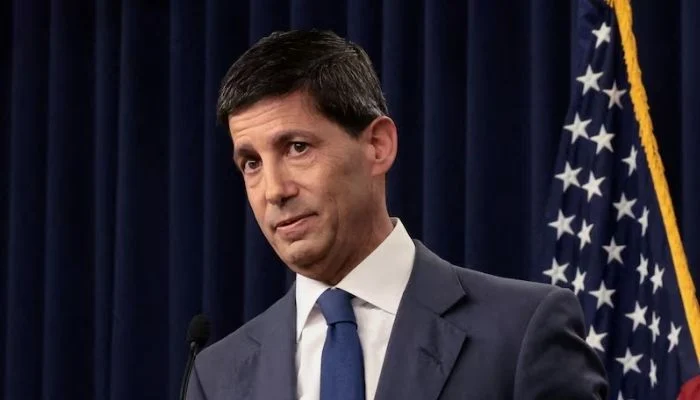
In his first major address at Jackson Hole, Federal Reserve Chairman Kevin Warsh signalled that persistent inflation could force the US central bank to consider further interest rate increases.
US Federal Reserve Chairman Kevin Warsh used his first major speech at the Jackson Hole economic symposium to deliver a clear message to financial markets: the Federal Reserve remains concerned about inflation, and another interest rate increase could still be considered if price pressures fail to ease sufficiently.
Although Warsh did not announce a rate hike for September, his comments suggested that the Federal Reserve is not yet convinced inflation is moving quickly enough towards its long-term target of 2%.
Inflation Remains the Fed’s Biggest Concern
The Fed’s preferred inflation measure, the Personal Consumption Expenditures (PCE) price index, rose 3.7% in the 12 months through July, remaining well above the central bank’s 2% target.
Warsh acknowledged that some recent inflation figures had been better than expected. However, he said the underlying trend had not yet shown sufficient improvement.
He also highlighted that 54% of goods and services included in the PCE basket recorded price increases of more than 3% over the past year. Although this represents a significant improvement compared with the sharp inflation surge that followed the pandemic, the figure remains above pre-pandemic levels.
Warsh said the Federal Reserve needed to see inflation moving towards 2% “clearly and at sufficient speed.” Otherwise, he warned, the central bank may still have work to do.
Could Interest Rates Rise Again?
Warsh avoided giving a firm indication about the timing of any future interest rate decision. Nevertheless, his remarks increased expectations that another rate hike could be considered at the Federal Reserve’s next policy meeting on September 15-16.
Before his speech, financial markets had placed the probability of a September rate increase at around 35%. That expectation reportedly rose to nearly 60% after his remarks.
Warsh’s argument is that the current state of the US economy does not yet provide a clear reason for lower interest rates. He said economic activity appears to have strengthened, business investment is increasing and the labour market remains relatively stable.
US Economy Shows Resilience
The Fed chairman said he was impressed by the overall performance of the US economy.
According to figures cited in his speech, equipment and intangible investment has grown at an annual pace of around 9% over four quarters, while profits at S&P 500 companies have increased by more than 20% over the past year.
More than half of this year’s growth in capital expenditure may be linked to investment in artificial intelligence, highlighting the increasing importance of AI in the American economy.
Meanwhile, the unemployment rate stands at 4.1%, which Warsh described as broadly consistent with full employment. As a result, inflation — rather than a weak labour market — remains the Federal Reserve’s main concern.
Bitcoin Surges Above $80,000 as Dollar Weakness Fuels Momentum
AI Could Reshape the US Economy
Artificial intelligence formed another major part of Warsh’s speech.
He said AI could eventually lead to significant gains in productivity and economic growth, particularly as companies continue investing heavily in AI infrastructure.
However, Warsh also acknowledged that there remains considerable uncertainty about how AI will affect employment, workers and long-term productivity.
One key question, he said, is whether AI will primarily support workers or eventually replace certain jobs. To study these issues, the Federal Reserve has established a task force focused on productivity and employment.
A “Quieter” Federal Reserve
Warsh also signalled a possible change in how the Federal Reserve communicates with financial markets.
He criticised the heavy use of “forward guidance”, under which central banks provide detailed signals about the likely future direction of interest rates.
According to Warsh, such guidance can sometimes encourage investors to focus excessively on predicting the Fed’s next move instead of analysing broader economic conditions.
He said the central bank should rely more on current and reliable data, as well as market signals such as Treasury yields, the US dollar and credit conditions.
Warsh also reaffirmed the Fed’s commitment to its 2% inflation target and said interest rates should remain the central bank’s main policy tool.
What Does It Mean for Americans?
For ordinary Americans, the most immediate impact could be on borrowing costs.
If inflation remains high and the Federal Reserve raises rates again, mortgages, credit cards, business loans and other forms of borrowing could become more expensive.
At the same time, the Fed must avoid tightening monetary policy too aggressively, as higher rates could eventually weaken the labour market and slow economic growth.
For now, Warsh’s message is clear: lower interest rates are not guaranteed. The next major test will come with new economic data ahead of the Federal Reserve’s September 15-16 meeting.