Sharks are generally associated with fear and danger in popular culture, but scientists are exploring a very different role for the marine predators: collecting data that could improve hurricane forecasts.
Researchers at the University of Delaware are testing whether sharks can act as mobile, near-real-time ocean observers by carrying small electronic sensors that record important conditions beneath the ocean surface.
The devices, known as CTD tags, measure water temperature, depth and electrical conductivity, which is closely related to salinity. As the sharks swim and dive, the sensors gather information from different parts of the water column.
Scientists hope these measurements can eventually be incorporated into oceanographic, atmospheric and climate models.
Why Sharks Could Help Predict Hurricanes
According to researchers, one of the most important measurements for understanding hurricane strength is the amount of heat stored in the upper layer of the ocean.
Aaron Carlisle, a professor at the University of Delaware’s School of Marine Science and Policy, said researchers are particularly interested in the mixed layer, the upper part of the ocean where water is relatively well mixed.
Warmer ocean water can provide additional energy to tropical systems, potentially contributing to stronger hurricanes. Therefore, having more accurate information about ocean temperatures could help scientists better understand how storms may intensify as they approach land.
Carlisle said animal-borne sensors have already been successfully used by oceanographers, including on elephant seals in remote polar regions where conventional observations can be difficult to obtain.
Sharks could provide another source of information because many species are widely distributed and move through areas where researchers need more ocean observations.
Which Sharks Are Being Studied?
The researchers are not tagging sharks randomly. They are looking for species whose movements and behaviour make them useful for collecting hurricane-related data.
Previous research has identified shortfin mako sharks, blue sharks, smooth hammerheads and juvenile great white sharks as promising candidates in the North Atlantic.
An important factor is how frequently a shark comes close enough to the ocean surface for its tag to communicate with satellites.
When the animal swims near the surface, the sensor can transmit the information it has collected to an orbiting satellite network.
Until now, shark-tagging programmes have generally focused on tracking where sharks travel and understanding their preferred habitats. The Delaware project seeks to expand that use by turning the animals into moving sources of environmental data.
How the Sharks Are Tagged
The research process begins in early May, when highly migratory shark species move closer to the US coast after spending winter farther offshore in the Atlantic.
Researchers travel approximately 30 to 40 miles (50 to 65 kilometres) offshore aboard a research vessel. They deploy baited lines and typically wait two to three hours for a shark to take the bait.
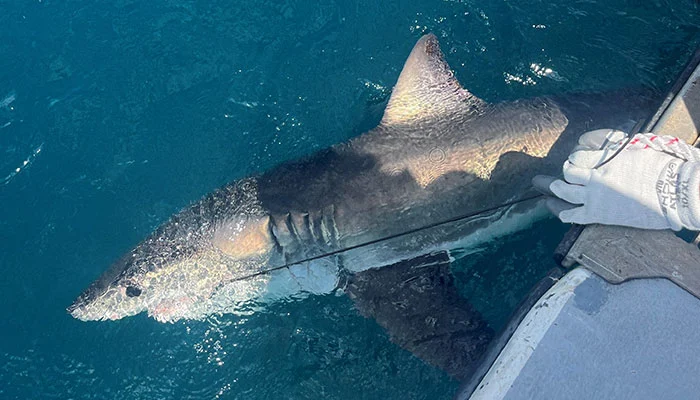
Once a suitable shark is caught, researchers work quickly to attach the sensor to its dorsal fin.
The procedure usually takes less than five minutes and is conducted under institutional animal-care oversight to minimise stress and potential harm to the animal.
The tags are attached using materials designed to gradually corrode, allowing them to eventually detach from the shark.
Before the animal is released, researchers also conduct a health assessment to make sure it is fit to return to the ocean.
NASA Unveils New Space Telescope to Explore Dark Energy and Distant Worlds
Researchers Describe Process as a ‘Pit Crew’
Carlisle compared the tagging operation to a pit crew during an auto race, highlighting how quickly the researchers need to work.
The goal is not only to protect the shark but also to ensure that the animal’s behaviour remains as natural as possible.
A stressed or injured shark could behave differently from normal, potentially affecting the quality of the scientific data.
Doctoral researcher Caroline Wiernicki also pointed out that the reality of working with sharks is far less dramatic than their portrayal in movies such as Jaws and the Sharknado series.
Rather than being the terrifying predators often shown on screen, the sharks involved in the project are effectively carrying out a scientific assignment as they move through the ocean.
Potential Benefits for Coastal Communities
If the project proves successful, shark-collected data could provide scientists with additional information about ocean conditions before hurricanes reach the US coastline.
Better observations of ocean temperature and heat content could ultimately contribute to improved predictions of hurricane intensity, giving forecasters a clearer picture of how storms may develop as they move toward land.
That could be particularly useful for coastal communities stretching from North Carolina to Massachusetts, where better information could help authorities and residents prepare for potentially severe storms.
The project also highlights how marine animals can contribute to scientific research in ways that go beyond traditional wildlife studies.
Carlisle said sharks are highly adapted to their marine environment and could teach scientists a great deal about the ocean.
If researchers can demonstrate that these animals can provide reliable environmental observations while being handled safely, the project could offer a rare win-win situation for both science and shark conservation.