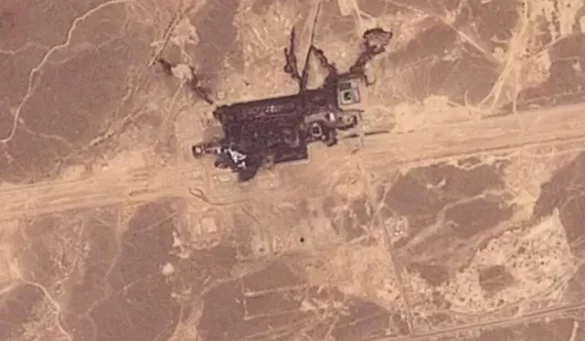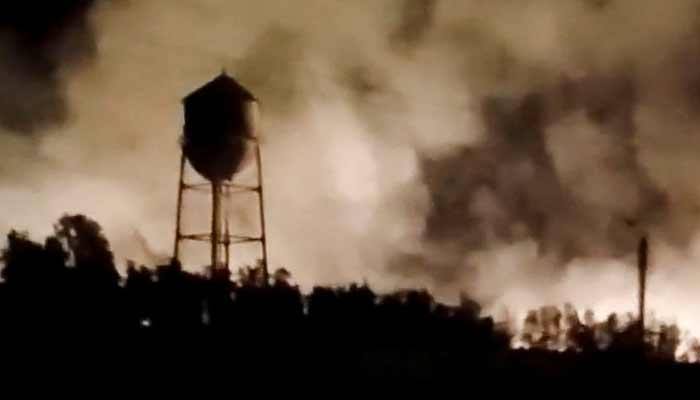
The United States carried out airstrikes against Iran for the 11th consecutive night, with explosions and air defence activity reported around Tehran and other parts of the country.
According to the US military, the latest attacks targeted military logistics infrastructure and other strategic sites, with the stated objective of reducing Iran’s capability to threaten commercial shipping in the Strait of Hormuz.
Iranian state media also reported strikes in several areas, including Bushehr, home to one of the country’s nuclear power plants.
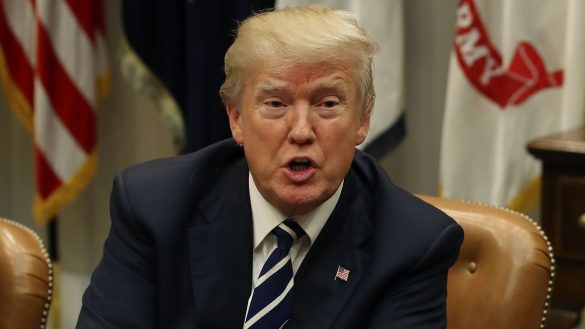
Trump Says Military Operation Is ‘Not Finished’
US President Donald Trump signalled that military operations would continue, saying the campaign against Iran was “not finished.”
Speaking to reporters, Trump claimed the damage inflicted on Iran would take decades to repair.
“If we left right now, it would take Iran 20 to 25 years to rebuild. We’re not finished at all… we’re not leaving right now,” he said.
His remarks came as the conflict entered another phase following the collapse of earlier ceasefire efforts.
Iran Warns of Retaliation
Iran warned that further attacks could trigger a wider regional conflict.
According to Iranian state media, the Khatam al-Anbiya Central Headquarters said any US strike on sensitive facilities, including the underground Pickaxe Mountain complex, would be viewed as an escalation of the war.
The military command warned that Iran could target US interests and those of its allies in response to further attacks.
Diplomacy Continues Despite Fighting
Despite the ongoing conflict, diplomatic contacts have not completely stopped.
Iranian Foreign Ministry spokesperson Esmaeil Baghaei said indirect discussions with Washington were continuing through international mediators.
US-Iran War Costs Reach $37.5 Billion, Pentagon Tells Congress
Meanwhile, US Secretary of State Marco Rubio, speaking during a regional meeting in Manila, reiterated that Washington remains open to a diplomatic solution but accused Tehran of not engaging seriously in negotiations.
Regional Tensions Spread Beyond Iran
The conflict has increasingly affected other countries in the region.
Kuwait said its air defence systems intercepted Iranian drones, while Bahrain reported intercepting missiles and drones after air raid sirens sounded across the country.
Jordan also confirmed intercepting aerial threats crossing its airspace.
Iran stated that it had targeted military assets linked to the United States in Kuwait and Bahrain, including radar installations and air defence systems.
Houthi Threat Raises Oil Supply Concerns
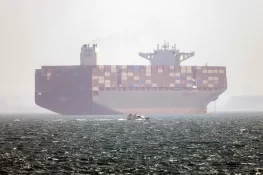
Regional tensions have also intensified after Yemen’s Houthi movement threatened to blockade Saudi Arabian ports.
Although it remains unclear how such a blockade would be enforced, maritime security companies reported that some oil tankers altered their routes in the Red Sea following the warning.
Analysts say any disruption to shipping routes around the Strait of Hormuz or the Red Sea could affect global energy markets, as these waterways are among the world’s most important oil transport corridors.
War Cost Reaches $37.5 Billion
The continued military operations come as the financial burden of the conflict grows.
US Defense Secretary Pete Hegseth told lawmakers this week that the war has already cost the United States an estimated $37.5 billion, including current expenditures and projected costs through the end of September.
The Pentagon is also seeking additional funding from Congress, while political pressure is mounting on the Trump administration to define its long-term strategy as the conflict continues.