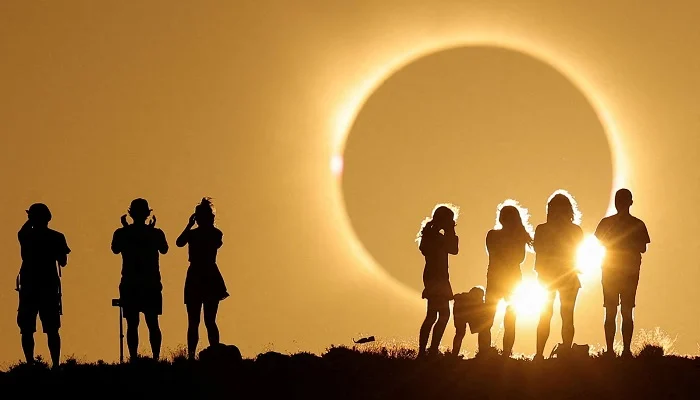
Spain witnessed a rare total solar eclipse on Wednesday, turning daylight into darkness for several minutes and creating a breathtaking spectacle for thousands of residents and tourists.
As the Moon moved directly between the Earth and the Sun, its shadow swept across parts of Europe, allowing crowds to witness the Sun’s outer atmosphere, known as the corona, glowing around the darkened Moon.
The eclipse reached Spain around 90 minutes after first appearing over the remote Arctic region of northern Russia.
Spain witnesses extraordinary darkness
Large crowds gathered across northern Spain and along the Mediterranean coast to watch the eclipse using specially designed protective glasses.
In Tarragona, 56-year-old Isabel Troyano watched the event with her son and described the experience as something she had never imagined witnessing.
Alejandro Cuesta, a 30-year-old nanoscience researcher, said the sight was so powerful that he nearly cried, describing it as one of the most beautiful experiences of his life.
The Moon’s shadow travelled from Greenland across the North Atlantic before reaching Iceland and then northern Spain. It continued across the Spanish mainland before moving towards the Balearic Islands.
Iceland also witnessed the spectacular event. Reykjavik had not experienced a total solar eclipse since 1433, while the next one visible there is not expected until 2196.
Why does a total solar eclipse turn day into night?
A total solar eclipse occurs when the Sun, Moon and Earth align, allowing the Moon to completely block the Sun from a narrow section of the Earth’s surface.
The darkest part of the Moon’s shadow is known as the umbra. As it passes over an area, daylight can quickly fade, temperatures may fall and shadows can appear unusually sharp or distorted.
The effect is brief because the lunar shadow moves rapidly across the Earth’s surface. According to the Paris Observatory, it travels at around 3,430 kilometres per hour.
A partial eclipse, during which the Moon covers only part of the Sun, lasted for roughly one hour and 45 minutes and was visible across large parts of Europe, as well as parts of Canada, the northern United States and northwest Africa.
Solar eclipse 2026: Complete guide to Wednesday’s celestial event
Scientists study the Sun’s atmosphere
The eclipse was also an important opportunity for scientists. NASA and the European Space Agency livestreamed the event as researchers observed the Sun’s outer atmosphere.
During totality, the Sun’s corona becomes visible, allowing scientists to study solar winds and the star’s magnetic field.
The observations could help researchers better understand solar activity and how changes in the Sun can affect the space environment around Earth.
Weather threatens eclipse viewing
Cloudy weather had raised concerns in Iceland’s Westfjords, but conditions improved in several locations, allowing crowds to see the eclipse.
Spain also faced concerns over high temperatures and wildfire risks. Nevertheless, relatively clear skies provided good viewing conditions in many areas.
The eclipse also brought a major tourism boost to Spain. Government estimates suggested that around 450,000 additional visitors could travel to the country, potentially generating approximately €347 million ($400 million) for the economy.
Authorities deployed nearly 25,000 police officers to manage security, crowds and traffic during the event.
When is the next major eclipse?
Total solar eclipses are relatively rare at any particular location because the Moon’s darkest shadow covers only a narrow path across Earth.
Another total solar eclipse is expected to cross southern Spain and northern Africa in August 2027.
In 2028, the Iberian Peninsula is expected to experience an annular solar eclipse, during which the Moon will not completely cover the Sun, leaving a bright ring of sunlight around its edges.