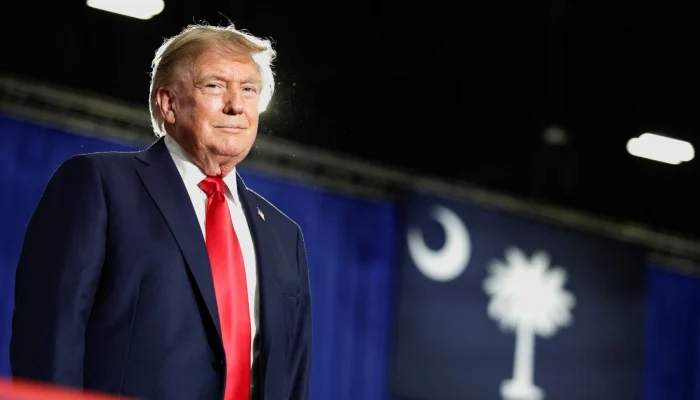
US President Donald Trump has pledged to increase economic pressure on Iran after Treasury Secretary Scott Bessent said Washington could introduce measures against Tehran that have “never been seen” as early as next week.
Bessent is scheduled to hold a press conference at 2pm EDT (1800 GMT) on Monday, where further details could emerge.
The United States, the United Nations and the European Union have imposed sanctions, trade restrictions and asset freezes on Iran for decades, citing concerns including its nuclear programme, alleged human rights violations and support for militant groups.
Since the war involving Iran began in February, Washington has expanded its measures to include additional maritime, energy and financial sanctions, while also beginning a naval blockade.
According to data from the US Treasury Department’s Office of Foreign Assets Control (OFAC), more than 1,000 individuals, vessels and aircraft have been sanctioned since Trump began his second term.
Pressure on Iran’s Oil Trade
Recent US measures have focused heavily on Iran’s oil industry and the network used to transport and sell its crude. Washington has targeted Iran’s so-called shadow oil fleet, shipping insurers and companies and individuals accused of helping Tehran acquire weapons.
The United States has also targeted digital exchanges, with sanctions freezing an estimated $500 billion in Iran-linked cryptocurrency, according to the information provided.
Iran has condemned Washington’s plans for additional sanctions, warning that further economic pressure could place an even greater burden on an economy already struggling under extensive restrictions.
Oil shipments through the Strait of Hormuz have also been severely disrupted, with Tehran threatening to attack unauthorised oil tankers attempting to use the strategically important waterway.
Against this backdrop, experts say Washington has several additional options.
Sanctions on Chinese “Teapot” Refineries
One possible target is China’s independent oil refineries, commonly known as “teapots”. These refineries account for roughly a quarter of China’s refining capacity and often operate on relatively narrow profit margins.
China purchased more than 80% of Iran’s seaborne oil in 2025, according to analytics firm Kpler. Independent Chinese refiners handle a significant portion of that trade, making them potential targets for US secondary sanctions.
Such sanctions can penalise companies that conduct business with an entity already under US sanctions.
Previous US measures have discouraged some larger independent refiners from purchasing Iranian crude. However, experts say smaller refiners can be harder to pressure because they have relatively limited exposure to the US financial system.
Trump Announces “Crushing” Economic War on Iran, Warns Supporters of Heavy Costs
Chinese Banks Could Face Greater Pressure
Another potential option would be sanctions against Chinese financial institutions accused of facilitating Iranian oil transactions or weapons procurement.
OFAC has already sanctioned smaller companies and entities in China and Hong Kong over alleged involvement in Iranian oil revenues and weapons financing.
US officials have also warned two larger Chinese banks that they could face secondary sanctions if Iranian funds were found moving through their systems. However, Washington has so far stopped short of publicly designating those institutions.
Targeting major Chinese banks could send a strong warning to other financial institutions, but it could also create serious tensions between Washington and Beijing.
The potential consequences are particularly significant because the United States remains concerned about China’s role in supplying critical minerals needed for advanced technologies.
A Continued “Whack-a-Mole” Strategy
Washington could also continue sanctioning Iranian companies and individuals, as well as businesses in China and Gulf countries that help Tehran bypass restrictions.
However, sanctions experts describe this strategy as a potential “whack-a-mole” approach. Brett Erickson of Obsidian Risk Advisors said Iran can respond by creating new companies to replace entities that have been sanctioned.
Miad Maleki of the Foundation for Defence of Democracies said the administration could intensify enforcement against oil shippers, buyers and currency exchangers that help Iran finance imports.
Additional aviation sanctions are another possibility, particularly if Washington seeks to restrict Iran’s ability to move goods while maritime routes remain heavily disrupted.
Land Blockade and Tariff Options
Some US and Israeli officials have also discussed the possibility of a land blockade. Such a move would be extremely difficult to implement because Iran shares borders with several countries, while some routes are mountainous and challenging to control.
A land blockade could further restrict Iran’s access to food, energy and textiles. However, experts warn that it could also increase pressure on ordinary Iranians without necessarily producing the political or social reaction Washington might seek.
Trump has also repeatedly threatened tariffs against countries that conduct business with Iran. The legal basis for some of those tariff measures was struck down by the US Supreme Court, but Congress is considering legislation that could provide new tariff powers.
The Senate recently passed a broad Russia sanctions bill containing additional Iran-related sanctions and potential tariff authority. The measure still needs approval from the House of Representatives, where it could face opposition from Democrats and some Republicans concerned about the wider use of tariffs.
For now, Washington appears to be weighing how far it can increase pressure on Iran without triggering broader economic and geopolitical consequences, particularly in its relationship with China.