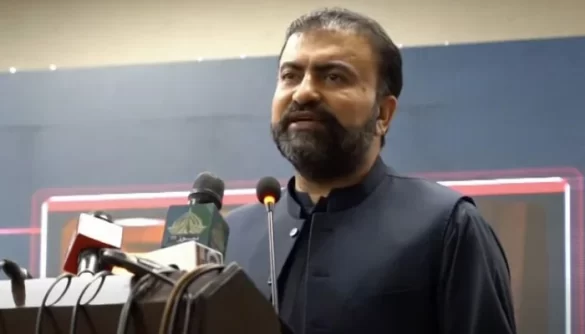
Deputy Prime Minister Ishaq Dar says Pakistan’s water security is directly linked to its economic, food and national security interests.
WASHINGTON: Deputy Prime Minister and Foreign Minister Ishaq Dar has warned that any “unilateral interference” with the Indus Waters Treaty (IWT) could have far-reaching consequences, not only for Pakistan and India but also for regional stability and respect for international agreements.
Speaking at a seminar titled “The Indus Waters Treaty: South Asian Security at the Crossroads”, organised by the Embassy of Pakistan in Washington, Dar stressed the importance of the treaty for Pakistan’s economy, agriculture and national security.
Pakistan’s Water Security Linked to National Security
Dar said the Indus Basin is the lifeline of more than 250 million Pakistanis, with the country’s agriculture, food security, energy production, livelihoods and economic development heavily dependent on the Indus River system.
He therefore described water security as inseparable from economic security, food security and, ultimately, national security.
“The implications of unilateral interference with such an arrangement are consequently profound,” Dar warned, adding that such actions could affect the stability of South Asia and establish a potentially dangerous precedent for treaty relations elsewhere in the world.
Pakistan, he said, maintains a clear and consistent position that the Indus Waters Treaty remains valid, binding and fully operative despite India’s announcement that it was placing the agreement in “abeyance”.
Dar Rejects Unilateral Suspension of Treaty
Dar said India’s decision in April 2025 to place the treaty in abeyance had no basis in the agreement itself.
According to the deputy prime minister, the IWT contains no provision allowing either party to unilaterally suspend the treaty. He argued that neither country could extinguish obligations undertaken under international law through a unilateral political declaration.
He also pointed to the continuation of treaty-based proceedings despite India’s position, saying this reinforced the principle that unilateral action could not replace an established legal framework.
How the Indus Waters Treaty Works
Dar explained that the IWT is more than an agreement governing the sharing of water. He described it as a legal and institutional framework for managing a vital shared resource and an important instrument of regional stability.
Pakistan and India signed the treaty in 1960 following years of negotiations facilitated by the World Bank.
Under the agreement, the three Eastern Rivers — Ravi, Beas and Sutlej — were allocated to India for unrestricted use. The three Western Rivers — Indus, Jhelum and Chenab — were allocated to Pakistan for unrestricted use, while India retained specific and carefully defined rights to use waters of the Western Rivers under the treaty.
Pakistan Calls for Comprehensive Dialogue with India, Warns Against Violating Indus Waters Treaty
The agreement also established the Permanent Indus Commission, along with procedures for resolving questions, differences and disputes between the two countries.
These mechanisms include consultation between the parties and, where required under the treaty, the involvement of a neutral expert or a Court of Arbitration.
Treaty Survived Wars and Political Crises
Dar highlighted the longevity of the agreement, noting that it had survived wars, military confrontations, diplomatic breakdowns and prolonged periods of political tension between Pakistan and India.
He said the treaty’s resilience demonstrated that even countries facing difficult bilateral relations could maintain cooperation when agreed rules and legal frameworks were respected.
According to Dar, the institutional arrangements created under the IWT were not an incidental part of the agreement but a central element of the framework negotiated by the two countries.
Issue Extends Beyond Pakistan and India
The deputy prime minister said the dispute over the treaty should not be viewed solely through the lens of Pakistan-India relations.
He argued that the issue also concerns the broader principle of the sanctity of international treaties and confidence in international law.
Dar maintained that weakening established treaty mechanisms could create uncertainty over how countries manage shared natural resources, particularly in regions where rivers cross international borders.
He reiterated Pakistan’s commitment to implementing the Indus Waters Treaty in accordance with its provisions and stressed the importance of resolving differences through the mechanisms established under the agreement.
The comments come amid continued tensions between Pakistan and India over water management and the future implementation of the decades-old treaty, making the issue a significant concern for regional stability and Pakistan’s water security.