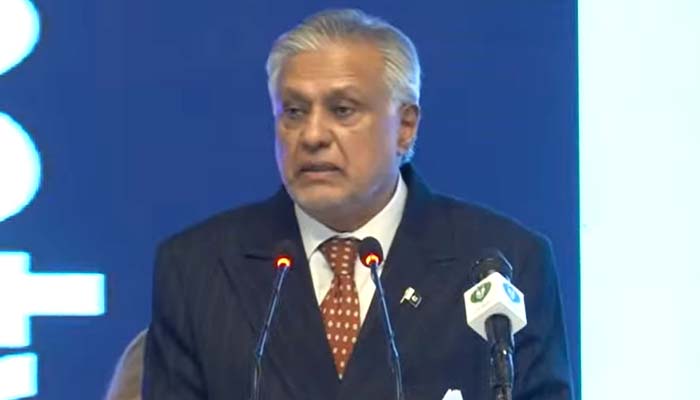
Pakistan has urged India to resolve all outstanding bilateral issues through dialogue and diplomacy, with Deputy Prime Minister and Foreign Minister Ishaq Dar saying that meaningful engagement requires willingness from both sides, remarking that “it takes two to tango.”
Speaking at an international seminar on the Indus Waters Treaty (IWT) in Islamabad on Tuesday, Dar emphasized that peaceful coexistence and mutual respect remain the only sustainable path toward regional stability. He also warned that any attempt to undermine internationally binding agreements, including the Indus Waters Treaty, could have serious consequences beyond the two neighbouring countries.
Dar Warns Against Undermining International Agreements
Addressing participants at the seminar, Dar said the consequences of violating international treaties extend beyond bilateral relations and can weaken confidence in the global legal order.
He argued that disregarding international agreements sets a dangerous precedent and damages the credibility of states in the international community.
Referring to recent tensions between Pakistan and India, Dar said New Delhi placed the Indus Waters Treaty in abeyance following the April 2025 attack in Indian-administered Kashmir that killed 26 people. India blamed Pakistan for the incident, an allegation Islamabad has consistently denied.
Dar reiterated Pakistan’s position that long-term peace can only be achieved through respect for sovereignty, dialogue, and adherence to international commitments. He warned that depriving Pakistan of its water rights could have serious consequences.
Pakistan Reaffirms Readiness for Dialogue
The deputy prime minister said Pakistan remains prepared to engage in a comprehensive dialogue covering all outstanding issues between the two countries.
“We are sincerely ready to discuss all matters through a composite dialogue,” Dar said, adding that progress requires willingness from both sides.
He also criticized India’s policies in broader terms, including comments on regional politics and sports, arguing that political differences should not overshadow opportunities for constructive engagement.
Information Minister Stresses Importance of Water Security
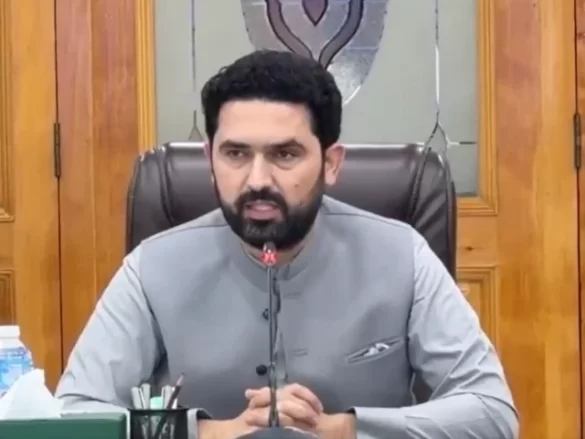
Earlier, Information Minister Attaullah Tarar reaffirmed Pakistan’s commitment to protecting the Indus Waters Treaty, describing water security as a matter of national survival.
He said the 1960 treaty remains one of the world’s longest-standing and most successful international water-sharing agreements, surviving multiple periods of political and military tension between Pakistan and India.
Tarar emphasized that the Indus River system supports Pakistan’s agriculture, which forms a significant part of the country’s economy, and provides water to millions of people across the country.
According to the minister, any attempt to stop or divert Pakistan’s share of river waters would receive an appropriate response from the country’s leadership. He added that Pakistan remains committed to peaceful relations, constructive dialogue, and the implementation of international agreements.
Pakistan Raises Concerns Over Chenab River
Pakistan’s Commissioner for the Indus Waters Treaty, Syed Mehr Ali Shah, said India has not been fully complying with certain treaty obligations since August 2023. He stated that Pakistan recently sent another letter requesting the exchange of hydrological data as provided under the agreement.
The commissioner also alleged that India was diverting water from the Chenab River in a manner inconsistent with the treaty and argued that any construction linking the Chenab and Beas rivers should remain subject to the agreement’s inspection and consultation mechanisms.
India has publicly maintained that its actions are consistent with its interpretation of the treaty.
International Expert Highlights Legal Concerns
Speaking at the seminar, Russian expert Dr. Roxolana Zigon said the Indus Waters Treaty remains an important example of international water cooperation and noted that it contains no provision allowing unilateral withdrawal.
She observed that the agreement has enabled Pakistan and India to manage shared water resources for more than six decades despite recurring political tensions.
Dr. Zigon also noted that Pakistan’s agriculture depends heavily on the Indus River system and warned that disputes over shared water resources could increase regional instability if not managed through established legal mechanisms.
The Indus Waters Treaty, signed in 1960 with the World Bank as a facilitator, governs the distribution and management of the Indus River system between Pakistan and India. Despite multiple conflicts and periods of strained diplomatic relations, the treaty has historically remained in force and is widely regarded as one of the most durable transboundary water-sharing agreements in the world.
Relations between Pakistan and India remain tense following the April 2025 attack in Indian-administered Kashmir and the subsequent military confrontation between the two countries. Both governments continue to present differing accounts of those events, while international observers have consistently called for dialogue and restraint to reduce tensions in the region.