Benjamin Netanyahu appeared set to remain Israel’s caretaker prime minister after his political bloc performed more strongly than expected among Jewish voters, leaving opposition parties with limited options for forming an alternative government despite the loss of his parliamentary majority.
With nearly 86% of votes counted on Wednesday, Israel’s three main broadcasters projected that Netanyahu’s alliance of right-wing, far-right and ultra-Orthodox parties would secure 53 seats in the 120-member Knesset. The rival opposition bloc led by Gadi Eisenkot was projected to win 48 seats.
Meanwhile, parties representing Arab Israelis were projected to secure a record 19 seats. Their strong performance could significantly influence the political landscape, although obtaining the support of Arab parties remains a major obstacle for many Jewish political leaders.
The projections could change as vote counting continues. However, the opposition alliance, which includes parties ranging from the centre-left to the hard right, has fallen short of pre-election polls that predicted a closely contested race.
Netanyahu to Continue as Caretaker Prime Minister
Netanyahu is expected to remain caretaker prime minister while political parties negotiate the formation of a new coalition. If the negotiations fail, Israel could face another election next year.
Although caretaker governments operate under certain political and administrative constraints, they retain substantial powers, including authority over national security and military policy.
Guy Lurie, a research fellow at the Israel Democracy Institute, said a caretaker government formally possessed the same powers as a regular government but was also subject to a duty of restraint, limiting its discretion in certain areas.
The prospect of Netanyahu continuing in office without a parliamentary majority has raised questions about the decisions his government could make during the transition.
Netanyahu Highlights Military Successes and Iran Threat
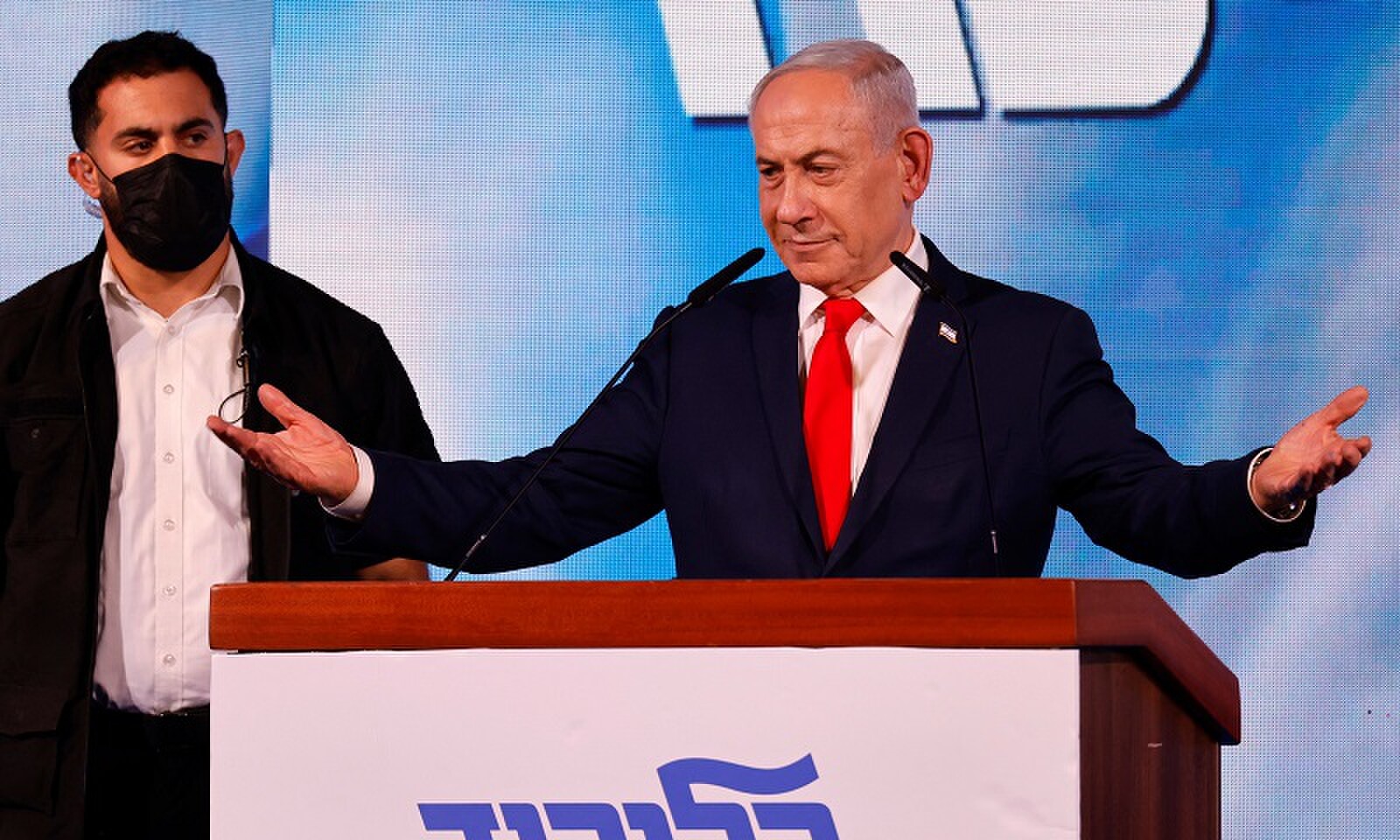
Addressing supporters of his Likud party after 3am local time, Netanyahu called for the formation of a strong right-wing national government.
He highlighted Israel’s military achievements and suggested that further joint military action against Iran alongside US President Donald Trump remained possible.
Netanyahu described the situation as a historic opportunity for the two countries to eliminate what he characterised as the Iranian threat.
Trump, who had urged Israeli voters to keep Netanyahu in power so the two leaders could finish their campaign against Iran, said Netanyahu had performed very well. He also claimed that his endorsement had significantly helped the Israeli prime minister.
Netanyahu’s emphasis on security comes as the regional conflict continues to shape political debate in Israel and neighbouring countries.
Opposition Leader Warns Against Political Use of Security Issues
Eisenkot acknowledged that Netanyahu would remain caretaker prime minister but warned that security concerns must not be used for political purposes.
He called on officials in Israel’s security establishment and civil service to resist any attempts to undermine their independence during the transition.
Netanyahu’s office has previously rejected accusations that he is exploiting the conflict with Iran for political gain. His office did not immediately respond to a request for comment on Wednesday.
The election outcome also affected financial markets. The Israeli shekel weakened by approximately 1.6% to 3.10 against the US dollar, while Tel Aviv’s main stock market indexes fell by more than 3%.
Israeli Politics Shifts Further to the Right
The results highlighted a broader rightward shift among Jewish Israeli voters during Netanyahu’s years as the country’s dominant political figure.
The centre-left, which played a leading role in Israeli politics during the country’s early decades, has been reduced to a comparatively small political force.
Nearly all major Jewish Israeli parties now reject the establishment of an independent Palestinian state, despite the central role that the two-state solution has played in internationally supported peace efforts since the 1990s.
The election was the first since the October 7, 2023, attacks and the subsequent war in Gaza, which expanded into conflicts involving Lebanon and Iran.
Israel’s military campaign in Gaza has caused widespread destruction and tens of thousands of Palestinian deaths, intensifying international criticism and contributing to the country’s growing diplomatic isolation.
Netanyahu is also facing international and domestic legal challenges. The International Criminal Court has issued an arrest warrant for him over alleged war crimes, accusations he rejects. He also faces corruption charges in Israel, which he has dismissed as politically motivated.
Israel Sees Fastest Election Turnout in Nearly 50 Years as Netanyahu Faces Political Test
Record Turnout and Strong Support for Arab Parties
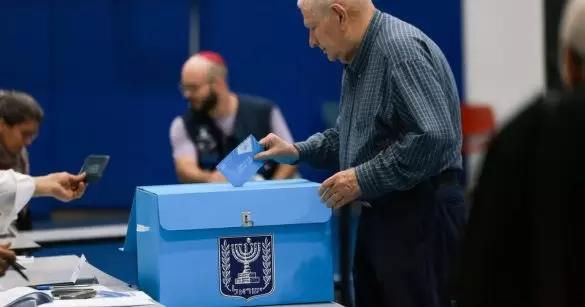
Voter turnout reached 77.7%, the highest level in more than two decades, according to the reported figures. Participation was particularly strong among Arab citizens of Israel, who account for more than one-fifth of the population.
Many Arab voters were reportedly motivated by concerns about racism and policies associated with Netanyahu’s governing allies. One party leader in his cabinet has previously been convicted of inciting racial hatred against Arabs.
At the headquarters of the Joint List, an alliance of several Arab political parties, supporters erupted in applause and whistles after exit polls were released.
“We refuse the occupation and racism, and we will remain here,” said Joint List candidate Faten Gattas.
Arab parties’ projected 19 seats could make them an important force in the next parliament. However, their ability to influence the formation of a government will depend on whether other parties are willing to cooperate with them.
The coalition that previously removed Netanyahu from power relied on support from one small Arab party. Following the opposition bloc’s weaker-than-expected performance, Eisenkot’s camp may need broader backing from the Joint List to assemble a viable parliamentary majority.
Most Jewish political leaders have historically avoided formal alliances with Arab parties, making coalition negotiations particularly challenging.
Political Uncertainty Ahead
The projected results leave Israel facing a potentially prolonged period of political uncertainty. Netanyahu’s bloc remains short of the 61 seats needed for a majority, while the opposition appears unable to form a government without overcoming longstanding political divisions.
The record projected representation for Arab parties adds another dimension to the negotiations, but their participation in a governing arrangement remains uncertain.
As vote counting continues, the final distribution of seats will help determine whether Netanyahu can assemble a coalition, remain at the head of a caretaker government for an extended period, or face another election.