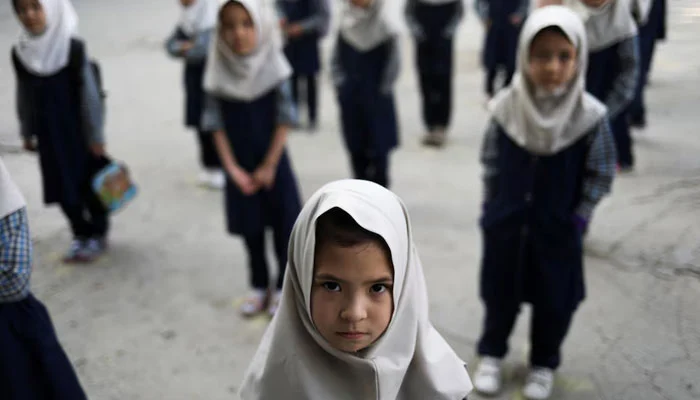
KABUL: Afghan fathers are struggling with growing anguish as their daughters remain barred from secondary education under Taliban restrictions, with many saying they fear their children’s futures are slipping away.
In interviews with AFP across Afghanistan, fathers from different backgrounds described the emotional toll of the education ban. Some said they had lost sleep trying to find ways to continue their daughters’ education, while even deeply religious men questioned the justification for the restrictions.
The Taliban administration defends the ban based on its interpretation of Islamic law. However, one devout father told AFP that there was no basis in the Quran for limiting education to men.
Another father, who praised the Taliban for restoring security and reducing corruption, said he could not find a “proper justification” for preventing girls from continuing their studies.
The identities of the fathers interviewed by AFP have been withheld for their protection.
Afghan men largely support girls’ education
A UN survey conducted last year found that nine out of 10 Afghan men believed it was important for girls to attend secondary school. Nearly two-thirds also considered supporting a daughter’s education a pious act.
Some men have reportedly been imprisoned for protesting the restrictions.
Afghan girls were barred from secondary schools in March 2022 after the Taliban returned to power, while universities were closed to women later that year.
The Taliban administration has repeatedly described the restrictions as temporary, but more than four years later, the United Nations estimates that at least one million girls have been directly affected by the ban on secondary education.
Fathers fear their daughters will lose their future
Engineer Ahmad, a father of four girls, said he never imagined that his daughters could grow up without access to education.
His wife, a secondary school mathematics teacher, is also no longer permitted to teach. With his eldest daughter approaching the end of primary school, Ahmad fears the family will soon face the reality of keeping her at home.
“Every day and every night, my wife and I are getting closer to the moment when our daughters will have to stay home,” he said.
Ahmad has explored clandestine courses, but said they cost more than half of his salary. He had previously hoped to move his family to the United States, but those plans collapsed after US immigration restrictions made the move impossible.
His children, he said, continue asking when the family will leave Afghanistan.
Secret schools offer limited hope
Mohammad, a doctor in Kabul province, had hoped his two daughters would attend leading universities.
“For the development of Afghanistan we need women, not only for the home,” he said.
His daughters, aged 12 and 14, are approaching the end of primary school. For years, he has searched for ways to continue their education, including sending them to Pakistan, an option that became difficult after the border was closed amid tensions between the two countries.
He eventually found a private school that secretly teaches general subjects alongside religious studies.
The school charges about 10,000 Afghanis ($153) a month for both girls because of the additional risks involved. However, students do not receive recognised graduation certificates.
Mohammad also fears authorities could raid the school and take his daughters into custody.
“The most important thing is that they go on learning,” he said, promising his daughters: “While I’m alive, I will find a solution for your education.”
Girls ask how they can continue learning
A father from Kandahar province, identified only as N, said his 12-year-old daughter is fascinated by astronomy and frequently asks him questions about subjects such as gravity.
But she has begun questioning how she can pursue those interests when she cannot study beyond grade six.
“How can I learn if I cannot go beyond grade six?” she asked him.
N moved his family to Kabul in search of work and has explored underground schools and online courses in areas such as design and computers.
He worries, however, that declining economic opportunities and reduced international aid could eventually make even these alternatives unaffordable.
For now, he tries to protect his daughter from the additional stress facing the family.
Fathers hide their pain
Another father, identified as M, said his 13-year-old daughter cried in her room after she could no longer attend school.
He said restrictions on girls’ access to education, parks and other public spaces had made life increasingly difficult for her.
M, who comes from a poor background and is deeply religious, said he supported the Taliban’s efforts to improve security and tackle corruption. But he could not understand why girls should be prevented from continuing their education.
“Sometimes when she gets so disappointed at home, I go to another room and hide to cry,” he said.
He had saved money in the hope of sending his daughter to Iran for further education, but those plans were disrupted by the conflict.
He later enrolled her in a Quranic school partly to provide her with social interaction, but she eventually stopped attending.
“Even if I continue, there will be no future for me,” she told him.
Parents turn to home schooling
Nasir, a 47-year-old father, said his daughter and her classmates were devastated when they reached the end of primary school.
His family has created a home library and uses secondhand secondary-school textbooks to continue educating their daughters.
The girls follow a structured routine similar to school and help other children in their building with homework. They have also recently begun secretly attending classes outside the home.
Nasir said the uncertainty had left the family struggling with sleepless nights.
His younger daughter has become depressed and sometimes struggles to remain motivated to study independently, he said.
“This regime does not want educated people,” Nasir said. “When will we go back to a normal life?”
For Afghan fathers like Nasir, Ahmad and Mohammad, finding alternatives to formal education has become a daily struggle as they try to protect their daughters’ hopes, ambitions and futures despite restrictions that have kept them out of secondary schools for more than four years.