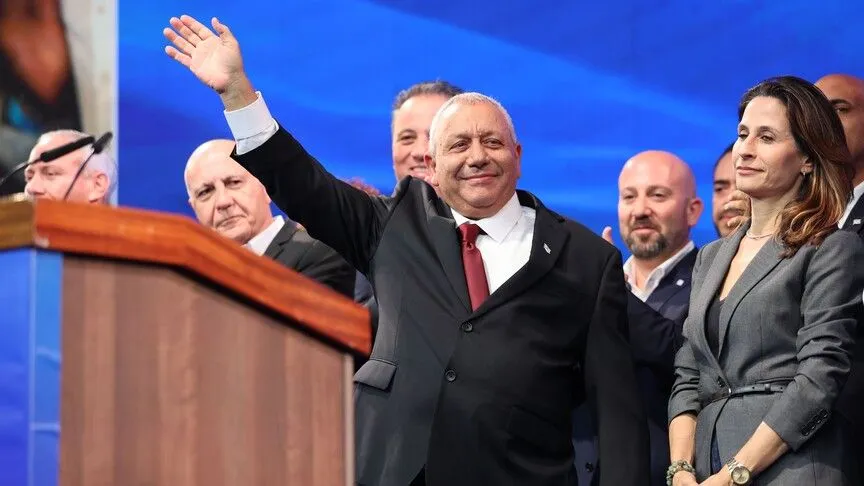
Israeli President Isaac Herzog has formally tasked Yashar party leader Gadi Eisenkot with forming a new government after parliamentary elections left both his political bloc and Prime Minister Benjamin Netanyahu’s alliance short of a majority. Eisenkot has 28 days to assemble a governing coalition, with the possibility of a 14-day extension.
Eisenkot received the mandate during a meeting with Herzog at the presidential residence in West Jerusalem on Sunday, according to Israel’s public broadcaster KAN.
The decision followed consultations between the president and political parties represented in the Knesset.
During the consultations, 67 lawmakers recommended Eisenkot for the task, while 46 supported Netanyahu. Another seven lawmakers declined to recommend either candidate.
Herzog Calls for Stability
Speaking at the mandate handover ceremony, Herzog said Eisenkot had secured clear support to attempt to form the next government.
The president stressed that Israel needed a stable administration capable of addressing the country’s political and security challenges.
He called for efforts to bring Israeli society together, continue implementing the 20-point plan for the Gaza Strip and pursue negotiations with countries across the region.
Herzog also highlighted the importance of responding to developments in relations with the United States and addressing the contentious issue of military conscription.
Eisenkot Warns of Crisis
After accepting the mandate, Eisenkot described the responsibility as a national duty, warning that Israel was facing a critical emergency.
He said the objectives of the war had yet to be achieved and that the country was experiencing a serious political and diplomatic crisis.
Eisenkot also pointed to growing concerns among Israel’s closest international allies, saying some were calling for a reassessment of their relations with the country.
“Israel is going through one of the most difficult periods in its democratic history. If the current situation continues, it could deteriorate to the point of no return,” he said.
He argued that the situation required urgent political change and pledged to work towards establishing a national emergency government.
According to Eisenkot, Israel could not afford further delays or another election and needed a new direction after years of political and national difficulties.
Coalition Talks Begin
Eisenkot invited Netanyahu’s Likud party and Finance Minister Bezalel Smotrich’s Religious Zionism party to join his proposed government.
However, he made no mention of the Jewish Power party led by National Security Minister Itamar Ben-Gvir.
In a statement issued after receiving the mandate, Eisenkot said he would approach all parliamentary factions and parties represented in the Knesset and invite them to participate in government formation, provided they accepted four principles. The statement did not specify those principles.
Israeli Opposition Leaders Say Netanyahu Cannot Remain in Power After US Midterm Elections
He acknowledged that forming a coalition would require compromises, saying political parties could not expect every campaign promise to be fulfilled.
Eisenkot described national unity as a core value based on genuine partnership and said he was willing to work with anyone prepared to recognise the seriousness of the situation.
He also left open the possibility of securing support from the United Arab List (Ra’am) and the Joint List, both Arab political groupings, as he attempts to broaden his parliamentary backing.
He warned that anyone obstructing government formation for personal rather than substantive reasons would be remembered as having failed to help Israel during a national emergency.
Majority Remains Uncertain
Despite receiving recommendations from 67 lawmakers, Eisenkot’s bloc does not have enough seats to secure a parliamentary majority independently.
He will therefore need agreements with additional parties to establish a government. Potential cooperation with Arab parties has emerged as a divisive issue within his political bloc.
Eisenkot also said that 74 Knesset members had expressed a lack of confidence in the continuation of Netanyahu’s government, although he did not provide further details.
He expressed confidence that he could overcome the political obstacles and form a government, saying the experience and capabilities of potential partners would be essential to guiding Israel through the crisis.
What Happens Next?
Under Israeli law, Eisenkot has 28 days to complete coalition negotiations and form a government. Herzog can grant him an additional period of up to 14 days if necessary.
If Eisenkot fails, the president may assign another member of the Knesset the responsibility of forming a government. That lawmaker would receive 28 days, without an extension.
If the second attempt also fails, a majority of Knesset members may nominate one of their colleagues to make a final attempt within an additional 14 days, in accordance with the law.
The coming weeks will therefore be crucial for Eisenkot as he seeks to secure the parliamentary support needed to replace Netanyahu’s government and establish a new political administration.