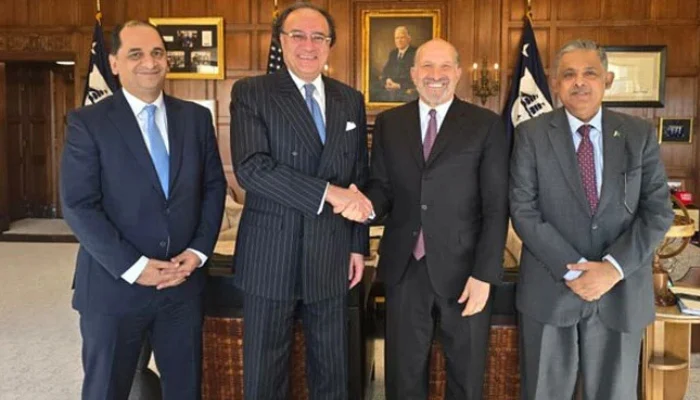
Pakistan and the United States have reported significant progress in negotiations on a proposed reciprocal trade framework, with both countries reaffirming their commitment to finalising the agreement at the earliest opportunity.
The development came during a virtual meeting between Finance Minister Muhammad Aurangzeb and US Trade Representative Ambassador Jamieson Greer, where the two sides reviewed the progress of ongoing negotiations aimed at strengthening bilateral trade and economic cooperation, according to a statement issued by Pakistan’s Ministry of Finance.
Both Sides Welcome Progress in Negotiations
During the meeting, Finance Minister Aurangzeb welcomed what he described as the steady progress achieved by negotiating teams from both countries.
He appreciated the constructive engagement throughout the discussions and emphasized the importance of maintaining the current momentum to support Pakistan’s broader economic priorities.
According to the finance minister, a stronger trade and investment partnership with the United States would help advance Pakistan’s export-led growth strategy, improve economic resilience, and create new commercial opportunities for businesses in both countries.
Focus on Trade, Investment and EXIM Cooperation
Aurangzeb also stressed the importance of continued collaboration with the US Export-Import Bank (EXIM) to facilitate greater bilateral trade and investment.
He said enhanced cooperation in trade financing could help strengthen commercial ties and encourage investment between Pakistan and the United States.
The finance minister further called for close coordination and faster technical-level discussions to resolve the remaining issues in the proposed framework.
Background of the Trade Talks
Pakistan and the United States reached a trade understanding in July 2025, ahead of President Donald Trump’s August 1 tariff deadline, which had introduced higher reciprocal tariffs on imports from several countries.
Following negotiations between Pakistani officials and the Office of the United States Trade Representative (USTR), the proposed reciprocal tariff on Pakistani exports was reduced from 29% to 19%.
However, the arrangement was later affected when the US Supreme Court, in a 6-3 ruling in February 2026, held that the White House had exceeded its constitutional authority by imposing broad tariffs under the International Emergency Economic Powers Act (IEEPA), effectively invalidating that tariff policy.
Following the ruling, the Trump administration invoked Section 122 of the Trade Act of 1974 to introduce a temporary 10% global tariff for a period of up to 150 days.
US Appreciates Pakistan’s Reform Efforts
During the virtual meeting, Ambassador Jamieson Greer acknowledged Pakistan’s continued engagement throughout the negotiations and welcomed the progress made on labour and regulatory reforms.
He specifically appreciated measures related to forced labour compliance, describing them as an important aspect of the ongoing discussions.
The US trade representative reaffirmed Washington’s commitment to continuing negotiations and expressed confidence that the remaining issues could be resolved through sustained technical engagement.
Commitment to Early Finalisation
Both Pakistan and the United States agreed to continue working closely to finalise the outstanding elements of the reciprocal trade framework.
The two sides also agreed to maintain regular engagement and accelerate technical discussions to conclude the agreement as soon as possible.
The virtual meeting was also attended by Federal Secretary for Commerce Jawad Paul and senior officials from the Office of the United States Trade Representative (USTR), reflecting the importance both governments attach to strengthening bilateral trade and economic relations.