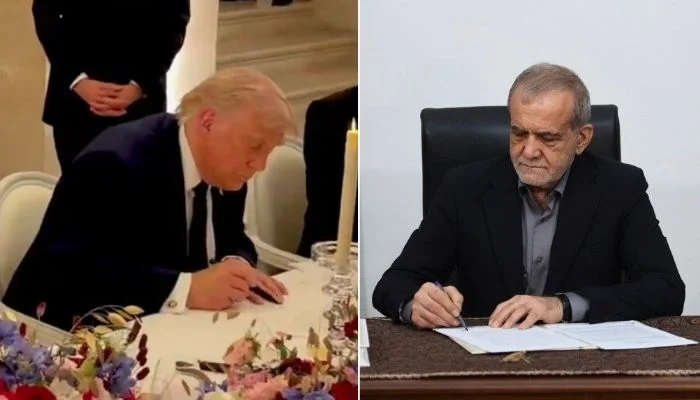
US President Donald Trump and Iranian President Masoud Pezeshkian have signed a landmark agreement aimed at ending the Middle East war, with Iran agreeing to dilute its enriched uranium stockpile in exchange for major economic relief.
Trump signed the memorandum of understanding (MoU) during a dinner at the Palace of Versailles following the G7 summit in France. The signing was witnessed by French President Emmanuel Macron and other world leaders.
Speaking to reporters after the ceremony, Trump said: “Just signed it.”
Iranian Foreign Ministry spokesperson Esmaeil Baqaei also confirmed that the document had been finalized with the signatures of both presidents.
Prime Minister Shehbaz Sharif announced on X that the agreement would come into effect immediately, describing it as a significant step toward regional peace and stability.
The deal seeks to end the conflict that began on February 28, when the United States and Israel launched strikes against Iran. Tehran responded with missile and drone attacks across the region and effectively shut down the Strait of Hormuz, a critical global energy route. In response, the United States imposed a naval blockade on Iranian ports.
Key Terms of the Agreement
Under the initial agreement:
- Iran will immediately reopen the Strait of Hormuz to international shipping.
- The United States will lift its naval blockade of Iranian ports.
- Washington will waive sanctions on Iranian oil exports.
- A $300 billion reconstruction fund, backed by regional allies, will be facilitated once a final agreement on Iran’s nuclear program is reached.
- Iran will dilute its enriched uranium under the supervision of the International Atomic Energy Agency (IAEA).
Iran Calls It a Victory
Iranian officials portrayed the agreement as a diplomatic success.
Parliament Speaker and chief negotiator Mohammad Bagher Ghalibaf said the public would judge the agreement for themselves, while emphasizing that Iran had preserved its key interests.
China welcomed the development and urged all parties to fully implement their commitments to ensure lasting peace in the region.
Criticism in Washington
Despite Trump’s celebration of the deal, some American lawmakers criticized the agreement.
Republican Senator Bill Cassidy argued that Iran’s nuclear ambitions had not been sufficiently curtailed and warned that lifting sanctions without stronger guarantees could prove to be a major foreign policy mistake.
Trump, however, defended the agreement, saying it creates a pathway to a broader settlement while preventing further bloodshed and economic disruption.
Lebanon Remains a Concern
Hezbollah leader Naim Qassem described the agreement as a “great victory” for Iran and thanked Tehran for ensuring that Lebanon was included in the ceasefire arrangements.
However, tensions have not completely subsided. Israeli strikes in southern Lebanon reportedly continued after the announcement, while the Israeli military said several of its soldiers were wounded in attacks near the border.
Next Phase of Negotiations
The agreement marks only the beginning of a broader diplomatic process. A two-month negotiation period will now begin, focusing on:
- Iran’s nuclear program.
- The future of uranium enrichment.
- International inspections and monitoring.
- Long-term sanctions relief.
- Regional security arrangements.
Analysts say a successful final agreement could significantly reduce tensions across the Middle East, stabilize global energy markets, and improve international trade by ensuring uninterrupted access through the Strait of Hormuz.