The United States imposed 50% tariffs on certain Canadian goods early Saturday after several days of trade negotiations ended without an agreement.
The new duties took effect shortly after midnight, or 0400 GMT, and cover approximately $20 billion worth of Canadian goods. That amount represents slightly more than 5% of Canada’s exports to the United States.
The affected products include items such as hockey equipment, including wooden hockey sticks, as well as other goods that do not receive preferential treatment under the United States-Mexico-Canada Agreement (USMCA).
Although the affected trade represents a relatively small portion of overall Canada-US commerce, the move could have broader political and economic consequences.
Carney suspends trade negotiations
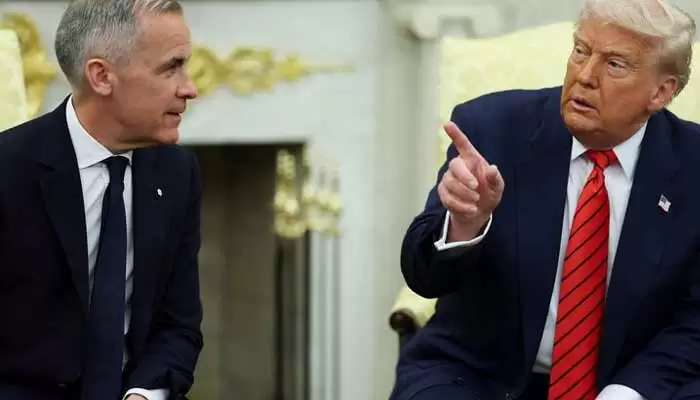
Canadian Prime Minister Mark Carney said Ottawa had suspended trade negotiations with Washington following what he described as last-minute changes to the US proposal.
Carney said Canadian negotiators had worked in good faith to protect the country’s interests but argued that the final US terms were unfair and economically damaging.
“I have decided to suspend trade negotiations with the US,” Carney said in a statement, directing Canada’s negotiating team to return to Ottawa.
He also said Canada would respond to the new US tariffs “dollar for dollar”, raising the possibility of another round of retaliatory measures between the two countries.
Talks had appeared close to a deal
The breakdown came after both sides had appeared to be moving toward an agreement.
According to sources cited in the report, a potential deal could have reduced US tariffs on important Canadian exports such as steel, aluminum and automobiles. The discussions had also reportedly raised the possibility of allowing American alcohol products to return to Canadian liquor stores.
However, US Trade Representative Jamieson Greer said Canada ultimately declined to finalize the agreement under terms that Washington believed had been settled earlier in the week.
Trump Says US and Canada Reach Deal as Tariffs Face Three-Day Pause
Greer described the failure as a missed opportunity for Canada to deepen its economic partnership with the United States.
A senior Trump administration official said Washington’s offer would have provided Canada with one of the most favorable tariff positions among major exporters to the US. The official said Canada had sought additional concessions involving steel, aluminum, automobiles and softwood lumber.
No additional trade negotiations are currently scheduled as the new duties take effect.
My statement on Canada-U.S. trade negotiations: pic.twitter.com/65OuQH40ra
— Mark Carney (@MarkJCarney) August 22, 2026
Vulnerable industries face pressure
The new tariffs could place additional pressure on several Canadian industries that are already dealing with uncertainty.
US President Donald Trump had previously threatened tariffs on a wide range of Canadian products, including wine, furniture, dairy products, cement, clothing, fishing equipment and hockey-related goods.
Trade experts have warned that sectors affected by the tariffs could face higher costs, weaker demand and potential job losses. Smaller businesses may also be particularly vulnerable if they rely heavily on the US market.
The latest measures come on top of existing US tariffs affecting Canadian steel, lumber and automobiles. Those industries have already experienced significant disruption over the past 18 months.
Tensions threaten broader trade relationship
The tariff dispute could make negotiations over the future of the broader North American trade framework more difficult.
Canada and the United States maintain one of the world’s largest bilateral trading relationships, with businesses and consumers in both countries heavily dependent on cross-border commerce.
The latest escalation followed three days of negotiations in Washington between Canadian Trade Minister Dominic LeBlanc and Greer.
Carney, who was elected last year after campaigning on a promise to defend Canadian interests in dealings with Trump, remains broadly popular in Canada. Public opinion has also generally shown strong opposition to making major concessions to the US president.
With Canada preparing retaliatory measures and Washington maintaining the new tariffs, businesses on both sides of the border now face greater uncertainty over costs, supply chains and future market access. The breakdown also raises concerns that the dispute could complicate efforts to maintain a stable North American trading relationship.