
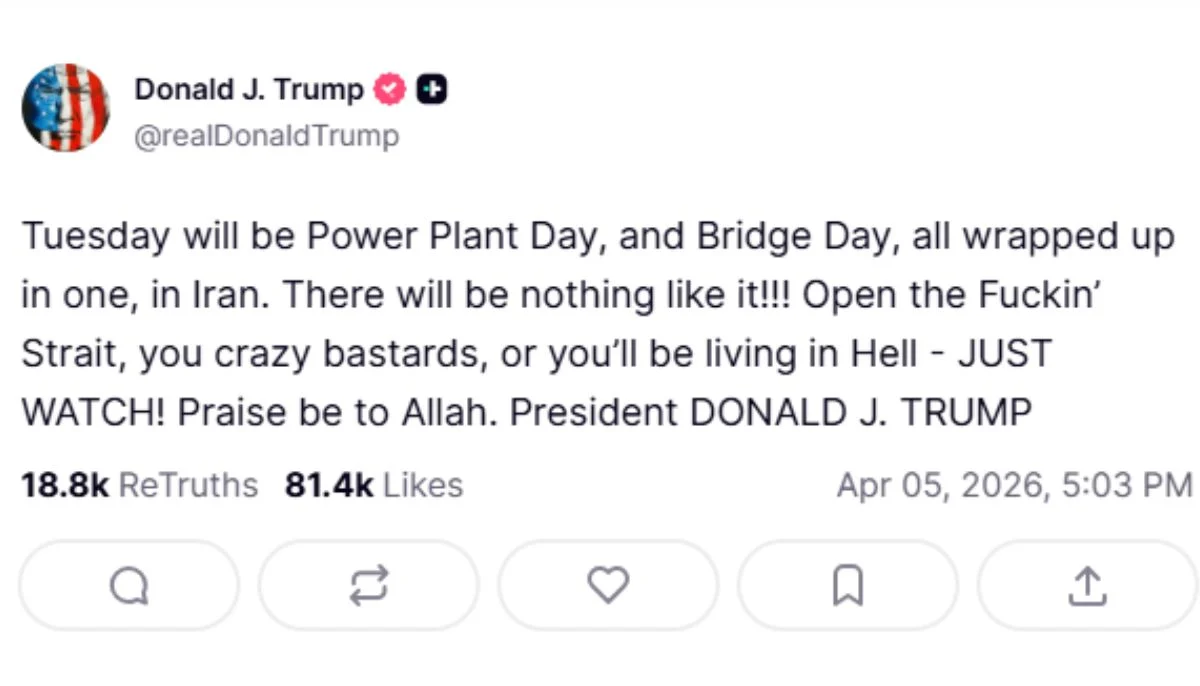
A recent social media post by US President Donald Trump has reignited debate in political circles over the possible use of the 25th Amendment of the United States Constitution. The discussion emerged after Trump issued strong warnings toward Iran, including threats to target energy infrastructure, amid rising tensions linked to the Strait of Hormuz crisis.
Trump’s Statement and Growing Reactions
In a post shared on Truth Social on April 5, Trump warned that Iran could face military action if it failed to reopen the Strait of Hormuz. He described an impending deadline and used aggressive language, which drew widespread attention and criticism.
As tensions escalated and fuel prices rose in the United States due to disruptions in global energy supply, critics—including some lawmakers—began calling for serious consideration of constitutional mechanisms to address presidential conduct.
What Is the 25th Amendment?
The 25th Amendment to the US Constitution outlines the procedures for transferring presidential power in specific situations, such as death, resignation, removal, or inability to perform official duties.
Adopted in 1967 following the assassination of John F. Kennedy, the amendment was designed to ensure continuity and stability in the executive branch during times of crisis.
It is divided into four sections, each dealing with different scenarios related to presidential succession and authority.
Key Sections Explained
- Section 1 establishes that the vice president becomes president if the sitting president dies or resigns.
- Section 2 allows for the appointment of a new vice president if the position becomes vacant.
- Section 3 permits a president to temporarily transfer power to the vice president, typically during medical procedures or other short-term incapacities.
- Section 4—the most debated provision—allows the vice president and a majority of the cabinet to declare the president unable to perform duties, effectively transferring power without the president’s consent.
Historical Use of the Amendment
Several parts of the amendment have been used in the past. For example, Section 2 was invoked in 1973 when Gerald Ford was appointed vice president after Spiro Agnew resigned.
In 1974, Section 1 came into effect when Ford became president following the resignation of Richard Nixon. He then used Section 2 to appoint Nelson Rockefeller as vice president.
Section 3 has also been used temporarily during medical procedures by several presidents.
Trump Confirms Daring Rescue of Downed US Airman in Iran
Why Section 4 Is in Focus
The current debate centers on Section 4, which has never been invoked in US history. This provision allows for the involuntary removal of a sitting president if they are deemed unable to discharge their duties.
Following Trump’s recent statements, some political figures and commentators have suggested that this section should be considered. Among those reportedly raising concerns are lawmakers such as Rep. Yassamin Ansari and Rep. Melanie Stansbury, along with former officials like Joe Walsh and Anthony Scaramucci.
Conclusion: A Rare but Powerful Provision
While calls to invoke the 25th Amendment have surfaced before in US political discourse, its actual use—particularly Section 4—remains unprecedented. The renewed debate highlights ongoing concerns about leadership, constitutional limits, and the mechanisms available to address extraordinary situations.
As tensions abroad and political divisions at home continue, discussions around the amendment are likely to remain part of the broader national conversation.