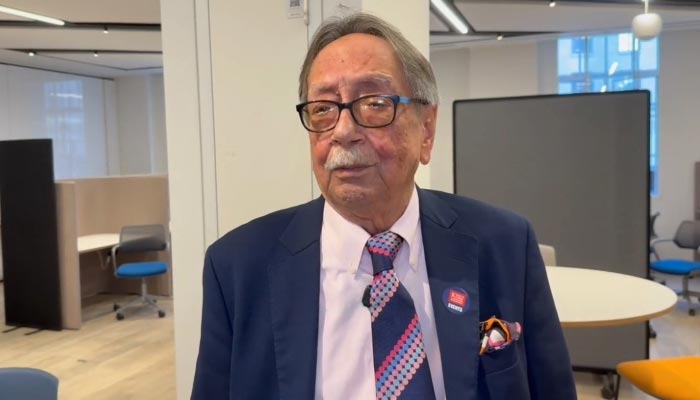
Former head of India’s external intelligence agency Research and Analysis Wing (RAW), AS Dulat, has said that India’s long-standing efforts to diplomatically isolate Pakistan have not succeeded.
Speaking in an interview with a British news outlet, he argued that despite years of international lobbying and security-focused narratives, India has failed to achieve its strategic objective of isolating Pakistan on the global stage.
His remarks reflect a rare public acknowledgment from a former senior intelligence official about the limitations of India’s foreign policy approach toward its neighbour.
Pakistan will not disintegrate, says Dulat
Dulat also rejected the idea, often discussed in some Indian strategic circles, that Pakistan could eventually break apart. He said such assumptions were unrealistic and that Pakistan would continue to remain a unified state.
According to him, regional dynamics are instead evolving in a way that challenges India’s broader diplomatic positioning.
Kashmir remains a source of tension
The former intelligence chief also highlighted the situation in Indian-administered Kashmir, officially referred to as Indian Illegally Occupied Jammu and Kashmir (IIOJK) in the report.
He said that beyond visible security concerns, there remains continued unrest, uncertainty, and a sense of political dissatisfaction among sections of the local population.
The Kashmir dispute has long been a central issue in India-Pakistan relations and remains unresolved despite multiple diplomatic efforts over the decades.
Pakistan’s diplomatic role highlighted
Dulat acknowledged Pakistan’s recent diplomatic engagement on the international stage, particularly its role in mediation efforts involving global conflicts.
He suggested that Pakistan’s active diplomatic outreach has helped improve its international standing in certain contexts, especially where it has engaged with multiple global actors.
Claims about regional perception shifts
During the interview, Dulat also commented on changing regional perceptions, suggesting that Pakistan has been increasingly visible in diplomatic discussions involving major global powers.
He further claimed that Pakistan’s military leadership, including Chief of Defence Forces Field Marshal Asim Munir, has received attention internationally in the aftermath of recent regional developments.
However, these remarks reflect his personal assessment and have not been independently verified by official sources.
Background: strained India-Pakistan relations
Relations between India and Pakistan have remained largely frozen in recent years, with limited diplomatic engagement and recurring tensions along the border.
Both countries have experienced periods of heightened conflict, followed by ceasefires and short-lived diplomatic pauses. The broader relationship continues to be shaped by security concerns, territorial disputes, and historical mistrust.
Broader regional implications
Dulat’s comments add to an ongoing debate about South Asia’s geopolitical balance, where both India and Pakistan continue to seek influence amid shifting global alliances.
While India positions itself as a rising global power, Pakistan has increasingly engaged in multilateral diplomacy and regional mediation efforts, according to the report.
The statements highlight how narratives around isolation, influence, and diplomacy remain contested in the region’s evolving strategic environment.