China has achieved another major milestone in its rapidly expanding space programme after its Tianwen-2 spacecraft successfully reached its target asteroid, paving the way for the country’s first-ever asteroid sample collection mission.
According to the China National Space Administration (CNSA), the probe arrived within 20 kilometres (12 miles) of the asteroid after travelling approximately one billion kilometres over a journey lasting around 400 days.
The mission represents a significant step in China’s ambitions to strengthen its capabilities in deep-space exploration and expand its scientific research beyond the Moon.
First Chinese Mission to Collect Asteroid Samples
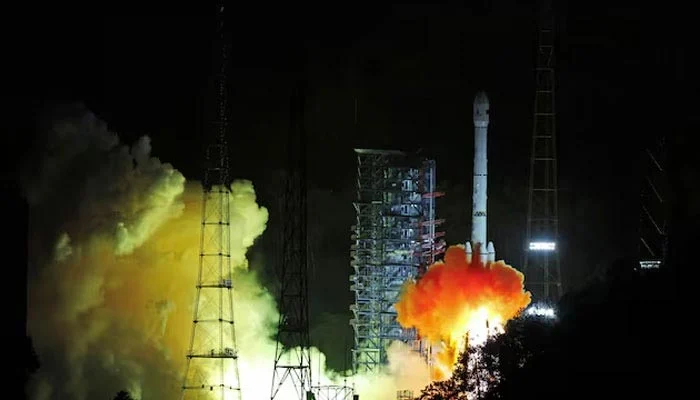
Tianwen-2 was launched in May 2025 aboard a Long March rocket and is China’s first mission specifically designed to collect material from an asteroid and return it to Earth for scientific analysis.
The spacecraft’s destination is the near-Earth asteroid 2016 HO3, a small rocky body that orbits the Sun. After reaching the asteroid, the probe has begun its scientific exploration phase.
The CNSA also released the first image of the asteroid, showing a rugged, grey, irregularly shaped surface set against the darkness of space.
Scientific Exploration Before Sample Collection
Before attempting to collect samples, Tianwen-2 will conduct a detailed survey of the asteroid.
According to the Chinese space agency, the spacecraft will study the asteroid’s shape, surface features, material composition, and internal structure. The information gathered during this stage will help mission controllers identify the most suitable location for collecting samples safely and efficiently.
Once the collection process is complete, Tianwen-2 will release a return capsule carrying the samples back to Earth, where scientists will examine them in laboratories.
Why Asteroid Samples Matter
Asteroids are considered some of the oldest objects in the Solar System, preserving material that has remained largely unchanged for billions of years.
Scientists believe that studying asteroid samples can provide important clues about how the Solar System formed and evolved, as well as the processes that shaped planets, including Earth. Such missions may also improve understanding of the organic compounds and minerals that existed during the early stages of planetary development.
Because the samples are returned to Earth, researchers can perform far more detailed analyses than would be possible using instruments aboard a spacecraft alone.
A Major Step in China’s Space Ambitions
China has invested heavily in its space programme over the past decade as part of President Xi Jinping’s vision of building the country into a leading space power.
The Tianwen-2 mission is viewed as another important achievement in that effort, particularly in the field of deep-space exploration, which extends beyond missions to the Moon.
Japan and the United States have previously completed successful asteroid sample-return missions, but Tianwen-2 marks China’s entry into this select group of nations. If successful, the mission will further strengthen China’s position in global space exploration and contribute valuable scientific knowledge about the history of the Solar System.