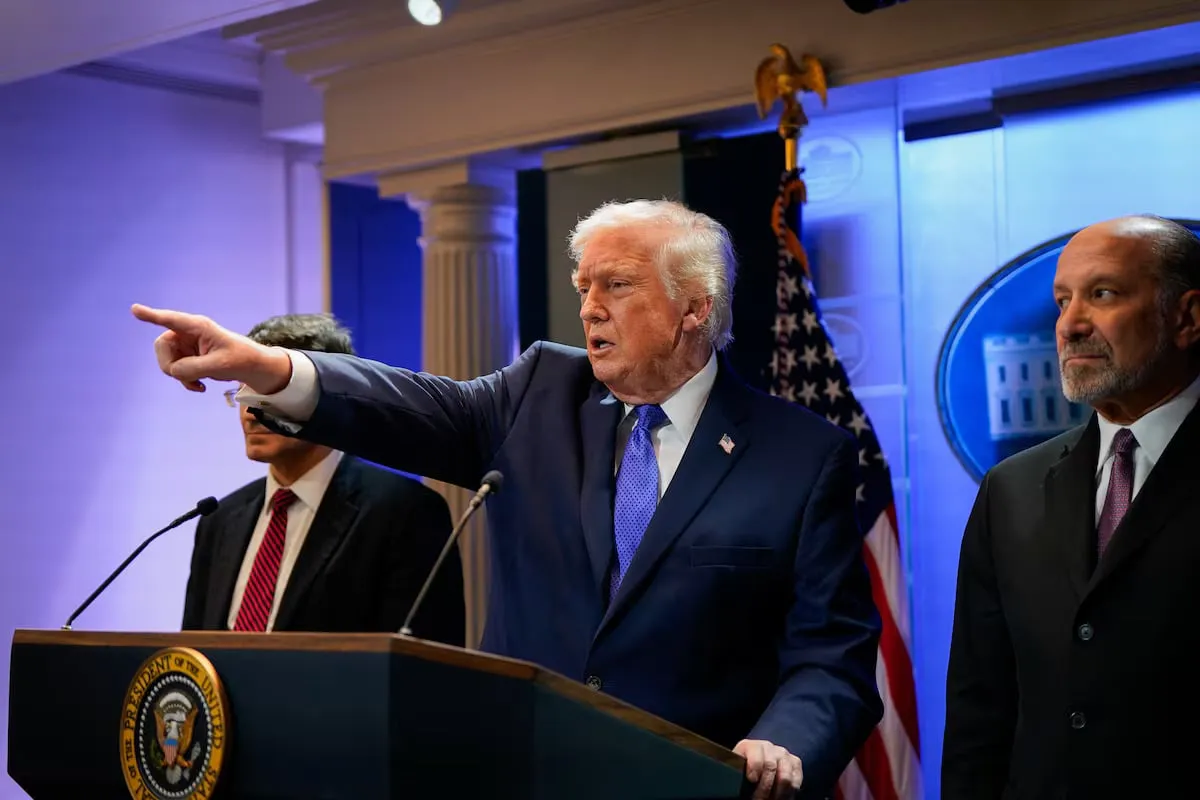
US President Donald Trump reacted angrily after the US Supreme Court ruled 6–3 that he lacked the authority to unilaterally impose sweeping global tariffs under emergency powers.
Within hours of the decision, Trump announced a new 10% tariff on imports from all countries, adding to existing duties. He signed a proclamation putting the measure into effect for 150 days, citing a separate legal provision that allows temporary tariffs of up to 15% to address international payments imbalances.
Supreme Court Ruling
The landmark decision, written by Chief Justice John Roberts, rejected Trump’s argument that the International Emergency Economic Powers Act (IEEPA) granted him unlimited authority to set tariffs by declaring a national emergency.
The court grounded its opinion in the US Constitution, which gives Congress — not the president — the power to levy taxes and duties. Roberts wrote that the government conceded the president does not have inherent authority to impose tariffs during peacetime and emphasized that the US “is not at war with every nation in the world.”
The ruling struck down tariffs Trump had imposed under IEEPA, calling into question approximately $175 billion collected from US importers under that authority.
Trump’s Reaction
Trump sharply criticized members of the court, saying he was “ashamed” of certain justices and accusing the majority — without evidence — of being influenced by foreign interests.
Trump Threatens New Tariffs on Countries Trading With Iran
Despite repealing the invalidated tariffs via executive order, he simultaneously moved to reimpose duties using Section 122 of the Trade Act of 1974, marking the first time a president has invoked that provision. The law permits tariffs of up to 15% for 150 days but requires congressional approval for extensions.
Trump insisted the ruling would not derail his trade agenda, saying, “We have other ways, numerous other ways.”
Impact on Trade Deals and Markets
The decision disrupted months of negotiations in which US trade envoys leveraged the threat of high tariffs to secure concessions from foreign governments.
- US stock indexes initially surged on the ruling before settling modestly higher.
- Analysts warned of renewed uncertainty in global markets.
- Economists cautioned that businesses now face confusion over the future direction of US trade policy.
US Treasury Secretary Scott Bessent suggested the administration could reach similar tariff levels through alternative legal mechanisms, potentially in a more complex manner.
Broader Economic Implications
After a year of fluctuating and often abrupt tariff announcements, the court’s ruling — and Trump’s swift countermeasure — reintroduced significant uncertainty into global trade.
Observers note that while the president retains limited temporary tariff authority, further legal challenges are likely, especially if the administration attempts to extend the measures without congressional approval.
The episode underscores a fundamental constitutional tension between executive trade strategy and congressional authority over taxation — a conflict that could shape US trade policy for years to come.