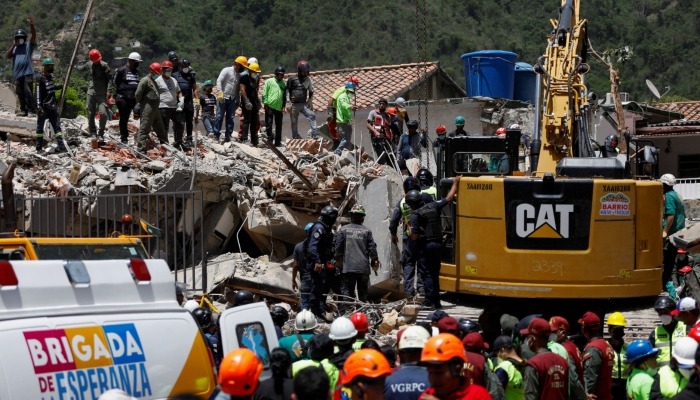
LA GUAIRA/CARACAS: Venezuela is facing one of the worst natural disasters in its modern history after two powerful earthquakes struck the country, leaving widespread destruction across Caracas and surrounding regions. As rescue teams continue searching through collapsed buildings, the official death toll has risen to 920, with authorities warning that the number could increase significantly in the coming days.
The twin earthquakes, measuring 7.2 and 7.5 in magnitude, struck approximately 160 kilometres west of Caracas, flattening residential buildings, damaging roads and critical infrastructure, and leaving thousands of families homeless. Government officials say hundreds of people remain trapped beneath the rubble, while tens of thousands are still unaccounted for.
Rescue Operations Intensify Amid Race Against Time
Emergency responders from Venezuela, supported by international rescue teams, are working around the clock to locate survivors buried beneath collapsed buildings.
According to government figures, at least 920 people have been confirmed dead, while more than 3,360 people have been injured. Officials also estimate that hundreds remain trapped under debris.
A public online portal established to help families report missing relatives had received reports of more than 50,000 missing persons by Friday afternoon. The United Nations Office for the Coordination of Humanitarian Affairs (OCHA) has reported similar figures, highlighting the enormous scale of the disaster.
The United States Geological Survey (USGS) has warned that the final death toll could exceed 10,000, potentially making the disaster one of the deadliest earthquakes in Latin America over the past century.
La Guaira Suffers the Worst Damage
The coastal city of La Guaira, located just outside Caracas, has emerged as the hardest-hit area.
Authorities say at least 100 buildings, including several high-rise apartment complexes, have collapsed completely.
Residents described scenes of devastation as families searched desperately for loved ones trapped beneath concrete slabs.
Twenty-five-year-old Jennifer Palacios said she had briefly left her apartment when the earthquake struck, leaving her six-year-old son and five other relatives trapped inside the collapsed building.
Speaking near the ruins, she said local residents had managed to rescue several survivors without heavy machinery but pleaded for cranes and specialised equipment to reach those still buried.
Throughout the city, collapsed buildings have been marked with spray-painted names to help emergency crews identify individual structures during rescue operations.
Survivors Criticise Slow Emergency Response
Although the Venezuelan government has pledged a large-scale relief effort, many residents say emergency assistance has been uneven.
In several neighbourhoods, firefighters, police officers, civil defence personnel and soldiers were visible conducting rescue work, while other areas reported little or no official presence.
Many survivors have relied on volunteers, who have transported food, water and medical supplies from nearby cities using motorcycles and private vehicles.
Lawyer Ricardo Trias said his godson’s body remained beneath the rubble for hours because forensic officials had not yet arrived to recover the remains.
Elsewhere, families used shovels, metal rods and even their bare hands to search through collapsed buildings while waiting for heavy rescue equipment.
Interim President Delcy Rodríguez announced that La Guaira State would be placed under heightened military control to facilitate rescue operations and maintain order. She also said the government had distributed 2,600 tonnes of food supplies to affected communities.
Tsunami Warning Issued in Japan After Powerful 7.4 Earthquake Off Sanriku Coast
International Community Mobilises Assistance
Countries from around the world have begun sending rescue teams, humanitarian aid and specialised equipment to Venezuela.
The first international rescue contingent arrived from the Dominican Republic, followed by teams from Mexico, El Salvador, Spain, Colombia, India and Switzerland.
Mexico dispatched 250 military rescue personnel, along with rescue dogs, heavy equipment and technical specialists experienced in earthquake response.
El Salvador sent nearly 300 emergency responders, while Spain deployed close to 100 rescue workers.
The United States announced $150 million in humanitarian assistance, temporarily eased certain sanctions to facilitate relief efforts, and deployed naval vessels, helicopters and aircraft to support search-and-rescue operations.
International rescue teams are using thermal imaging cameras, drones and specially trained search dogs to locate survivors beneath collapsed buildings.
Millions Could Be Affected
The International Organization for Migration (IOM) estimates that nearly seven million people could be affected by the disaster through displacement, infrastructure damage and disruption to essential services.
The earthquakes have struck Venezuela at a time when the country is already grappling with prolonged economic hardship, political instability and deteriorating public infrastructure.
Many survivors have lost both their homes and livelihoods.
One resident, Suhayl Sarquiz, said her apartment building had become uninhabitable, leaving her and her son without shelter.
Despite the widespread destruction, foreign energy companies reported that Venezuela’s vital oil production facilities suffered only limited disruption. Meanwhile, the Caracas Stock Exchange has temporarily suspended trading after its building was converted into a humanitarian aid collection centre.
One of Venezuela’s Deadliest Natural Disasters
Before this catastrophe, Venezuela’s deadliest modern earthquake occurred in 1967, claiming approximately 240 lives.
The twin earthquakes have already far surpassed that figure, making them the country’s most devastating seismic disaster in decades.
With rescue operations still underway and thousands of people believed to be missing, officials fear the death toll may continue to rise as emergency teams reach the hardest-hit areas. International aid continues to arrive, but authorities acknowledge that the recovery and rebuilding process will likely take months, if not years.