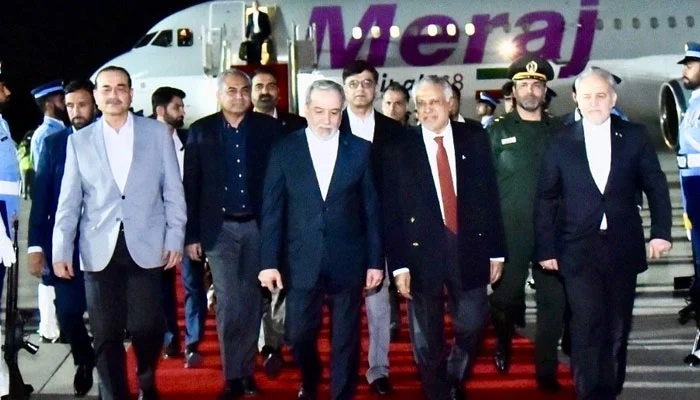
Islamabad: Iranian Foreign Minister Abbas Araghchi arrived in Islamabad on Friday night as Pakistan continues to play a central mediating role in efforts to sustain a fragile ceasefire and advance talks between the United States and Iran.
His visit comes amid renewed diplomatic momentum, with both Iranian and US delegations expected to engage in discussions aimed at reducing tensions and preventing further escalation in the region.
High-Level Reception in Islamabad
Upon arrival, Araghchi was received by senior Pakistani leadership including Deputy Prime Minister and Foreign Minister Ishaq Dar, Chief of Defence Forces Field Marshal Asim Munir, and Interior Minister Mohsin Naqvi.
According to Pakistan’s Foreign Office, the Iranian delegation will hold meetings with Prime Minister Shehbaz Sharif and other senior officials to discuss regional developments and ongoing peace efforts.
Pakistan’s Continued Mediation Role
Officials stated that discussions will focus on regional stability, ceasefire arrangements, and diplomatic pathways to resolve tensions between Washington and Tehran.
Ishaq Dar has repeatedly emphasized that dialogue and engagement remain the only viable options for achieving long-term peace. During a recent phone call with Araghchi, both sides reviewed the status of the ceasefire and broader diplomatic initiatives.
Clearing Strait of Hormuz Mines Could Take Up to Six Months, Report Says
Iran has also acknowledged Pakistan’s role, with the Iranian foreign minister reportedly praising Islamabad’s efforts in facilitating dialogue between the two sides.
US Delegation Also Expected
In a parallel development, US envoys Steve Witkoff and Jared Kushner are expected to arrive in Pakistan for further discussions. Reports indicate that Vice President JD Vance was initially prepared to join but will not travel at this stage, though remains on standby.
A US logistical and security team has already been deployed in Islamabad ahead of the expected talks, reflecting the sensitivity and urgency of the negotiations.
Pleased to receive and welcome my brother, Foreign Minister of Iran, H. E. Abbas Araghchi @Araghchi, to Islamabad, alongside Field Marshal Syed Asim Munir and Interior Minister Mohsin Naqvi.
Look forward to our meaningful engagements aimed at promoting regional peace and… pic.twitter.com/XHrqXijgqx
— Ishaq Dar (@MIshaqDar50) April 24, 2026
Background: Fragile Ceasefire and Regional Tensions
The diplomatic efforts come after weeks of heightened tensions following military escalations between the United States, Israel, and Iran. The conflict disrupted maritime activity in the Strait of Hormuz, a critical global shipping route.
A temporary ceasefire was brokered earlier with Pakistan’s involvement, followed by initial talks held in Islamabad. However, those discussions ended without a permanent agreement, leaving several key issues unresolved.
Ongoing Uncertainty and Diplomatic Efforts
Despite setbacks, Islamabad continues to push for renewed engagement. Recent statements from US leadership suggest openness to further dialogue, while Iran has also signaled conditional willingness to continue discussions under certain terms.
The situation remains fluid, with multiple delegations, back-channel diplomacy, and international stakeholders involved in efforts to prevent further escalation.
As both Iranian and US officials converge in Pakistan, expectations remain cautious but significant. While no breakthrough is guaranteed, the continued choice of Islamabad as a diplomatic venue underscores Pakistan’s emerging role as a facilitator in one of the most sensitive geopolitical negotiations of recent years.