Global oil prices climbed by more than 5% on Wednesday after US President Donald Trump declared that the memorandum of understanding (MoU) aimed at ending the conflict with Iran was “over.” The statement heightened fears of potential disruptions to oil supplies from the Middle East, a region that plays a critical role in global energy markets.
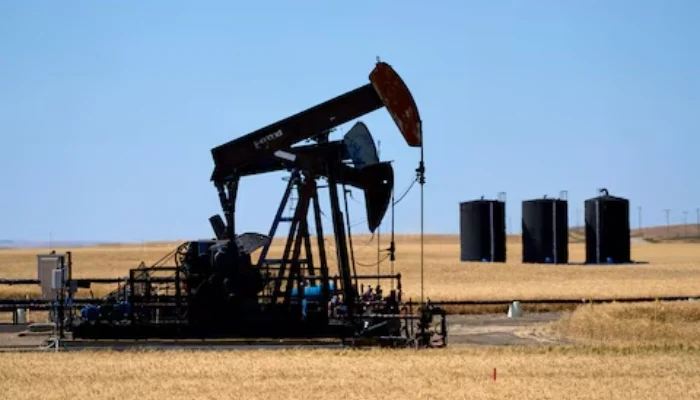
By 0832 GMT, Brent crude futures had risen $3.82 (5.15%) to $77.98 per barrel, while US West Texas Intermediate (WTI) crude gained $3.70 (5.25%) to $74.14 per barrel. Both benchmarks reached their highest levels since June 23.
US Reimposes Sanctions on Iranian Oil
The latest price surge followed a decision by the United States to revoke a general licence that had previously allowed the sale of Iranian crude oil. The move came after Washington blamed Iran for attacks on commercial vessels transiting the Strait of Hormuz.
Commodity analysts at ING said the policy change does not immediately alter global oil supply fundamentals but significantly affects market sentiment.
According to the analysts, the decision increases concerns that the temporary understanding between Washington and Tehran could collapse, raising uncertainty in energy markets.
Vessel Attacks Raise Supply Concerns
The US Central Command (CENTCOM) said American airstrikes were launched in response to Iranian attacks on three commercial vessels travelling through the Strait of Hormuz.
Iran has not accepted responsibility for the incidents. However, Qatar accused Tehran of carrying out the attacks, including one involving a Qatari liquefied natural gas (LNG) tanker that reportedly caught fire after being struck by a drone.
Separately, maritime security sources said a Saudi-flagged crude oil tanker, believed to be the supertanker Wedyan, was also damaged off the coast of Oman. The exact cause of the damage has not yet been confirmed.
Strait of Hormuz Remains a Critical Chokepoint
The latest incidents have renewed concerns over the security of shipping through the Strait of Hormuz, one of the world’s most strategically important maritime routes.
Before the conflict began in February, the waterway handled cargo equivalent to around 20% of global energy supplies, making any disruption a major concern for international oil markets.
According to reports, Iran has instructed ships to use routes closer to its coastline instead of those nearer Oman. The United States, meanwhile, has insisted that international shipping must continue to enjoy free passage through the strait.
Iranian Oil Tankers Leave Hormuz Blockade Area Ahead of Key US-Iran Peace Talks
Analysts Warn of Higher Prices if Tensions Continue
Saul Kavonic, Head of Research at MST Marquee, said the latest developments highlight how vulnerable global energy supplies remain despite earlier hopes that regional tensions were easing.
He noted that prolonged disruptions to shipping or a sustained reduction in tanker traffic through the Strait of Hormuz could tighten global oil supplies and support higher crude prices in the coming weeks.
Market analysts also pointed out that many traders had recently built large short positions in oil futures after prices fell following last month’s US-Iran truce. The renewed escalation has forced investors to reassess those expectations.
Falling US Oil Inventories Add Support
Oil prices also received support from declining US crude inventories.
According to market sources citing data from the American Petroleum Institute (API), US crude stockpiles fell again during the week ending July 3. Analysts surveyed by Reuters had expected inventories to decrease by approximately 2.4 million barrels.
Lower inventories, combined with renewed geopolitical uncertainty, have added to concerns about future supply, contributing to the sharp rise in global oil prices.
While markets continue to react to rapidly evolving developments, analysts say future price movements will largely depend on the security situation in the Middle East, shipping conditions in the Strait of Hormuz, and any further policy decisions by the United States and Iran.