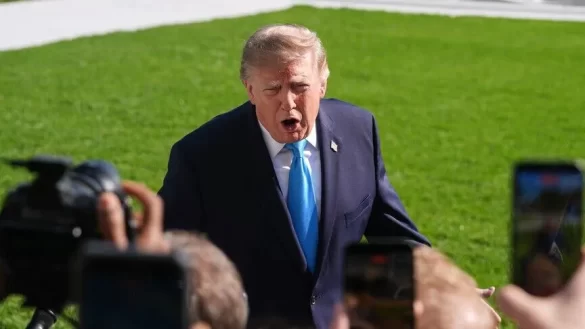
US President Donald Trump said on Wednesday that the interim agreement aimed at ending the conflict with Iran was effectively “over” following a new wave of Iranian military actions against US facilities in the Gulf.
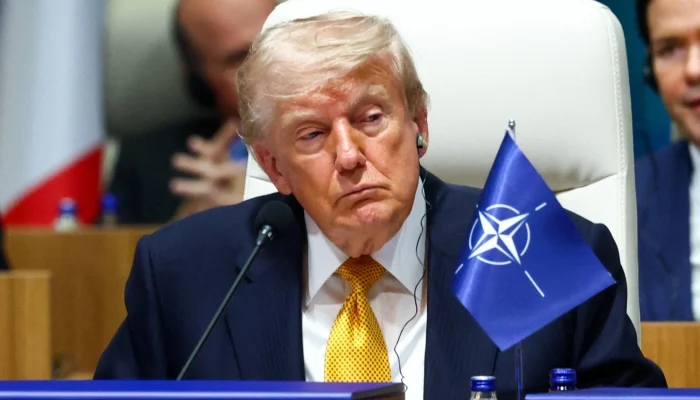
Speaking to reporters ahead of the NATO leaders’ summit in Ankara, Türkiye, Trump said he no longer believed the memorandum of understanding (MoU) signed on June 17 could serve as the basis for a lasting peace agreement.
“It’s a very interesting question. To me, I think it’s over. I don’t want to deal with them,” Trump said when asked whether the agreement was still in effect.
He also made several strongly worded remarks about Iran’s leadership, underscoring the growing strain in relations between Washington and Tehran.
Iran Announces Attacks on US Military Sites
Iran’s Islamic Revolutionary Guard Corps (IRGC) said it had launched attacks against US military sites in Bahrain and Kuwait, describing the strikes as retaliation for recent US military operations inside Iran.
The IRGC also claimed it had shot down a US MQ-9 Reaper drone during the operation.
However, Bahrain’s military later stated that it had successfully intercepted and thwarted the Iranian attacks. Independent verification of all battlefield claims was not immediately available.
US Says Recent Strikes Targeted Iranian Military Assets
The latest escalation followed US military strikes against Iranian targets after Washington blamed Tehran for attacks on commercial vessels transiting the Strait of Hormuz.
According to the US Central Command (CENTCOM), the operation targeted more than 60 small boats allegedly operated by the IRGC, along with Iranian air defence systems, coastal surveillance equipment, anti-ship cruise missiles, surface-to-air missile systems, and drone launch facilities.
CENTCOM said the operation was intended to impose a significant cost on Iran for what it described as attacks on international shipping and violations of the ceasefire.
US officials added that there were no reports of civilian casualties resulting from the strikes.
Oil Prices Rise as Markets React
The renewed military confrontation immediately affected global financial markets.
Brent crude oil rose by more than 5%, climbing to approximately $78.48 per barrel, its largest single-day increase since late May.
Investors also moved away from equities and bonds as fears grew that continued instability could disrupt energy supplies from the Middle East.
Although oil prices remain well below the highs recorded earlier in the conflict, analysts warned that prolonged tensions could increase inflationary pressures and create further uncertainty in global markets.
Iran Launches Missile and Drone Strikes on US Sites in Bahrain, Kuwait After Fresh American Attacks
Strait of Hormuz Back in Focus
The latest developments have once again drawn attention to the Strait of Hormuz, one of the world’s most important maritime trade routes.
Roughly one-fifth of global oil and energy shipments normally pass through the narrow waterway, making any disruption a significant concern for international trade.
Shipping data indicated that several oil and gas tankers altered their routes or turned back rather than transit the strait following the latest exchange of attacks.
Analysts say Iran continues to use its strategic position near the strait as leverage during negotiations with the United States.
Iran Accuses Washington of Violating the Agreement
Iranian officials rejected the US position and accused Washington of breaching the ceasefire framework.
Parliament Speaker Mohammad Bagher Ghalibaf, who has been involved in negotiations, said the United States had violated the agreement through renewed military strikes, the reimposition of oil sanctions, and what Tehran views as interference in the Strait of Hormuz.
In a statement posted on social media, Ghalibaf said that the era of US “bullying and extortion” was over and insisted that Iran would not back down.
Iran’s Foreign Ministry also condemned Washington’s decision to restore restrictions on Iranian oil exports, arguing that it contradicted the framework established to reduce hostilities.
International Concern Grows
The renewed exchange of military action has raised concerns among international leaders.
NATO Secretary General Mark Rutte said the latest US strikes were “absolutely necessary,” while the European Union’s foreign policy chief Kaja Kallas condemned Iran’s reported attacks on Bahrain and Kuwait, saying they further complicated already fragile efforts to end the conflict.
With both sides exchanging accusations and military actions continuing, hopes for a permanent peace agreement have weakened considerably. Analysts say the coming days will be critical in determining whether diplomatic efforts can resume or whether the conflict will escalate further, with potentially significant consequences for regional security and global energy markets.