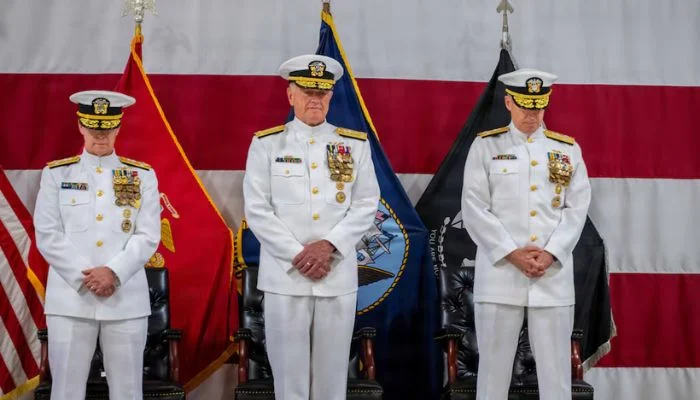
The United States Navy has directed several of its commands to remove leadership photographs and biographies from public-facing websites as part of new measures to strengthen the security of military personnel and their families.
The decision comes amid heightened tensions between the United States and Iran, with officials citing growing concerns that publicly available information could be used by adversaries to identify and target service members.
According to an administrative message issued by the Navy, hostile actors are increasingly collecting publicly available data to track and profile military personnel.
The directive states that routine publication of leadership biographies can unintentionally expose individuals to greater security risks by attracting unnecessary public attention.
Who is affected by the new policy?
Under the new guidance, commands led by vice admirals (O-9) and officers of lower rank are required to remove leadership information from publicly accessible websites.
The policy applies to the biographies and official portraits of:
- Commanding officers
- Executive officers
- Chiefs of staff
- Chief staff officers
- Deputy commanders
Command master chiefs or their equivalents
However, commands led by four-star admirals (O-10) have been exempted from the directive and may continue displaying leadership profiles on public websites.
The Navy’s administrative message does not explain why these senior commands are excluded from the policy.
US-Iran Conflict Escalates as Seventh Consecutive Night of Strikes Deepens Regional Tensions
Internal access to continue
Although the information is being removed from public websites, the Navy clarified that official biographies and photographs will remain available through secure internal systems.
These include CAC-enabled repositories, command intranets and other non-public military networks, ensuring authorised personnel can still access the information for official purposes.
Move comes amid rising regional tensions
The policy change follows renewed tensions between the United States and Iran in the Middle East.
According to the report, Iran has announced the closure of the Strait of Hormuz, while the United States maintains that the strategic waterway remains open for lawful maritime traffic. The US Navy has stated that it continues to provide security for commercial vessels operating in the region.
Although the Navy did not explicitly link the directive to the regional situation, the timing has drawn attention as concerns over military security and cyber threats continue to grow.
The latest measures reflect the Navy’s broader effort to reduce the exposure of its personnel to potential threats by limiting the amount of personal information available on publicly accessible platforms.