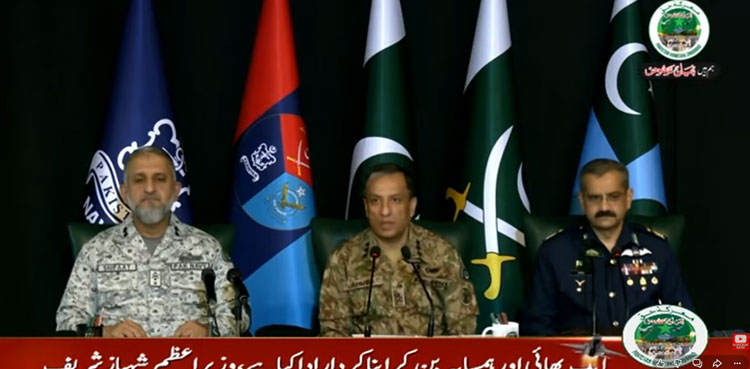
Pakistan’s military has reiterated that there is “no space for war” between two nuclear-armed neighbours as the country marked the first anniversary of Marka-e-Haq, the military operation linked to last year’s confrontation with India.
The remarks were made by Ahmed Sharif Chaudhry during a joint press conference alongside Rear Admiral Shifaat Ali Khan and Air Vice Marshal Tariq Ghazi in Islamabad.
Background of the Conflict
The military confrontation between Pakistan and India began on May 6-7 last year after India accused Pakistan of involvement in an attack in Indian Illegally Occupied Jammu and Kashmir. Pakistan rejected the allegations and responded militarily after Indian strikes targeted areas inside Pakistan.
The conflict lasted for more than 80 hours before international diplomatic intervention, particularly from the United States, helped prevent further escalation. During the standoff, both sides exchanged claims regarding aircraft losses, drone interceptions, and military operations.
Pakistan’s military leadership described the conflict as a major test of national defence preparedness and regional deterrence.
“No Space for War”
During the press conference, Lt Gen Ahmed Sharif Chaudhry stressed that a full-scale conflict between two geographically connected nuclear powers would be disastrous.
“Anyone who thinks there is space for war between two nuclear neighbours is crazy,” he said, adding that such an idea reflected “madness.”
At the same time, he reaffirmed Pakistan’s resolve to defend itself if challenged militarily.
The ISPR chief also stated that the anniversary should not only focus on battlefield events, but on what he described as the broader “strategic consequences” that emerged after the conflict.
Ten Strategic Consequences Highlighted
According to the military spokesperson, the first major consequence was that international perceptions regarding Pakistan and terrorism had changed. He claimed that the global community increasingly viewed Pakistan as a victim of terrorism rather than a supporter of it.
The second consequence, he said, was Pakistan’s emergence as a “net security stabiliser” in the region through what he described as mature handling of escalation.
Another point raised by Chaudhry concerned what he called the “politicisation” of India’s military leadership and the “militarisation” of Indian politics. He criticised statements made by Indian political and military figures after the conflict and warned that such trends were dangerous for regional stability.
He further accused India of attempting to externalise its domestic political issues while using terrorism allegations as a strategic tool.
Pakistan Marks First Anniversary of ‘Marka-e-Haq’ With Warning Against Future Aggression
Information Warfare and Modern Conflict
A significant portion of the briefing focused on the changing nature of warfare. The ISPR chief said modern conflicts are no longer limited to traditional battlefields but now involve cyber operations, information campaigns, drones, and psychological warfare.
He stated that Pakistan’s armed forces were prepared to respond across all these domains during Marka-e-Haq and remained prepared for future threats.
Chaudhry also criticised Indian media coverage during the conflict, claiming misinformation and propaganda had damaged the credibility of Indian information operations internationally.
Kashmir and Regional Stability
The military spokesperson reiterated Pakistan’s longstanding position on Kashmir, saying it remained an internationally recognised dispute rather than India’s internal matter.
He argued that durable peace in South Asia could not be achieved without addressing unresolved political disputes through dialogue and diplomacy.
“Bunyan-un-Marsoos Effect”
Concluding the press conference, Lt Gen Chaudhry described what he called the “Bunyan-un-Marsoos effect” as the most important outcome of the conflict — referring to what he characterised as unity between Pakistan’s public, government, and armed forces.
He also said the conflict strengthened Pakistan’s image internationally as a responsible middle power capable of managing crises while maintaining strategic restraint.
The anniversary events reflected both the continuing tensions between Pakistan and India and the broader concern within the region about avoiding escalation between two nuclear states.