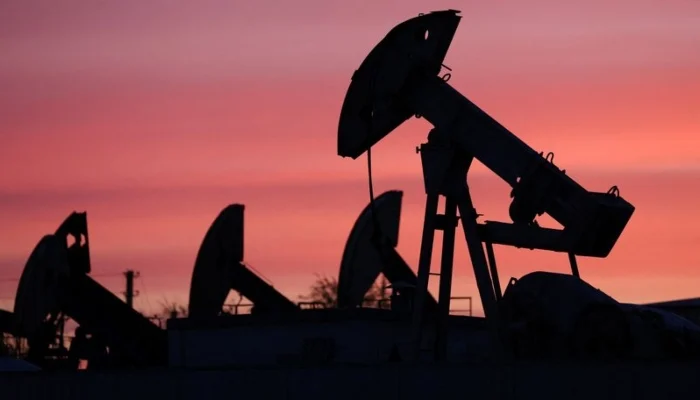
SINGAPORE: International oil prices climbed sharply on Tuesday, reaching their highest level in a month as escalating military tensions between the United States and Iran increased concerns over the security of oil shipments through the strategically important Strait of Hormuz.
The latest rise came after the United States carried out a third consecutive night of strikes against Iranian targets, while both countries intensified military activity in and around the vital shipping route.
Brent and WTI Extend Gains
During early trading, Brent crude futures rose $1.50, or 1.8%, to $84.80 per barrel, while US West Texas Intermediate (WTI) crude gained $1.70, or 2.2%, to $79.84 per barrel.
Both benchmark contracts had earlier climbed by more than $2 per barrel before trimming some of their gains.
The rally followed a 9.6% jump in Brent crude during the previous trading session—its largest single-day increase since May 2020.
Current oil prices are now at their highest level since the United States and Iran signed a memorandum of understanding aimed at ending the conflict on June 17.
Fresh Escalation Fuels Market Anxiety
Oil markets reacted after the United States launched another round of military strikes against Iran and President Donald Trump announced the reinstatement of a naval blockade on Iranian shipping.
Trump also proposed imposing a 20% security fee on cargo transiting the Strait of Hormuz, a move that has added further uncertainty to global energy markets.
According to Tim Waterer, Chief Market Analyst at KCM Trade, the latest military escalation has significantly increased geopolitical risks for oil markets.
He said the renewed blockade and Iran’s response have created fresh uncertainty over future energy supplies, even though the Strait of Hormuz has not been completely closed.
Strait of Hormuz Remains Key Concern
The Strait of Hormuz is one of the world’s busiest maritime trade routes, with around one-fifth of global oil supplies passing through the narrow waterway.
Any disruption to shipping in the area has the potential to affect global energy markets and increase fuel prices worldwide.
According to shipping data, the number of oil tankers passing through the Strait of Hormuz fell to its lowest level in two months, reflecting growing security concerns among shipping companies.
US Launches Third Consecutive Day of Strikes on Iran as IRGC Targets American Military Sites in Gulf
Tanker Attack Heightens Tensions
The latest military escalation also coincided with an attack on two United Arab Emirates oil tankers in Omani territorial waters.
According to the UAE Ministry of Defence, the vessels were struck by Iranian cruise missiles, resulting in the death of one Indian crew member and injuries to eight others.
The incident has further heightened concerns about the safety of commercial shipping in the Gulf.
Analysts Watching Supply Flows
Market analysts say the future direction of oil prices will largely depend on whether crude exports through the Strait of Hormuz continue without significant disruption.
Priyanka Sachdeva, an analyst at Phillip Nova, said that any prolonged interruption to tanker traffic or export flows could push oil prices even higher.
However, she noted that if shipments continue despite the military tensions, some of the current geopolitical premium built into oil prices could gradually decline.
Regional Conflict Adds Further Pressure
Elsewhere in the region, Yemen’s Houthi movement reportedly launched missiles toward Saudi Arabia after accusing the kingdom of carrying out airstrikes on an airport under Houthi control.
Analysts warn that if attacks expand to include Saudi Arabia’s oil infrastructure or Red Sea shipping routes, additional pressure could be placed on global crude supplies.
Market Awaits US Inventory Data
Investors are also monitoring upcoming US oil inventory data for further clues about supply and demand.
A preliminary Reuters survey indicates that US crude oil stockpiles likely declined last week, while inventories of gasoline and distillate fuels are expected to have increased.
With geopolitical tensions remaining high and uncertainty surrounding energy exports from the Gulf, analysts believe oil markets are likely to remain volatile in the coming days.