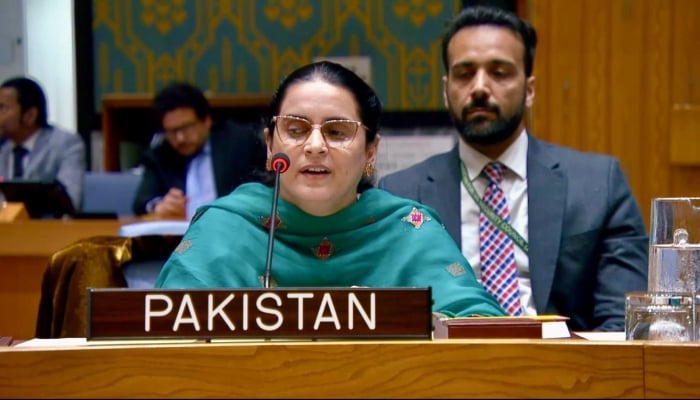
At a United Nations Security Council (UNSC) debate on the protection of civilians, Pakistan strongly criticized India, accusing it of sponsoring terrorism, violating international law, and mistreating minorities. The exchange highlighted deep-rooted tensions between the two nuclear-armed neighbors.
Pakistan Raises Serious Allegations at UNSC
During the annual UNSC discussion, Pakistan’s Counsellor on Human Rights, Saima Saleem, delivered a sharp rebuttal, stating that India presents itself as a victim on the global stage while allegedly engaging in actions that contradict this image. She said the international community can “see the face behind the mask” that India wears in diplomatic forums.
Pakistan argued that India has been repeatedly involved in activities that destabilize regional peace and uses international platforms to shift attention away from its own actions.
Allegations of Proxy Groups and Cross-Border Terrorism
Pakistan claimed that India is involved in sponsoring terrorism against it through groups such as the Tehrik-i-Taliban Pakistan (TTP), Balochistan Liberation Army (BLA), and the Majeed Brigade. According to the Pakistani delegation, these groups have been responsible for the deaths of thousands of civilians, including women and children, in attacks targeting mosques, schools, markets, and public spaces.
It was further alleged that these networks are financed and facilitated through Afghan territory. Pakistan also stated that it has conducted “precision counter-terrorism operations” targeting militant hideouts, training camps, and weapons storage sites used to plan attacks against civilians and security forces.
Pakistan Warns UNSC: US-Israel Attack on Iran Risks Regional Conflagration
Kashmir and Human Rights Concerns
Pakistan also raised the issue of Jammu and Kashmir, referring to it as an internationally recognized dispute on the UN agenda. It alleged that civilians in Indian-administered Kashmir face killings, arrests, displacement, and restrictions on basic freedoms.
In addition, concerns were raised about the treatment of minorities in India, including Muslims, Sikhs, Dalits, and Christians. Pakistan referred to what it described as rising religious intolerance and discrimination under state policies.
Water Disputes and International Law
The Pakistani representative also criticized India’s suspension of parts of the Indus Waters Treaty, warning that any threat to water and food security affects millions of people in Pakistan. It was argued that such actions are inconsistent with international law and undermine regional stability.
Pakistan’s Stance on Peace
Concluding the statement, Pakistan reiterated its commitment to peace, dialogue, and adherence to the United Nations Charter. It emphasized that all disputes should be resolved through peaceful means based on mutual respect and sovereign equality among states.